
IT training across Europe - tecnovy makes you future-ready.

iSAQB® AGILA - Agile Software Architecture

In an agile project the architecture is not settled at the start; it takes shape release by release. That raises questions an up-front design never has to ask: how much design does the team need now, when does a decision actually have to be made, and how does it stay traceable a year later? In the AGILA training you answer them with an architecture vision and a walking skeleton, with decisions taken as late as you responsibly can, and with architecture decision records.
iSAQB Accredited Training PartnerAttendance certificate4.8/5 on ProvenExpert

What this module delivers.

AGILA is the iSAQB module for architecture work inside an agile team: in the tecnovy training you facilitate decisions, slice quality requirements into backlog items and measure architecture continuously. Responsibility then sits with the whole team, not one person.

How the training runs

Method
Practise team decision formats, analyse real project examples
Outcome
30 credit points: 20 methodical, 10 communicative, no course exam

Dates & booking

Choose a date that fits

2 dates

  • EUREuro
  • USDUS Dollar
  • CHFSwiss Franc

Sessions with this symbol offer up to 25% group discount. Click “Details & Registration” to learn more.

22–24 Sep 2026CEST
Tue–Thu 09:00–17:00
Online training Group Discount Guaranteed
Time zone CEST
Language German
Trainer Serkan Karagulle
Seats 5+ seats
10% Earlybird Discount

2,573 $−257 $2,316 $

excl. VAT
08–10 Dec 2026CET
Tue–Thu 09:00–17:00
Switzerland Group Discount
City Zürich
Language German
Trainer Serkan Karagulle
Seats 5+ seats
10% Earlybird Discount

3,564 $−356 $3,208 $

excl. VAT

Fit

Who this module is designed for

Typical roles

  • You make architecture decisions together with a self-organising team.
  • You bring quality requirements and technical debt into a backlog.
  • You advise teams on architecture without deciding alone.

Prerequisites

No prerequisites

You can start right away. Helpful: experience with architecture decisions and documenting them, initial hands-on experience in agile software projects, basic knowledge of Scrum, Lean or Kanban.

Consider instead FLEX Covers modularisation, integration and operation of modern systems, and carries the 20 technical credit points AGILA does not award.

Curriculum

CPSA® AGILA Course in Detail

Curriculum 2025.1 splits AGILA into seven parts across 1080 teaching minutes. It runs from the foundations of agile architecture work through approach and requirements to team decisions, its centrepiece. Feedback formats, supporting structures across team boundaries and real project examples follow.

01Introduction to Agile Software Architecture

This part settles how much architecture work a project genuinely needs.

  • Which definitions of architecture suit agile settings, and where architecture borders on design
  • Values and principles of the agile manifesto, complexity through the Cynefin framework
  • The tasks of architecture development and how their working style shifts in an agile setting
  • Just enough architecture work: criteria for architectural relevance and waste reduction from lean
02The Agile Architecture Approach

Here you learn to create orientation without pre-empting a complete design.

  • Developing an architecture vision and architecture communication canvas the lightweight way
  • Planning a walking skeleton with broad architectural coverage and separating it from an MVP
  • Risk-driven architecture work, prioritising architecture topics in the backlog
  • Role models from architecture owner to a team with no explicit architecture role
03Architecture Requirements in Agile Projects

The second-longest part puts quality requirements into a shape a team can work with.

  • Naming quality attributes per ISO/IEC 25010 and phrasing them as scenarios or acceptance criteria
  • Anchoring architecture requirements as quality stories, enabler stories or tech tasks
  • Spotting technical debt and tracking it through static analysis and monitoring data
  • Estimation and prioritisation, urgency and the last responsible moment
04Designing and Developing Architectures in a Team

The longest part of the curriculum practises what agile architecture work comes down to: deciding together.

  • Applying group decision procedures: consensing, voting and veto formats
  • Facilitating decision processes and handling objections constructively
  • Setting decision scopes and architecture principles as guard rails
  • Just-in-time decisions, set-based design and architecture decision records
05Reflection and Feedback on Architecture Work in the Agile Context

This part closes the loop: architecture gets checked continuously instead of signed off once.

  • Running lightweight evaluation formats such as DCAR and LASR
  • Finding the causes of architecture problems with root cause analysis and 5-why
  • Selecting quality indicators, reading their trends and tracing them back to architecture goals
  • Embedding fitness functions in CI/CD with tools such as ArchUnit or jQAssistant
06Supporting Architecture (spanning multiple teams)

This part is about several teams at once and how much autonomy an organisation can carry.

  • Establishing architecture as a base capability through communities of practice and architecture katas
  • Centralisation against decentralisation, governance through principles rather than rules
  • Weighing architecture boards, advice forums and the architecture advice process
  • Socio-technical systems, Conway's law and team topologies
07Examples of Agile Architecture Work

To close, you work through real projects rather than textbook cases.

  • At least two projects of differing size and how each of them reaches architecture decisions
  • Architecture requirements as they actually appear in stories and backlogs
  • Architecture walls, information radiators and architecture radars from practice
  • Architecture communities and guilds: how companies build them and keep them alive
Official syllabus(external link)

Outcome

What you will be able to do afterwards

  1. 01

    You size architecture effort by risk and confine it to the problems that matter.

  2. 02

    You develop an architecture vision and plan a walking skeleton with broad coverage.

  3. 03

    You write quality requirements against ISO/IEC 25010 and anchor them in the backlog.

  4. 04

    You identify technical debt at architecture level and make it prioritisable in the backlog.

  5. 05

    You facilitate group decisions using consensus and veto procedures.

  6. 06

    You make architecture decisions just in time and capture them as architecture decision records.

  7. 07

    You assess architecture continuously with lightweight reviews and fitness functions.

  8. 08

    You choose governance formats for several agile teams, from architecture boards to the advice process.

Credit points toward CPSA-A

Methodical competence
20
Technical competence
0
Communicative competence
10

30 of 70 points toward CPSA-A admission

Trainers

Why tecnovy

What you get on top with us

02

Certificate Showroom

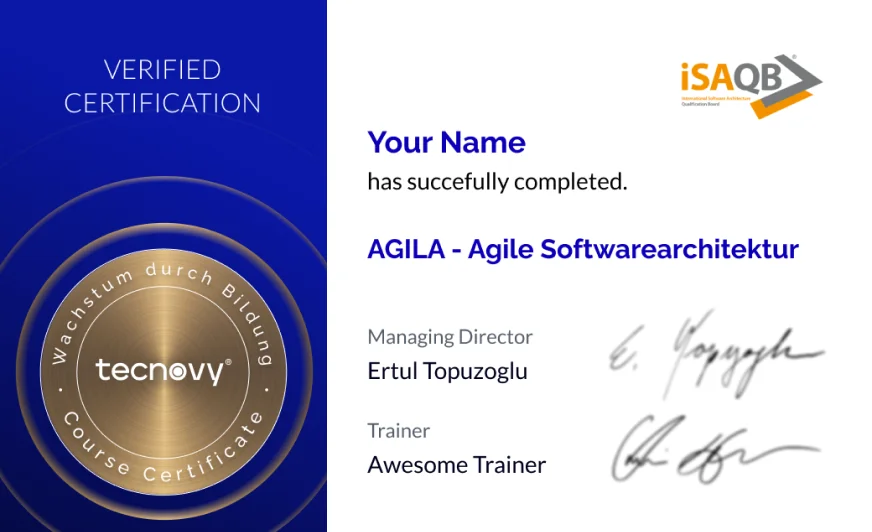
Get your certificate of participation and, if you have one, add your exam certificate from E-Learning. Fully automated, beautifully designed. Just for you, only at tecnovy.

03

No Slideshow, Hands-On!

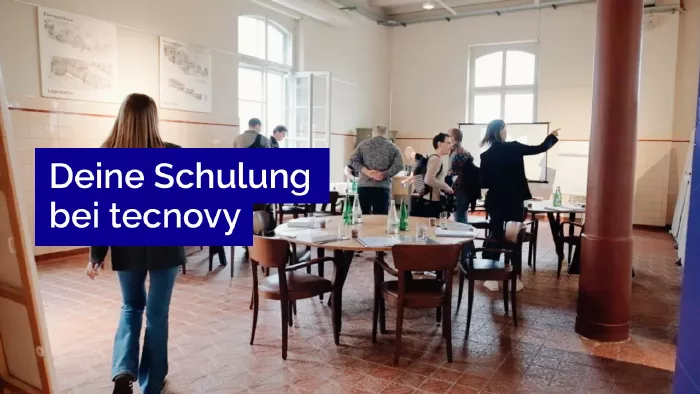
Promised: no PowerPoint marathon. We work in groups, tie theory to practice, and you get real project examples from our experienced trainers plus the exchange with like-minded people.

04

Attend Twice, Pay Once

You are welcome to attend the training online again within a year as a refresher.

05

Learn from Experts

We always guarantee you the use of didactically and methodically first-class qualified trainers who draw their knowledge from training experience as well as professional practical and project experience.

06

Flexible Date Change

If you are not able to attend the course, you can rebook your training free of charge up to one week before the start of the training.

FAQs

Frequently asked questions

01Do I need CPSA-F to attend the tecnovy AGILA training?
No. The iSAQB curriculum for the AGILA module lists practical experience only as a prerequisite, not a certification. For the later CPSA-A certification, CPSA-F is mandatory.
02Is there an AGILA examination?
No. There is no examination for the AGILA module. The tecnovy AGILA training earns you 30 credit points and a certificate of participation; the assessment comes later on the path to CPSA-A certification, and it covers all modules together.
03How many credit points does AGILA carry?
The tecnovy AGILA training carries 30 credit points: 20 methodical and 10 communicative. AGILA awards no technical points, which matters for your planning: CPSA-A admission requires 70 points in total and at least 10 in each of the three areas of competence. The iSAQB may re-evaluate point allocations every 12 months; these figures are as of August 2026.
04How does the CPSA-A certification work?
CPSA-A certification consists of a written assignment. Two examiners recognised by the iSAQB assess it, and you then defend it in discussion with them. You can take it in German or English, and tecnovy is glad to help if you have questions about the process.
05Which book belongs to the AGILA seminar?
The tecnovy AGILA training works with "Vorgehensmuster für Softwarearchitektur" by Stefan Toth, which every participant receives as an eBook within the seminar price. The official iSAQB curriculum cites the same book as a source. It is available in German only.
06What is the difference between AGILA and FLEX?
AGILA covers how a team organises architecture work: decisions, requirements, feedback and governance. FLEX covers the technical side of modern systems: modularisation, integration, installation and operation. The point split says the same thing: AGILA awards 20 methodical and 10 communicative points, FLEX 10 methodical and 20 technical.
07How long is the AGILA training?
The tecnovy AGILA training runs for three days. The iSAQB curriculum sets a minimum of three days and 1080 teaching minutes for the module, which is 18 hours.
08Do I get the flipcharts from the AGILA training?
Yes. Every flipchart produced during the tecnovy AGILA training reaches you as a photo protocol after the course.

What does your training at tecnovy look like?

AGILAAGILA - Agile Software Architecture

Ready for the next step?

Choose a public date or plan the course for your team.

Feedback Form
What should we improve?

Tell us what we can do better next time.

Success
Error

© Copyright 2026, tecnovy GmbH, All Rights Reserved