

1,338 $−200 $1,138 $
What this module delivers.
How the training runs
- Method
- The design cycle worked through on running examples
- Basis
- Official CPUX-F curriculum 4.01
- Outcome
- Exam at a certification body, fee not included
Dates & booking
Choose a date that fits
2 dates
Sessions with this symbol offer up to 25% group discount. Click “Details & Registration” to learn more.
1,338 $−133 $1,205 $
No dates match this selection.
Dates are still available. Reset the filters to see them.
Fit
Who this module is designed for
Typical roles
- You decide about interfaces without a shared vocabulary existing for it.
- You are expected to write user requirements a team can build and test against.
- You work with UX specialists and want to understand their terms precisely.
Prerequisites
No prerequisites
You can start right away. Helpful: some contact with product development, design or requirements work.
Curriculum
UXQB® CPUX-F Course in Detail
The course follows CPUX-F curriculum 4.01. It starts at human-centred design and the basic concepts, runs through planning, context of use and user requirements to design and evaluation, and closes on organisational maturity.
01Human-centred design
The opening fixes the cycle everything else follows.
- The four activities, and why they form a loop rather than a chain
- What ISO 9241 prescribes and what it leaves open
- Where human-centred design attaches to a project
02Basic concepts
The part the exam asks about most precisely: the terms themselves.
- Usability and user experience, and what separates them
- Users, stakeholders and the roles in between
- User need against user requirement against wish
- Accessibility as a dimension of human-centred quality in its own right
03Planning a project
Short, but the point where design gets a budget and roles.
- Which activities a project actually needs
- Assigning roles and deliverables to those activities
04Understanding and specifying the context of use
The largest part of the curriculum, and the base for everything after it.
- User interviews and observation in the field
- Recording the result as a context of use description
- Telling personas, scenarios and user journey maps apart
- Capturing tasks and the order they run in
05Specifying the user requirements
Here observation becomes something you can later test against.
- Turning user needs into testable user requirements
- The form a user requirement is written in
- Quality criteria that expose a bad requirement
06Designing solutions
The part where requirements turn into something you can see.
- From a rough draft to a prototype, and what each stage buys
- Information architecture and the user interface specification
- Applying the design principles from ISO 9241
- Guidance for designing user interfaces
07Evaluating against the user requirements
This is where the design is settled, and not by a vote.
- Preparing, moderating and analysing a usability test
- Usability inspections, and when they are enough
- User surveys as a complementary method
- Recording findings so they actually lead to changes
08Human-centred design maturity
The closing part places where your organisation actually stands.
- The maturity levels and how you recognise them
- What blocks the step to the next one
Outcome
What you will be able to do afterwards
- 01
You explain the steps of human-centred design and the order they run in.
- 02
You use the ISO 9241 terms as precisely as the exam asks for them.
- 03
You plan a human-centred design project with its roles and deliverables.
- 04
You capture the context of use and record it so others can follow it.
- 05
You derive testable user requirements from user needs.
- 06
You design solutions and justify them against the requirements.
- 07
You plan a usability test and tell it apart from an inspection.
- 08
You place your organisation on the human-centred design maturity scale.
Certified Professional for Usability and User Experience – Foundation Level
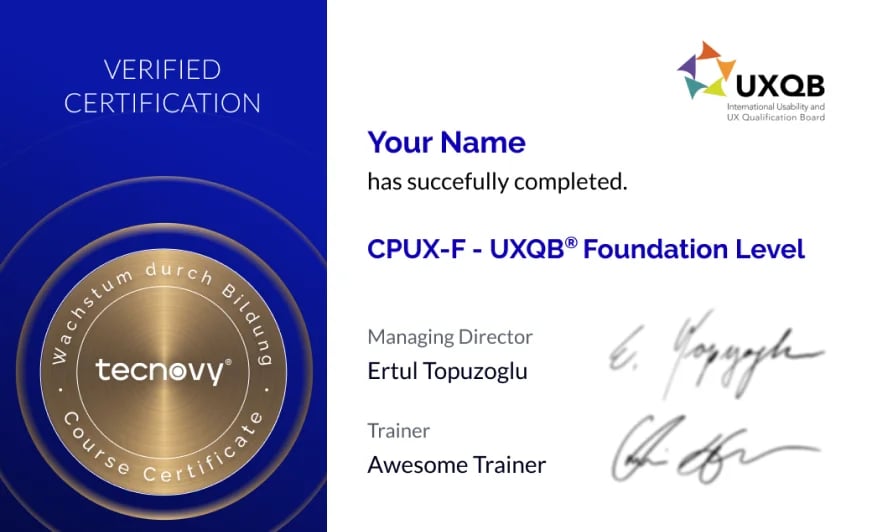
UXQB also calls the same certification "Foundation in Human-Centred Design (CPUX-F)" on its website and on the certificate itself; both names mean this one credential. The certification has no expiry date: it is valid indefinitely and never needs renewing.
Certification terms uxqb.org ↗Examination
CPUX-F examination
40Questions
- Working time
- 75 min
- Pass mark
- 28 / 40
- Format
- Multiple Choice
- Answer options
- 6
- Conditions
- Closed Book
For each question one, two or three of the six options are correct, and the paper tells you how many. Points are awarded proportionally and subtracted proportionally for wrongly marked answers, never below zero. The exam is administered by a certification body rather than by tecnovy. If you do not sit the exam in your first language you can request 15 minutes of extra time.
Official examination rules uxqb.org ↗Proof of attendance
Certificate of participation
≥80%attendance
The tecnovy certificate of participation records your attendance of the CPUX-F training, not a passed UXQB examination.
Open the Certificate Showroom tecnovy → Offer scope
What is included – and what is not
Included
- The textbook "Basiswissen Usability und User Experience" as an eBookThe book by Guido Tesch and Thomas Geis (dpunkt.verlag) is what the seminar is built on, and it is included in the price for every participant.
Not included
- Fee for the CPUX-F certification examinationThe certification body bills the exam to you directly, around CHF 295 excl. VAT, about EUR 315; the euro amount is shown at the daily rate in the booking step.
Why tecnovy
What you get on top with us
01
Certification Guarantee
Our pass rate is impressive. If you do not pass at the first attempt, we cover your second attempt (online exam), provided you sit it within 24 hours of the training.
02
Certificate Showroom
Get your certificate of participation and, if you have one, add your exam certificate from E-Learning. Fully automated, beautifully designed. Just for you, only at tecnovy.
03
Flexible Date Change
If you are not able to attend the course, you can rebook your training free of charge up to one week before the start of the training.
04
Attend Twice, Pay Once
You are welcome to visit the training course online again within a year as a refresher or exam preparation.
05
No Slideshow, Hands-On!
Promised: no PowerPoint marathon. We work in groups, tie theory to practice, and you get real project examples from our experienced trainers plus the exchange with like-minded people.
06
Learn from Experts
We always guarantee you the use of didactically and methodically first-class qualified trainers who draw their knowledge from training experience as well as professional practical and project experience.
FAQs
Frequently asked questions
01Do I need prior knowledge for CPUX-F?
02How is the CPUX-F exam scored?
03Does the CPUX-F exam test practical skills?
04Do I need CPUX-F before an advanced-level certification?
05Where and when do I sit the CPUX-F exam?
06Does the CPUX-F certification expire?
07I have worked in usability for years. Is CPUX-F still worth it?
08What material do I get in the CPUX-F training?
What does your training at tecnovy look like?