
IT training across Europe - tecnovy makes you future-ready.

IREB® CPRE Foundation Level - Requirements Engineering

Requirements rarely arrive finished. They turn up as a wish, a complaint, half a sentence in a meeting, and somebody has to turn that into something a team can build. That is what you practise in the IREB CPRE Foundation Level: eliciting requirements, documenting them clearly, agreeing them with everyone involved and managing them over time. No prior knowledge is required. It ends with the official examination and a certificate that never expires.
Attendance certificate4.8/5 on ProvenExpert

What this module delivers.

The four IREB Practitioner modules each go deep into one area of practice. CPRE-FL lays the breadth underneath: elicit, document, agree, manage. The tecnovy training makes you effective across all four and gives your team one shared vocabulary.

How the training runs

Method
Apply elicitation techniques and notations in exercises
Outcome
Official IREB examination, certificate with no expiry

Dates & booking

Choose a date that fits

3 dates

  • EUREuro
  • USDUS Dollar
  • CHFSwiss Franc

Sessions with this symbol offer up to 25% group discount. Click “Details & Registration” to learn more.

08–10 Sep 2026CEST
Tue–Thu 09:00–17:00
Online training Group Discount
Time zone CEST
Language German
Trainer Alexander Quast
Seats 5+ seats
15% Monthly Pick

1,688 $−253 $1,435 $

excl. VAT
12–14 Oct 2026CEST
Mon–Wed 09:00–17:00
Online training Group Discount
Time zone CEST
Language German
Trainer Rudolf Siebenhofer
Seats 5+ seats
10% Earlybird Discount

1,688 $−169 $1,519 $

excl. VAT
10–12 Nov 2026CET
Tue–Thu 09:00–17:00
Germany Group Discount
City Munich
Language English
Trainer Rudolf Siebenhofer
Seats 5+ seats
10% Earlybird Discount

1,804 $−180 $1,624 $

excl. VAT

Fit

Who this module is designed for

Typical roles

  • You turn what the business asks for into requirements a team can actually build.
  • You write or review specifications that the result is later measured against.
  • You mediate between stakeholders who disagree on scope and priority.

Prerequisites

No prerequisites

You can start right away. Helpful: hands-on experience in projects where requirements take shape.

Curriculum

CPRE® Foundation Level Course in Detail

IREB syllabus 3.3.0 splits the Foundation Level into seven educational units. They run from what requirements engineering is and what it is worth, through documentation, elicitation and agreement, to process, management and tool support. Every unit ends at a decision you genuinely have to make on a project.

01Introduction to and overview of Requirements Engineering

This unit settles what everyone is actually talking about when they say "requirement".

  • Requirement, stakeholder and system as the load-bearing terms
  • Functional requirements and quality requirements told apart
  • What weak requirements engineering costs a project
  • The requirements engineer's role alongside the rest of the team
02Basic principles of Requirements Engineering

This is where you get the nine principles every later decision can be measured against.

  • Value contribution, stakeholders and shared understanding as the starting point
  • Context, problem and solution kept properly apart
  • Why requirements change, and what that means for how you work
  • Iteration and validation as continuous activity rather than a phase
03Work products and documentation practices

This unit decides the form a requirement gets written down in.

  • Natural-language requirements and the language traps that come with them
  • Sentence templates as a tool against ambiguous wording
  • Model-based documentation for goals, processes and data
  • Quality criteria a work product is checked against
04Practices for the development of requirements

Here you get requirements out of the heads of the people involved and into a state that holds.

  • Survey, observation and creativity techniques, and when each one fits
  • Sources of requirements beyond the people in the room
  • Validation for completeness, freedom from contradiction and testability
  • Spotting conflicts between stakeholders, classifying them and resolving them
05Process and work structure

This unit fits the approach to the project rather than the other way round.

  • The factors that shape an RE process: context, goal, constraints
  • Plan-driven, agile and mixed approaches compared
  • How requirements engineering fits into the development process
06Practices for requirements management

This is about everything that happens after the writing down.

  • Attributes and views that keep a large body of requirements manageable
  • Prioritisation as a decision about order and about what gets dropped
  • Traceability from the source through to implementation
  • Versioning, and handling change while the project runs
07Tool support

The final unit places what tools can do and what they cannot fix.

  • Types of RE tool and what each one is built for
  • Selection criteria taken from how you actually work
  • What introducing a tool costs in effort further down the line
Official syllabus(external link)

Outcome

What you will be able to do afterwards

  1. 01

    You apply the nine basic principles of requirements engineering to your own project.

  2. 02

    You document requirements in natural language and in models, and justify which form carries which case.

  3. 03

    You elicit requirements through survey, observation and creativity techniques, and pick the technique to fit the situation.

  4. 04

    You check requirements for completeness and freedom from contradiction, and settle conflicts between stakeholders.

  5. 05

    You configure the RE process to the context, goals and constraints of the project.

  6. 06

    You manage requirements through attributes, views and prioritisation, and keep them traceable from source to implementation.

  7. 07

    You assess what RE tools are good for and what introducing them actually costs.

IREB Certified Professional for Requirements Engineering, Foundation Level

Once you pass, the certification body issues you the official CPRE Foundation Level certificate. It is valid indefinitely and never needs renewing, because the fundamentals of requirements engineering change only slowly.

Certification terms cpre.ireb.org ↗

Examination

IREB CPRE Foundation Level examination

70%Pass mark

Questions
~45
Working time
75 min
Format
Multiple Choice

You can book the examination together with your registration; the exam fee is not part of the seminar price. It takes place after the training at a certification body recognised by the IREB, online or on site. If the exam language is not your native language, you can request a 15-minute extension.

Official examination rules cpre.ireb.org ↗

Proof of attendance

Certificate of participation

≥80%attendance

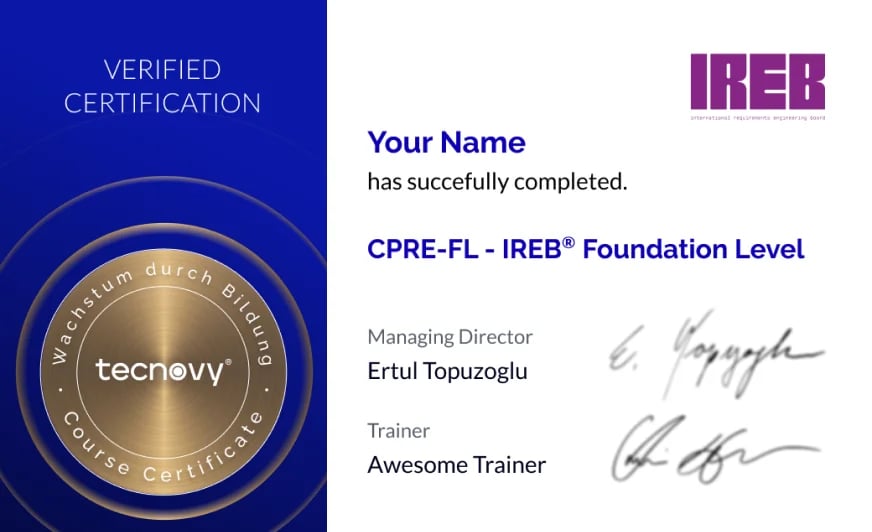
The tecnovy certificate of participation records your attendance of the CPRE-FL training, not a passed examination.

Sample of the tecnovy certificate of participation Open the Certificate Showroom tecnovy →

Offer scope

What is included – and what is not

Included

  • eBook "Basiswissen Requirements Engineering"The German-language companion book to the CPRE Foundation Level, published by dpunkt.verlag, is included in the seminar price for every participant.

Not included

  • Fee for the CPRE Foundation Level examinationThe examination is a separate item you add to your registration.

Why tecnovy

What you get on top with us

02

Certificate Showroom

Get your certificate of participation and, if you have one, add your exam certificate from E-Learning. Fully automated, beautifully designed. Just for you, only at tecnovy.

03

Flexible Date Change

If you are not able to attend the course, you can rebook your training free of charge up to one week before the start of the training.

04

Attend Twice, Pay Once

You are welcome to visit the training course online again within a year as a refresher or exam preparation.

05

No Slideshow, Hands-On!

Promised: no PowerPoint marathon. We work in groups, tie theory to practice, and you get real project examples from our experienced trainers plus the exchange with like-minded people.

06

Learn from Experts

We always guarantee you the use of didactically and methodically first-class qualified trainers who draw their knowledge from training experience as well as professional practical and project experience.

FAQs

Frequently asked questions

01Do I need prior knowledge for the tecnovy CPRE-FL training?
No. The IREB CPRE Foundation Level has no formal admission requirements, neither for the tecnovy training nor for the examination. Experience from projects where requirements take shape helps you place the examples, but it is not a condition.
02When and where do I sit the CPRE-FL examination?
The CPRE Foundation Level examination takes place after the tecnovy training, at a certification body recognised by the IREB, online or on site. You choose the date yourself, and you can book the exam together with your training registration.
03What does the CPRE-FL examination look like?
The CPRE Foundation Level examination is about 45 multiple-choice questions in 75 minutes, and you pass from 70 per cent of the points. If the exam language is not your native language you can request a 15-minute extension. No aids are permitted.
04What happens if I do not pass the CPRE-FL examination?
You can retake the CPRE Foundation Level examination twice with no waiting period. Only after a third unsuccessful attempt does a one-year waiting period apply. You do not need to attend the tecnovy training again, and tecnovy covers your second attempt if you sit the examination within 24 hours of the training.
05Does the CPRE Foundation Level certificate expire?
No, the CPRE Foundation Level certificate is valid indefinitely. It needs neither renewal nor continuing-education points to stay valid, unlike schemes that require recertification.
06What language are the training and the examination in?
The tecnovy CPRE-FL training runs in German or in English, and each session in the list above states which. You can sit the examination in German or English regardless, and the certification bodies offer further languages beyond those.
07What materials do I get in the tecnovy CPRE-FL training?
You get the eBook "Basiswissen Requirements Engineering" as a companion volume, which exists in German only, plus the seminar materials and a photo record of the flipcharts produced during the training. That record keeps the examples your own group worked out.
08What comes after the CPRE Foundation Level?
After the CPRE Foundation Level the Practitioner stage of the IREB scheme opens up, with four modules: Requirements Elicitation, Requirements Modeling, Requirements Management and RE@Agile. The Foundation Level certificate is the prerequisite for their examinations, and tecnovy teaches all four.

What does your training at tecnovy look like?

CPRE-FLCPRE Foundation Level - Requirements Engineering

Ready for the next step?

Choose a public date or plan the course for your team.

Feedback Form
What should we improve?

Tell us what we can do better next time.

Success
Error

© Copyright 2026, tecnovy GmbH, All Rights Reserved