IT training across Europe - tecnovy makes you future-ready.

iSAQB® ARCEVAL - Architecture Evaluation

Sooner or later somebody asks whether the architecture will carry what is coming in two years. ARCEVAL answers that with named procedures instead of instinct. The tecnovy training takes you from quality scenarios and the utility tree into a facilitated ATAM workshop. From there the course moves on to metrics-based assessment of an existing system. Afterwards you run an evaluation yourself and defend its results in front of clients and development teams.
iSAQB Accredited Training PartnerAttendance certificate4.8/5 on ProvenExpert

What this module delivers.

You facilitate ATAM yourself in the tecnovy ARCEVAL training, 150 of its 570 teaching minutes. CBAM, DCAR, TARA, PBAR and ARID come in as named alternatives. The result is a report of risks, trade-offs and sensitivity points.

How the training runs

Method
Facilitated ATAM workshops on one worked example
Outcome
20 credit points, all methodical, no course exam

Dates & booking

Choose a date that fits

1 dates

  • EUREuro
  • USDUS Dollar
  • CHFSwiss Franc

Sessions with this symbol offer up to 25% group discount. Click “Details & Registration” to learn more.

04–05 Nov 2026CET
Wed–Thu 09:00–17:00
Online training Group Discount
Time zone CET
Language English
Trainer MB Matthias Bohlen
Seats Only 4 left
10% Earlybird Discount

1,672 $−167 $1,505 $

excl. VAT

Fit

Who this module is designed for

Typical roles

  • You have to demonstrate whether an architecture carries its quality goals.
  • You facilitate architecture reviews and defend their results in front of stakeholders.
  • You assess existing or acquired systems before a decision to rebuild.

Prerequisites

No prerequisites

You can start right away. Helpful: describing architectures with views, crosscutting concepts and design decisions, your own experience designing and maintaining architectures, a system of your own to evaluate.

Consider instead IMPROVE Gives three of its six parts to the rebuild, from cost-benefit analysis to application strangling, where ARCEVAL stops at the finding.

Curriculum

CPSA® ARCEVAL Course in Detail

Curriculum 2022.1 splits ARCEVAL into six parts across 570 teaching minutes. It starts at the basic terminology, makes quality requirements testable and gives the largest block to scenario-based workshops. Evaluating existing systems, further named methods and one worked example follow.

01Basic terminology of architecture evaluation

This part settles when an evaluation is worth running and what it presupposes.

  • Software architecture, architecture goals and crosscutting concepts as shared terms
  • Typical occasions: a rebuild decision, an acquisition, a release, a recurring audit
  • What has to exist before an evaluation can produce reliable results
  • Qualitative and quantitative methods, and how they complement each other
02Requirements in architecture evaluation

Here you turn vague quality wishes into statements that can be tested.

  • Quality attributes under DIN/ISO 9126 and DIN/ISO 25010
  • Eliciting, phrasing and documenting quality scenarios
  • The utility tree ranks them by benefit and by risk
  • Interactions between quality attributes, and the tactics that fit them
03Scenario-based workshops

The longest part of the curriculum: the ATAM workshop from preparation to evaluation.

  • The phases of ATAM and who takes part in which of them
  • Telling risks, non-risks, sensitivity points and trade-off points apart
  • Grouping results into risk clusters and deriving mitigation measures
  • Communicating findings so that they feed into the next iteration
04Evaluation of existing systems (or their parts)

This part turns to what is in the code rather than in the document.

  • Metrics, measurements and mathematical models as the basis for judgement
  • Implementation check: does the source code follow the architecture as designed
  • Setting the as-is architecture against the target one and naming pain points
  • Tools for static analysis and for dynamic investigation at runtime
05Other evaluation methods

Beyond ATAM the curriculum names five further methods, plus pre-mortems.

  • CBAM sets the cost of architecture decisions against their benefit
  • DCAR starts from decisions already taken, TARA from expert knowledge
  • PBAR and ARID as rapid reviews of patterns and of intermediate designs
  • Pre-mortems, and how to structure a larger evaluation project
06Examples

To close, a complete evaluation runs through on one worked example.

  • At least one realistic example of a software architecture is mandatory
  • From the quality goals through the workshop to the report of results
  • The evaluation results and what they mean for the system
Official syllabus(external link)

Outcome

What you will be able to do afterwards

  1. 01

    You elicit quality scenarios with stakeholders and document them so they can be tested.

  2. 02

    You prioritise quality requirements in a utility tree by benefit and by risk.

  3. 03

    You classify quality attributes against DIN/ISO 25010 and expose the trade-offs between them.

  4. 04

    You run an ATAM workshop through all of its phases and facilitate the stakeholders involved.

  5. 05

    You separate risks, non-risks and sensitivity points, and group them into risk clusters.

  6. 06

    You present evaluation results so that they feed into the next iteration.

  7. 07

    You use metrics to check whether an existing system's code follows the architecture as designed.

  8. 08

    You justify when CBAM, DCAR, TARA, PBAR or ARID is the better choice.

Certificate of participation

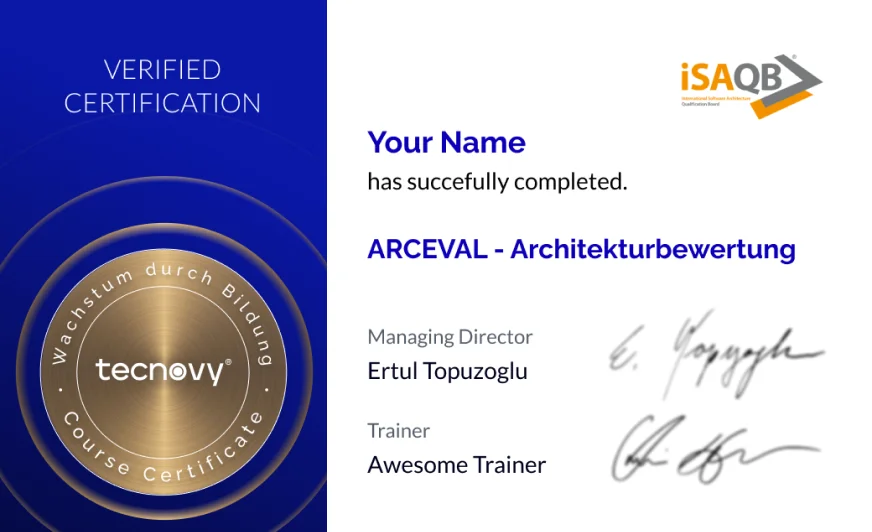
The tecnovy certificate of participation records your attendance of the ARCEVAL training, not a passed examination.

Open the Certificate Showroom tecnovy →

≥80%attendance

Trainers

Matthias Bohlen

Matthias Bohlen

iSAQB®

Why tecnovy

What you get on top with us

02

Certificate Showroom

Get your certificate of participation and, if you have one, add your exam certificate from E-Learning. Fully automated, beautifully designed. Just for you, only at tecnovy.

03

No Slideshow, Hands-On!

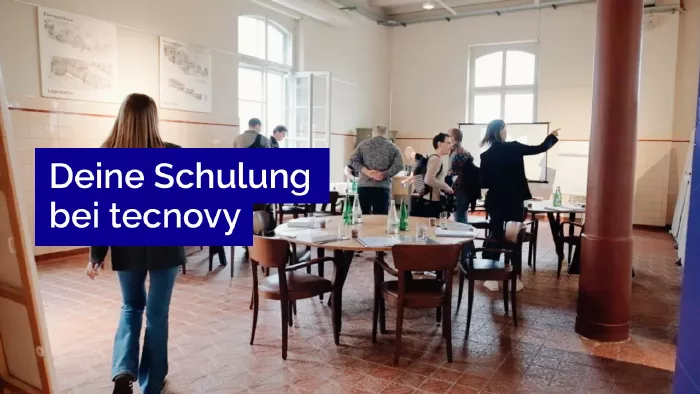
Promised: no PowerPoint marathon. We work in groups, tie theory to practice, and you get real project examples from our experienced trainers plus the exchange with like-minded people.

04

Attend Twice, Pay Once

You are welcome to attend the training online again within a year as a refresher.

05

Learn from Experts

We always guarantee you the use of didactically and methodically first-class qualified trainers who draw their knowledge from training experience as well as professional practical and project experience.

06

Flexible Date Change

If you are not able to attend the course, you can rebook your training free of charge up to one week before the start of the training.

FAQs

Frequently asked questions

01Do I need CPSA-F to attend the tecnovy ARCEVAL training?
No. The iSAQB curriculum for the ARCEVAL module expects knowledge at CPSA Foundation Level but does not require the certificate, so you can book the tecnovy ARCEVAL training without CPSA-F. For the later CPSA-A certification, CPSA-F is mandatory.
02Is there an ARCEVAL examination?
No. There is no examination for the ARCEVAL module. The tecnovy ARCEVAL training earns you 20 credit points and a certificate of participation; the assessment comes later on the path to CPSA-A certification, and it covers all modules together.
03How many credit points does ARCEVAL carry?
The tecnovy ARCEVAL training carries 20 credit points, all of them methodical. ARCEVAL awards no technical and no communicative points, which matters for your planning: CPSA-A admission requires 70 points in total and at least 10 in each of the three areas of competence. The iSAQB may re-evaluate point allocations every 12 months; these figures are as of August 2026.
04How does the CPSA-A certification work?
CPSA-A certification consists of a written assignment. Two examiners recognised by the iSAQB assess it, and you then defend it in discussion with them. You can take it in German or English, and tecnovy is glad to help if you have questions about the process.
05How long is the ARCEVAL training?
The tecnovy ARCEVAL training runs for two days. The iSAQB curriculum sets exactly that minimum, two days with 570 teaching minutes, which is nine and a half hours. Of those, 150 minutes go to the ATAM workshop alone and 90 to one worked example.
06What is the difference between ARCEVAL and IMPROVE?
ARCEVAL evaluates an architecture and stops at the finding; IMPROVE takes that finding as its starting point. Three of the six IMPROVE parts go to cost-benefit analysis, long-term planning and rebuilding techniques such as refactoring and application strangling. ARCEVAL carries 20 methodical credit points, IMPROVE 30, made up of 20 methodical and 10 technical.
07Which evaluation methods does ARCEVAL cover?
ATAM is at the centre and takes the largest block, 150 of the 570 teaching minutes. Alongside it come CBAM for the cost-benefit view, DCAR along decisions already taken, TARA as the expert-based method, plus PBAR, ARID and pre-mortems. The tecnovy ARCEVAL training puts them in context rather than practising each of them at the depth it gives ATAM.
08What has to be in place before an architecture evaluation is worthwhile?
A describable architecture, and stakeholders who stand behind the quality goals. The tecnovy ARCEVAL training covers these preconditions in its first part, together with the occasions on which an evaluation is worth running at all. Where the description is missing, every evaluation starts by reconstructing it.
09Do I get the flipcharts from the ARCEVAL training?
Yes. The utility trees, risk clusters and trade-off points your group works out on the flipcharts in the tecnovy ARCEVAL training reach you afterwards as a photo protocol.


What does your training at tecnovy look like?

ARCEVALARCEVAL - Architecture Evaluation

Ready for the next step?

Choose a public date or plan the course for your team.

Feedback Form
What should we improve?

Tell us what we can do better next time.

Success
Error

© Copyright 2026, tecnovy GmbH, All Rights Reserved