
2,826 $−283 $2,543 $
iSAQB® CLOUDINFRA - Infrastructure, Container and Cloud Native
What this module delivers.
How the training runs
- Method
- Case study plus exercises in six of seven curriculum parts
- Basis
- Official iSAQB curriculum 2024.2
- Outcome
- 30 credit points: 10 methodical, 20 technical, no course exam
Dates & booking
Choose a date that fits
4 dates
Sessions with this symbol offer up to 25% group discount. Click “Details & Registration” to learn more.
3,517 $
excl. VAT2,537 $−254 $2,283 $
2,826 $−283 $2,543 $
No dates match this selection.
Dates are still available. Reset the filters to see them.
Fit
Who this module is designed for
Typical roles
- You design or operate distributed applications in the cloud.
- You decide on container managers, persistence and cloud providers.
- You answer for a system's availability, scaling and running costs.
Prerequisites
No prerequisites
You can start right away. Helpful: hands-on design of small to medium software systems, first experience with containers and their deployment, working knowledge of microservices, container managers or cloud providers.
Consider instead FLEX Covers architecture design and implementation at the depth CLOUDINFRA only outlines.
Curriculum
CPSA® CLOUDINFRA Course in Detail
Curriculum 2024.2 splits CLOUDINFRA into seven parts across roughly 20 teaching hours. It runs from choosing a cloud through containers, patterns for distributed applications and CI/CD to automation, observability and a closing case study.
01Fundamentals of Modern Infrastructures
This part settles which cloud actually fits your system.
- Telling public, private, hybrid, multi and on-premise apart
- Provider selection criteria, including vendor lock-in and digital sovereignty
- Managed versus self-managed services and the shared responsibility model
- Compliance frameworks such as GDPR, ISO 27001 and BSI C5
02Common Architecture Concepts
Here you decide how the parts of a distributed application talk to each other.
- Weighing monolith, microservices and self-contained systems against each other
- Decoupled communication through event sourcing, messaging and HTTP feeds
- Integration through the backend or through the frontend
- Eventual consistency and what it does to data integrity
03Cloud Native Journey
The longest part of the curriculum takes containers apart, from isolation to migration.
- The goals and benefits of the cloud native concept
- Namespaces, cgroups, capabilities and the risks of privileged containers
- Container manager abstractions: health checks, scaling, placement, overlay networks
- Object and block storage, backup and restore, cloud migration patterns
04Patterns for Distributed Applications and Cloud Native Architectures
This part supplies the patterns for cutting modules into containers and keeping them standing.
- Container application design: ambassador, adapter, sidecar, scatter and gather, work queue
- Choosing between functions as a service and container orchestration
- Fault tolerance at the communication layer and service mesh concepts
- Chaos engineering as a deliberate test of system resilience
05Development and CI/CD
This part is about the road from commit to cloud production.
- Development and CI/CD environments for cloud projects
- Rolling, canary and blue/green deployment
- Dev, test and prod clusters with responsibilities and access control
- Secrets management, automated secret rotation, the secrets operator
06Automation and Operation
Operations becomes a design job: automated, measurable and on minimal privileges.
- DevOps, DevSecOps and site reliability engineering as roles
- Infrastructure as code across the APIs of different cloud providers
- Least privilege and policy enforcement in hybrid and multi-cloud setups
- Observability architecture, plus sizing clusters and calculating availability
07Case Study
The case study pulls the curriculum together on one continuous example.
- Practical exercises across the full length of the part
- Applying the patterns from parts 1 to 6 to a concrete system
- Not exam relevant, but mandatory in every conformant training under the curriculum
Outcome
What you will be able to do afterwards
- 01
You select cloud type and provider against compliance, cost and lock-in risk.
- 02
You derive availability, scaling and performance as requirements on the infrastructure.
- 03
You choose communication and integration concepts for distributed applications to fit the case.
- 04
You assess container isolation mechanisms and name the security risks they carry.
- 05
You compare persistence options and justify object, block or managed storage.
- 06
You design container patterns such as sidecar or work queue and plan for resilience.
- 07
You shape deployment procedures and secrets management for cloud environments.
- 08
You automate infrastructure as code and plan the observability architecture.
Credit points toward CPSA-A
- Methodical competence
- 10
- Technical competence
- 20
- Communicative competence
- 0
30 of 70 points toward CPSA-A admission
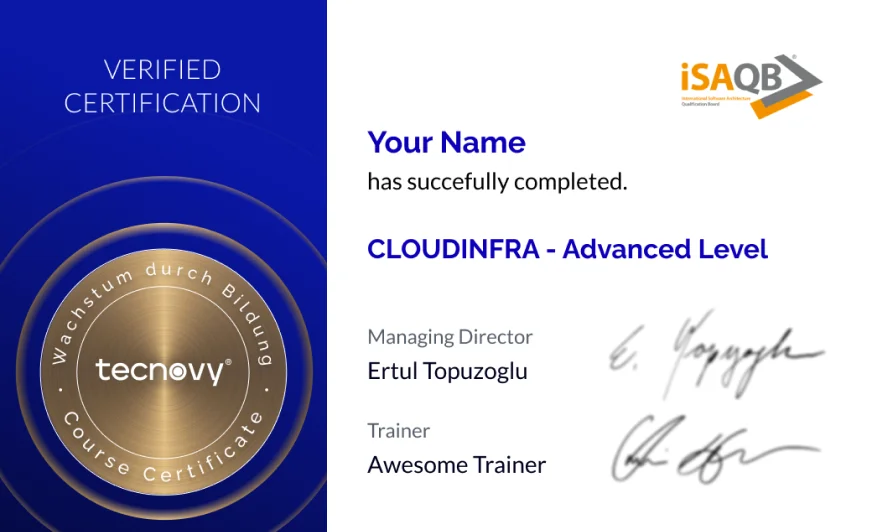
Certificate of participation
The tecnovy certificate of participation records your attendance of the CLOUDINFRA training, not a passed examination.
Open the Certificate Showroom tecnovy →≥80%attendance
Trainers
Why tecnovy
What you get on top with us
01
iSAQB® Accredited Provider
We are an officially accredited Training Provider of the International Software Architecture Qualification Board.
02
Certificate Showroom
Get your certificate of participation and, if you have one, add your exam certificate from E-Learning. Fully automated, beautifully designed. Just for you, only at tecnovy.
03
No Slideshow, Hands-On!
Promised: no PowerPoint marathon. We work in groups, tie theory to practice, and you get real project examples from our experienced trainers plus the exchange with like-minded people.
04
Attend Twice, Pay Once
You are welcome to attend the training online again within a year as a refresher.
05
Learn from Experts
We always guarantee you the use of didactically and methodically first-class qualified trainers who draw their knowledge from training experience as well as professional practical and project experience.
06
Flexible Date Change
If you are not able to attend the course, you can rebook your training free of charge up to one week before the start of the training.
Experiences
What participants say
The courses (iSAQB EAM & CLOUDINFRA) that I attended were conducted by very competent trainers. The content was very good, the lessons were instructive and questions were answered immediately. My expectations were fully met.
FAQs