IT training across Europe - tecnovy makes you future-ready.

iSAQB® FUNAR - Functional Software Architecture

Functional architecture starts with something given up: no mutable state, no objects carrying their identity around with them. The FUNAR training shows you what takes their place. It runs from single values and types up to the macro architecture of whole systems, with events and Model View Update. You do not need prior knowledge of functional programming: tecnovy puts a pre-course day in front of the course.
iSAQB Accredited Training PartnerAttendance certificate4.8/5 on ProvenExpert

What this module delivers.

Architecture here is executable code, not a picture of it. FUNAR builds systems from pure functions, immutable data and algebraic abstractions. You model domains with combinators and monads, and your team reads the design in the source.

How the training runs

Method
Programming exercises in a functional language, 420 of 1,080 minutes
Outcome
30 credit points: 10 methodical, 20 technical, no course exam

Dates & booking

Choose a date that fits

1 dates

  • EUREuro
  • USDUS Dollar
  • CHFSwiss Franc

Sessions with this symbol offer up to 25% group discount. Click “Details & Registration” to learn more.

26–29 Oct 2026CET
Mon–Thu 09:00–17:00
Online training Group Discount
Time zone CET
Language German
Seats 5+ seats
10% Earlybird Discount

2,711 $−271 $2,440 $

excl. VAT

Fit

Who this module is designed for

Typical roles

  • You design domain models and want them to hold up without mutable state.
  • You introduce functional patterns into an existing object-oriented codebase.
  • You decide the macro architecture and own how state flows through the system.

Prerequisites

No prerequisites

You can start right away. What you need: experience modelling architectures. Helpful: basic knowledge of algebra.

Consider instead DDD Orders the domain through ubiquitous language, knowledge crunching and context mapping, and assumes object-oriented rather than functional development.

Curriculum

CPSA® FUNAR Course in Detail

iSAQB curriculum 2023.1 divides FUNAR into five parts across 1,080 teaching minutes and sets three days as the minimum duration. tecnovy puts a pre-course day on functional programming in front of those three accredited days, so the seminar runs four days in total.

01Basics of Functional Programming

This part lays out the tools everything else is built from.

  • Values, functions, composition, types and modules as the building blocks
  • Breaking domain data down into composite and mixed data types
  • Telling pure functions apart from state-changing procedures
  • Construction recipes: deriving the function from its type
02Technologies

The shortest part answers the question of which language fits.

  • Static against dynamic type systems and what each costs the design
  • Strict against non-strict evaluation
  • Tail recursion and why it decides the runtime behaviour
  • Criteria for choosing a functional language for a project
03Functional Modeling

The domain model is built here, out of algebra rather than out of classes.

  • Combinator models with recursion as the structure of the model
  • Semigroup, monoid and functor in domain modelling
  • Applicative functors as the next step of abstraction
  • Closure of operations as the bridge to tactical domain-driven design
04Functional Macro Architecture

From here on the subject is the whole system rather than a single model.

  • Monads for processes that have to follow one another
  • Dependency injection without mutable state
  • Event-based architecture and the modelling of domain processes
  • Model View Update as the pattern for the system as a whole
05Examples

To close, everything comes together in worked examples.

  • Immutable data and pure functions across a complete design
  • Functional modelling and macro architecture working together
  • A comparison against the object-oriented version of the same design
Official syllabus(external link)

Outcome

What you will be able to do afterwards

  1. 01

    You break domain data down into composite and mixed data types and derive the signature from them.

  2. 02

    You separate pure functions from state-changing procedures and justify where the line falls.

  3. 03

    You choose between static and dynamic typing and name the consequences for the design.

  4. 04

    You model a domain as a combinator model and test it against semigroup, monoid and functor.

  5. 05

    You carry tactical domain-driven design building blocks over into functional models using closure of operations.

  6. 06

    You describe sequential processes with monads and inject dependencies without mutable state.

  7. 07

    You design event-based systems along the Model View Update pattern.

  8. 08

    You compare a functional design against its object-oriented counterpart and name the differences.

Why tecnovy

What you get on top with us

02

Certificate Showroom

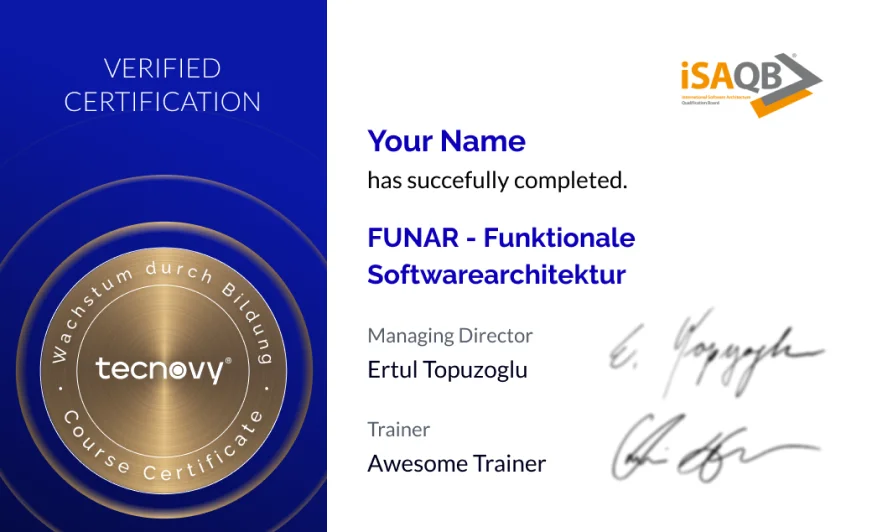
Get your certificate of participation and, if you have one, add your exam certificate from E-Learning. Fully automated, beautifully designed. Just for you, only at tecnovy.

03

No Slideshow, Hands-On!

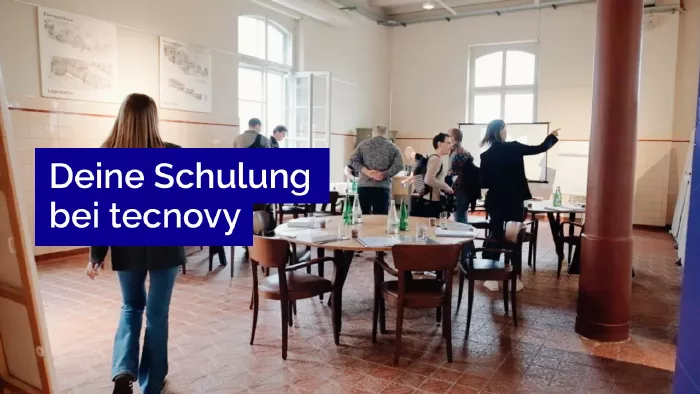
Promised: no PowerPoint marathon. We work in groups, tie theory to practice, and you get real project examples from our experienced trainers plus the exchange with like-minded people.

04

Attend Twice, Pay Once

You are welcome to attend the training online again within a year as a refresher.

05

Learn from Experts

We always guarantee you the use of didactically and methodically first-class qualified trainers who draw their knowledge from training experience as well as professional practical and project experience.

06

Flexible Date Change

If you are not able to attend the course, you can rebook your training free of charge up to one week before the start of the training.

FAQs

Frequently asked questions

01Do I need CPSA-F to attend the tecnovy FUNAR training?
No. The iSAQB curriculum for the FUNAR module names basic knowledge of functional programming and experience modelling architectures as its prerequisites, not a certification. For the later CPSA-A certification, CPSA-F is mandatory.
02Is there a FUNAR examination?
No. There is no examination for the FUNAR module. The tecnovy FUNAR training earns you 30 credit points and a certificate of participation; the assessment comes later on the path to CPSA-A certification, and it covers all modules together.
03How many credit points does FUNAR carry?
The tecnovy FUNAR training carries 30 credit points, 20 of them in technical competence and 10 in methodical. FUNAR awards no communicative points, and that matters for your planning: CPSA-A admission requires 70 points in total and at least 10 in each of the three areas of competence. The iSAQB may re-evaluate point allocations every 12 months; these figures are as of August 2026.
04How does the CPSA-A certification work?
CPSA-A certification consists of a written assignment. Two examiners recognised by the iSAQB assess it, and you then defend it in discussion with them. You can take it in German or English, and tecnovy is glad to help if you have questions about the process.
05How long is the FUNAR training?
The tecnovy FUNAR training runs for four days: one pre-course day on functional programming and three accredited FUNAR days. The iSAQB curriculum sets a minimum of three days and 1,080 teaching minutes for FUNAR, which is 18 hours. The 30 credit points come from the three accredited days.
06Do I need prior knowledge of functional programming?
Not necessarily: tecnovy puts a pre-course day in front of the FUNAR training that introduces values, functions, recursion and data modelling from scratch. The iSAQB curriculum expects basic knowledge of functional programming, and this day closes that gap. The pre-course day is not part of the accredited curriculum and carries no credit points of its own.
07Which programming language does the FUNAR training use?
The tecnovy FUNAR training works in a functional programming language. The iSAQB curriculum names Haskell and Racket as particularly suitable, because both support every architecture principle in the curriculum directly. Of the 1,080 teaching minutes, 420 are budgeted as exercise time, so you write code yourself.
08What is the difference between FUNAR and DDD?
Both modules model domains, but by opposite means: the iSAQB curriculum for DDD assumes object-oriented development and works through ubiquitous language, knowledge crunching and context mapping, while FUNAR expects basic functional programming and models with combinators, semigroups and monoids. The points show it too: DDD carries 20 methodical and 10 communicative credit points, FUNAR 10 methodical and 20 technical. If you want the domain ordered without committing to functional programming, book DDD.
09Do I get the flipcharts from the FUNAR training?
Yes. The flipcharts produced in the tecnovy FUNAR training reach you as a photo protocol after the seminar.


What does your training at tecnovy look like?

FUNARFUNAR - Functional Software Architecture

Ready for the next step?

Choose a public date or plan the course for your team.

Feedback Form
What should we improve?

Tell us what we can do better next time.

Success
Error

© Copyright 2026, tecnovy GmbH, All Rights Reserved