IT training across Europe - tecnovy makes you future-ready.

iSAQB® WEB - Web Architectures

In the iSAQB WEB module you design web-based architectures and assess systems that are already live. At tecnovy it is the only Advanced module whose credit points fall entirely into technical competence. The material matches that: protocols and standards, architecture styles and the infrastructure behind them. WCAG accessibility and internationalization count as architecture here, not as polish on the frontend.
iSAQB Accredited Training PartnerAttendance certificate4.8/5 on ProvenExpert

What this module delivers.

REST, a stateful backend or a single-page app: that choice is made on the protocol layer beneath the frontend, not in it. WEB at tecnovy spends three days there, from HTTP/3 and TLS to reverse proxies, CDNs and load balancing.

How the training runs

Method
Design web architectures, weigh styles and infrastructure
Outcome
30 credit points, all technical, no course exam

Dates & booking

Choose a date that fits

3 dates

  • EUREuro
  • USDUS Dollar
  • CHFSwiss Franc

Sessions with this symbol offer up to 25% group discount. Click “Details & Registration” to learn more.

14–16 Oct 2026CEST
Wed–Fri 09:00–17:00
Online training Group Discount
Time zone CEST
Language German
Trainer Raphael Pigulla
Seats 5+ seats
10% Earlybird Discount

2,200 −220 1,980

excl. VAT
11–13 Nov 2026CET
Wed–Fri 09:00–17:00
Online training Group Discount
Time zone CET
Language English
Trainer Raphael Pigulla
Seats Only 4 left
10% Earlybird Discount

2,200 −220 1,980

excl. VAT
09–11 Dec 2026CET
Wed–Fri 09:00–17:00
Online training Group Discount
Time zone CET
Language German
Trainer Raphael Pigulla
Seats 5+ seats
10% Earlybird Discount

2,200 −220 1,980

excl. VAT

Fit

Who this module is designed for

Typical roles

  • You design systems whose interface runs in a browser.
  • You decide the authentication, session handling and access control of a web application.
  • You own response times and availability behind reverse proxies, CDNs and load balancers.

Prerequisites

No prerequisites

You can start right away. Helpful: basic knowledge of HTML, CSS and JavaScript, hands-on experience with at least one server-side framework, experience with distributed systems, ideally web applications.

Consider instead WEBSEC Gives threat analysis, cryptography and attack classes all six of its curriculum parts, where WEB treats security as one of six quality attributes.

Curriculum

CPSA® WEB Course in Detail

Curriculum 2020.1 splits WEB into seven parts across 1140 teaching minutes. It starts at the request/response cycle, runs through protocols, architecture styles and infrastructure into design, and closes on quality and worked examples. The centre of gravity is design, at 300 minutes.

01Fundamentals

This part sorts out the building blocks every web application is made of.

  • The request/response cycle from the address bar to the response
  • Client, server, proxy, reverse proxy and load balancer, and what each one does
  • Hypermedia, pattern libraries and the single sign-on flow
  • Accessibility under WCAG as a requirement on the architecture
02Protocols and Standards

This part is about the layer every later design decision rests on.

  • HTTP/1.1, HTTP/2 and HTTP/3 compared, plus caching headers and DNS resolution
  • TLS and the public key infrastructure behind it
  • OAuth 2 and OpenID Connect for sign-in and authorisation
  • CORS and content security policy as boundaries inside the browser
03Architecture Styles

This part sets the competing forms side by side so you can choose between them.

  • REST with identifiable resources, a uniform interface, statelessness and hypermedia
  • Component-oriented stateful backend architectures
  • Single-page applications with data binding and client-side routing
  • Web components built from custom elements and shadow DOM
04Technology and Infrastructure

This part covers everything that sits between the browser and the application.

  • Proxies and reverse proxies, and what they absorb in load and in attacks
  • Content delivery networks and load balancing
  • Horizontal against vertical scaling, and what each of them costs
  • Graceful degradation and progressive enhancement for weak clients
05Design of Web Architectures

The longest part of the curriculum: this is where the expensive decisions are made.

  • The CAP theorem and ACID as the frame for consistency decisions
  • Eventual consistency, plus CQS and CQRS as a split between reading and writing
  • Strategies for session management in distributed operation
  • SQL injection, cross-site scripting and CSRF, and what actually stops them
06Quality in Web Architectures

This part measures the design against the properties that count in operation.

  • Least privilege, defense in depth and secure by default as security principles
  • Threat modelling as part of the design work
  • Scalability and availability as design goals
  • Usability, accessibility, internationalization and localization
07Examples

To close, you work the decisions through on examples that are carried to the end.

  • Handling reverse proxies in a delivery chain
  • The rough pattern of a web backend application
  • Features of a single-page framework: data binding and client-side routing
  • Examples of database models behind web applications
Official syllabus(external link)

Outcome

What you will be able to do afterwards

  1. 01

    You justify the choice between HTTP/1.1, HTTP/2 and HTTP/3 by latency, multiplexing and caching.

  2. 02

    You design sign-in flows with OAuth 2 and OpenID Connect, and guard the browser with CORS and a content security policy.

  3. 03

    You decide between REST, stateful backend and single-page application by state, caching and delivery.

  4. 04

    You plan scalability and availability through reverse proxies, load balancing and content delivery networks.

  5. 05

    You defend applications against SQL injection, cross-site scripting and CSRF, and justify every countermeasure.

  6. 06

    You derive a consistency and session strategy for distributed web applications from the CAP theorem and ACID.

  7. 07

    You assess web architectures against security, scalability, usability, WCAG accessibility and internationalization.

Credit points toward CPSA-A

Methodical competence
0
Technical competence
30
Communicative competence
0

30 of 70 points toward CPSA-A admission

Trainers

Raphael Pigulla

Raphael Pigulla

iSAQB®

Why tecnovy

What you get on top with us

02

Certificate Showroom

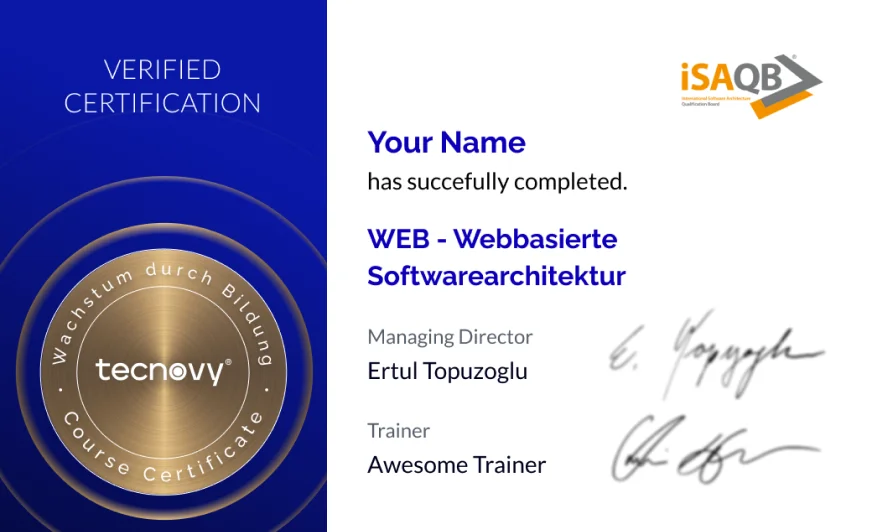
Get your certificate of participation and, if you have one, add your exam certificate from E-Learning. Fully automated, beautifully designed. Just for you, only at tecnovy.

03

No Slideshow, Hands-On!

Promised: no PowerPoint marathon. We work in groups, tie theory to practice, and you get real project examples from our experienced trainers plus the exchange with like-minded people.

04

Attend Twice, Pay Once

You are welcome to attend the training online again within a year as a refresher.

05

Learn from Experts

We always guarantee you the use of didactically and methodically first-class qualified trainers who draw their knowledge from training experience as well as professional practical and project experience.

06

Flexible Date Change

If you are not able to attend the course, you can rebook your training free of charge up to one week before the start of the training.

FAQs

Frequently asked questions

01Do I need CPSA-F to attend the tecnovy WEB training?
No. The iSAQB curriculum for the WEB module lists CPSA-F as a recommendation, not as an admission condition for the training. For the later CPSA-A certification, CPSA-F is mandatory.
02Is there a WEB examination?
No. There is no examination for the WEB module. The tecnovy WEB training earns you 30 credit points and a certificate of participation; the assessment comes later on the path to CPSA-A certification, and it covers all modules together.
03How many credit points does WEB carry?
The tecnovy WEB training carries 30 credit points, and all 30 count toward technical competence. WEB awards no methodical and no communicative points, which matters for your planning: CPSA-A admission requires 70 points in total and at least 10 in each of the three areas of competence. The iSAQB may re-evaluate point allocations every 12 months; these figures are as of August 2026.
04How does the CPSA-A certification work?
CPSA-A certification consists of a written assignment. Two examiners recognised by the iSAQB assess it, and you then defend it in discussion with them. You can take it in German or English, and tecnovy is glad to help if you have questions about the process.
05How long is the WEB training?
The tecnovy WEB training runs for three days. The iSAQB curriculum sets a minimum of three days and 1140 teaching minutes, which is 19 hours; tecnovy spreads them across the three course days.
06What is the difference between WEB and WEBSEC?
WEB designs the web architecture, WEBSEC hardens it. In WEB security is one of six quality attributes alongside scalability, availability, usability, accessibility and internationalization, and all 30 credit points are technical. WEBSEC gives risk analysis, secure development process, cryptography, attack classes and security infrastructure all six of its curriculum parts, and carries 20 technical plus 10 methodical points.
07Does WEB cover specific frameworks such as React or Angular?
No. The iSAQB curriculum for the WEB module stays technology-independent and names no framework at all. The tecnovy WEB training therefore works with the concepts behind them: data binding and client-side routing as the standard features of a single-page application, custom elements and shadow DOM as the building blocks of web components.
08Do I need to be able to program for the WEB training?
No, programming skills are not required for the tecnovy WEB training. The iSAQB curriculum does recommend basic knowledge of HTML, CSS and JavaScript plus experience with at least one server-side framework, because the design decisions in the course build on them.
09Do I get the flipcharts from the WEB training?
Yes. Every flipchart produced during the tecnovy WEB training reaches you as a photo protocol after the course.


What does your training at tecnovy look like?

WEBWEB - Web Architectures

Ready for the next step?

Choose a public date or plan the course for your team.

Feedback Form
What should we improve?

Tell us what we can do better next time.

Success
Error

© Copyright 2026, tecnovy GmbH, All Rights Reserved