

2,200 €
excl. VATWhat this module delivers.
How the training runs
- Method
- Exercises plus a real EAM example, 490 of 1080 minutes
- Basis
- Official iSAQB curriculum 2024.1
- Outcome
- 30 credit points, all methodical, no course exam
Dates & booking
Choose a date that fits
2 dates
Sessions with this symbol offer up to 25% group discount. Click “Details & Registration” to learn more.
2,200 €−220 €1,980 €
No dates match this selection.
Dates are still available. Reset the filters to see them.
Fit
Who this module is designed for
Typical roles
- You design systems that have to fit into an application landscape that already exists.
- You sit on an architecture board or prepare the decisions it takes.
- You are asked to turn your company's IT planning into an architecture roadmap.
Prerequisites
No prerequisites
You can start right away. Helpful: architecture fundamentals at CPSA-F level, hands-on experience in an architecture role, some exposure to strategic IT planning or IT portfolio management.
Consider instead IMPROVE Improves one existing system, from current-state analysis through refactoring and test automation, instead of steering a whole landscape.
Curriculum
CPSA® EAM Course in Detail
Curriculum 2024.1 splits EAM into five parts across 1080 teaching minutes, 490 of which are exercise time. It starts at the basic terms, spends half the course on approaches and methods, and ends at the interaction between software and enterprise architecture.
01Basic terms used in Enterprise Architecture Management
This part draws the boundaries: what EAM does and what it is not.
- EAM as the bridge between strategic enterprise planning and individual projects
- Delineation from IT, solution and software architecture, with the architect roles that go with them
- The four architecture domains of business, application, data and technology, plus capabilities
- Baseline, target and transition architecture, and an overview of the frameworks: TOGAF, Zachman, BIAN, TM Forum Frameworx
02EAM Approaches
The longest part of the curriculum and the methodical core of the module.
- TOGAF Architecture Development Method, capability-based planning and application portfolio management
- Business capabilities as the bridge between business and software architecture, related to domain-driven design
- Maturity, gap, impact and risk analysis, plus architecture principles and reference models
- Agility in EAM with Scrum, Kanban, SAFe and Open Agile Architecture, plus the EAM repository and its metamodel
03Architecture Governance
This part settles who in a company is allowed to take an architecture decision at all.
- Governance at three levels: corporate, IT and architecture
- The function, remit and composition of architecture boards
- Architecture guidelines, metrics and compliance monitoring, for example according to TOGAF
- Roles and responsibilities of enterprise, solution and software architects
04Interaction Between Software Architecture and Enterprise Architecture Management
The influence runs both ways, and this part gives that 200 minutes.
- How enterprise strategy, legal change and reorganisation shape your system designs
- Market, methodology and technology trends such as blockchain, microservices and cloud
- The feedback from architecture decisions such as microservices into processes and the organisation
- Cross-application concerns: integration, security, monitoring, transactions
05Examples
To close, you discuss a real enterprise architecture with its advantages and drawbacks.
- At least one real EAM example is mandatory in every licensed training
- The type and shape of the example follow the interests of the group
- The curriculum marks this section explicitly as not examinable
Outcome
What you will be able to do afterwards
- 01
You delineate enterprise architecture management from IT, solution and software architecture.
- 02
You plan the evolution of an application landscape along the TOGAF Architecture Development Method.
- 03
You derive an architecture roadmap from the baseline and target architecture, and keep it current.
- 04
You bridge business and software architecture using business capabilities.
- 05
You assess an existing IT landscape through maturity, gap, impact and risk analysis.
- 06
You justify architecture principles and reference architectures as guidance for individual projects.
- 07
You judge how a decision such as microservices feeds back into processes and the organisation.
Credit points toward CPSA-A
- Methodical competence
- 30
- Technical competence
- 0
- Communicative competence
- 0
30 of 70 points toward CPSA-A admission
Certificate of participation
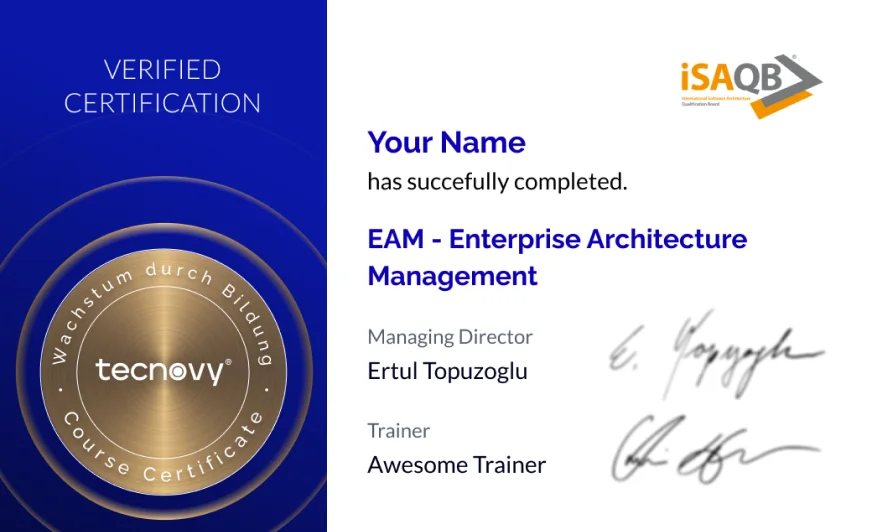
The tecnovy certificate of participation records your attendance of the EAM training, not a passed examination.
Open the Certificate Showroom tecnovy →≥80%attendance
Trainers
Why tecnovy
What you get on top with us
01
iSAQB® Accredited Provider
We are an officially accredited Training Provider of the International Software Architecture Qualification Board.
02
Certificate Showroom
Get your certificate of participation and, if you have one, add your exam certificate from E-Learning. Fully automated, beautifully designed. Just for you, only at tecnovy.
03
No Slideshow, Hands-On!
Promised: no PowerPoint marathon. We work in groups, tie theory to practice, and you get real project examples from our experienced trainers plus the exchange with like-minded people.
04
Attend Twice, Pay Once
You are welcome to attend the training online again within a year as a refresher.
05
Learn from Experts
We always guarantee you the use of didactically and methodically first-class qualified trainers who draw their knowledge from training experience as well as professional practical and project experience.
06
Flexible Date Change
If you are not able to attend the course, you can rebook your training free of charge up to one week before the start of the training.
FAQs
Frequently asked questions
01Do I need CPSA-F to attend the tecnovy EAM training?
02Is there an EAM examination?
03How many credit points does EAM carry?
04How does the CPSA-A certification work?
05How long is the EAM training?
06What is the difference between EAM and IMPROVE?
07Is the tecnovy EAM training a TOGAF course?
08Do I get the flipcharts from the EAM training?
What does your training at tecnovy look like?