
IT training across Europe - tecnovy makes you future-ready.

IREB® CPRE RE@Agile Practitioner

Agile teams do not write requirements any more, so the saying goes. They write different ones: shorter, later, closer to the conversation, and binding all the same if the result is to hold. IREB CPRE RE@Agile describes exactly that middle ground, and tecnovy trains it on vision, system boundary, backlog granularity, quality requirements and prioritisation, until your team knows how much documentation it actually needs.
Attendance certificate4.8/5 on ProvenExpert

What this module delivers.

CPRE RE@Agile is the only one of the four Level 2 modules with three admission routes to its examination rather than just the CPRE Foundation certificate. In the tecnovy training you work on backlog, quality requirements, prioritisation and scaling.

How the training runs

Method
Backlog, estimation and prioritisation through exercises
Outcome
Official IREB examination, three admission routes

Dates & booking

Choose a date that fits

No public dates are scheduled yet.

New dates are published regularly. Join the waitlist or plan an in-house course for your team.

Request in-house training

Fit

Who this module is designed for

Typical roles

  • You own a backlog and decide what goes into it and in what order.
  • You work between the business and an agile team that is expected to deliver quickly.
  • You coordinate requirements across several teams building the same product.
Prerequisites

Formal prerequisites

  • IREB certificate CPRE RE@Agile Primer
  • Or the IREB certificate CPRE Foundation Level
  • Or one of seven further recognised certificates, among them CSPO, PSPO, SAFe PM/PO and BCS Practitioner in Requirements Engineering

Consider instead CPRE-FL One of the three admission routes to the RE@Agile examination, and the right one if you hold neither the Primer nor one of the seven recognised certificates.

Curriculum

CPRE® RE@Agile Course in Detail

IREB syllabus 2.3.0 splits RE@Agile into six educational units and gives a minimum time for each, 975 minutes in total. They run from the project start through functional and quality requirements to prioritisation, estimation and scaling.

01What is RE@Agile

The shortest unit in the syllabus, and the one that places the rest.

  • What requirements engineering and agile working need from each other
  • Cooperative, iterative and incremental as a shared stance
  • The product owner role between the business and the team
02A clean project start

This unit settles what is even being discussed before the first backlog exists.

  • Framing vision and goals so they can carry decisions
  • Determining the system boundary with context and use case diagrams
  • Identifying stakeholders and managing them over time
  • The dependencies between goals, stakeholders and the system boundary
03Handling functional requirements

At 195 minutes plus 120 of exercise, the largest unit in the syllabus.

  • Levels of granularity from epic through feature to user story
  • Communicating and documenting appropriately at each level
  • User stories and backlog items with INVEST and a Definition of Ready
  • Splitting, grouping, and knowing when fine-grained enough is enough
04Handling quality requirements and constraints

The requirements that most often disappear in an agile backlog.

  • Why quality requirements and constraints carry weight of their own
  • Adding precision to quality requirements, for instance through a quality tree
  • Anchoring them in the backlog and tying them to the Definition of Done
  • Making constraints explicit instead of assuming them silently
05Prioritizing and estimating requirements

This is where the order things actually get built in comes from.

  • Determining business value and weighing it against risks and dependencies
  • Expressing priorities and ordering the backlog by them
  • Estimating with planning poker, reference stories and t-shirt sizes
  • MVP, MMP and choosing a development strategy
06Scaling RE@Agile

What changes as soon as several teams work on the same product.

  • Scaling requirements and teams together
  • Criteria for structuring both of them in the large
  • Roadmaps and planning across longer horizons
  • Product validation when no single team sees the whole
Official syllabus(external link)

Outcome

What you will be able to do afterwards

  1. 01

    You judge how much requirements engineering an agile undertaking actually needs.

  2. 02

    You start an undertaking with a vision, goals, a system boundary and a defensible stakeholder map.

  3. 03

    You move requirements between levels of granularity, from epic through feature to user story.

  4. 04

    You split and group backlog items and recognise when a requirement is fine-grained enough.

  5. 05

    You add precision to quality requirements and make constraints explicit instead of assuming them.

  6. 06

    You determine business value, order the backlog by it and estimate items in a way others can follow.

  7. 07

    You structure requirements and teams for large undertakings and plan across roadmaps.

CPRE RE@Agile Practitioner certificate (Level 2)

Once you pass, the certification body issues you the official certificate. IREB describes it as lifelong proof of competence, and no renewal is foreseen. It entitles you to aim for the next step in the scheme, the CPRE RE@Agile Specialist at Level 3.

Certification terms cpre.ireb.org ↗

Examination

IREB CPRE RE@Agile Practitioner examination

70%Pass mark

Questions
~45
Working time
75 min
Format
Multiple Choice

You book the examination together with your registration; the exam fee is not part of the seminar price. It takes place at a certification body recognised by IREB, either straight after the training or independently of it. Each question is worth one to three points by difficulty, and no aids are permitted apart from language dictionaries.

Official examination rules cpre.ireb.org ↗

Proof of attendance

Certificate of participation

≥80%attendance

The tecnovy certificate of participation records your attendance of the CPRE RE@Agile training, not a passed examination.
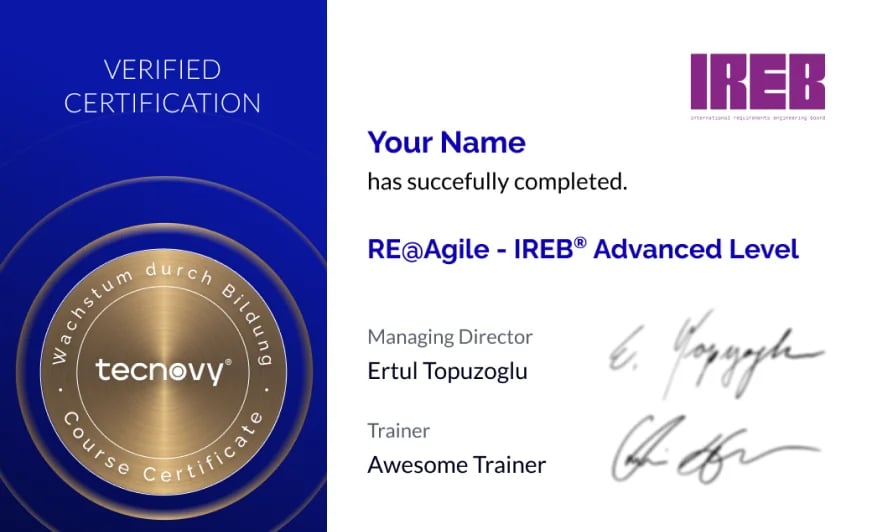
Sample of the tecnovy certificate of participation Open the Certificate Showroom tecnovy →

Offer scope

What the course price does not cover

Not included

  • Fee for the CPRE RE@Agile Practitioner examinationNot part of the seminar price; you add it as a separate item during registration, where the amount is shown.

Trainers

Rudolf Siebenhofer

Rudolf Siebenhofer

IREB®

Why tecnovy

What you get on top with us

02

Certificate Showroom

Get your certificate of participation and, if you have one, add your exam certificate from E-Learning. Fully automated, beautifully designed. Just for you, only at tecnovy.

03

Flexible Date Change

If you are not able to attend the course, you can rebook your training free of charge up to one week before the start of the training.

04

Attend Twice, Pay Once

You are welcome to visit the training course online again within a year as a refresher or exam preparation.

05

No Slideshow, Hands-On!

Promised: no PowerPoint marathon. We work in groups, tie theory to practice, and you get real project examples from our experienced trainers plus the exchange with like-minded people.

06

Learn from Experts

We always guarantee you the use of didactically and methodically first-class qualified trainers who draw their knowledge from training experience as well as professional practical and project experience.

FAQs
Frequently asked questions

01Which certificates admit me to the CPRE RE@Agile examination?
IREB accepts nine certificates by three routes: the CPRE RE@Agile Primer, the CPRE Foundation Level, or one of seven others, namely ScrumAlliance CSPO, Scrum.Inc RPO, Scrum.org PSPO, SAFe PM/PO, itedas.org Product Owner, Kanban University Team Kanban Practitioner and BCS Practitioner in Requirements Engineering. Without one of them the examination is not possible.
02What is the difference between the RE@Agile Primer and the RE@Agile Practitioner?
They are two separate certificates with their own syllabi and their own examinations. The Primer is the entry point with no admission rule and is examined with about 22 questions in 40 minutes. This tecnovy training leads to the Practitioner at Level 2: about 45 questions in 75 minutes, and the Primer is one of its three admission routes.
03What does the CPRE RE@Agile Practitioner examination look like?
The examination is about 45 multiple-choice questions in 75 minutes, and you pass from 70.00 percent of the available points. Each question is worth one to three points by difficulty, so the threshold applies to points rather than to the number of correct answers. Language dictionaries are the only aid permitted.
04When and where do I sit the examination after the tecnovy training?
The examination takes place at a certification body recognised by IREB, and IREB states it can be held either immediately after a training course or independently of one, for instance remotely or at an examination centre. IREB does not run examinations itself; it licenses certification bodies working to ISO/IEC 17024.
05Do I get extra time if the exam language is not my native language?
On written request, yes, from 75 to 90 minutes. IREB requires a justification and the request must be submitted together with the examination application. Unlike the Primer, you cannot hand it in up to the start of the exam, and the certification body is entitled to verify what you state.
06What happens if I do not pass the examination?
You can retake the CPRE RE@Agile examination twice with no waiting period; only after a third failed attempt does IREB require a year's pause. tecnovy gives you the second attempt as an online examination if your first sitting is within 24 hours of the training.
07Does the CPRE RE@Agile Practitioner certificate expire?
No. IREB describes the certificate as lifelong proof of competence and foresees no renewal. It attests to this one Level 2 module, not to the CPRE scheme as a whole.
08Is this the former IREB Advanced Level?
Yes. IREB split the former Advanced Level into the two levels Practitioner and Specialist. RE@Agile has been a Level 2 module since then, and older labels such as "CPRE AL" refer to the same stage. IREB itself now writes it consistently as "Level 2 | CPRE RE@Agile Practitioner".
09What materials do I get in the tecnovy RE@Agile training?
You get the seminar script and a photo record of every flipchart produced during the training. One thing that matters for preparation: IREB states that the exam questions refer not only to the syllabus but also to the RE@Agile Handbook, which IREB makes available through a free Cockpit account.
10Why book the CPRE RE@Agile training with tecnovy?
The RE@Agile syllabus sets aside 300 of its 975 minimum minutes explicitly for exercises, and tecnovy runs the training over three days so that share actually happens. tecnovy is a Swiss training provider based in Lenzburg in the canton of Aargau, and runs its IREB trainings online and on site, in German and English. Group discounts of up to 25 percent apply from three participants from one company.

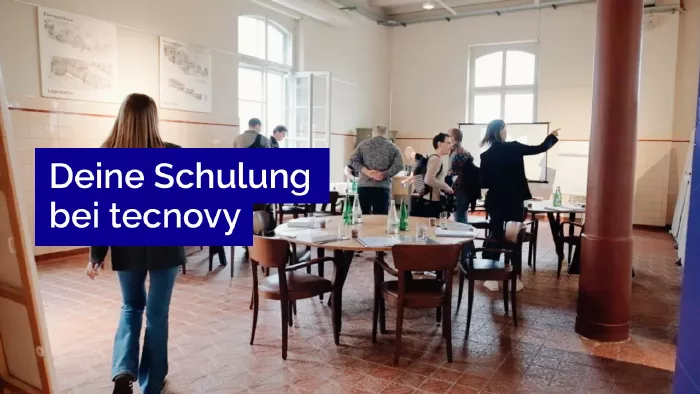
What does your training at tecnovy look like?

CPRE-RE@AgileCPRE RE@Agile Practitioner

No dates yet

We will let you know as soon as the next date is scheduled.

Feedback Form
What should we improve?

Tell us what we can do better next time.

Success
Error

© Copyright 2026, tecnovy GmbH, All Rights Reserved