

Typical roles
- You write requirements that reviewers regularly read in more than one way.
- You hand specifications to development or test and want to pre-empt the questions.
- You work on flows and states that plain prose can no longer describe cleanly.
Dates & booking
No public dates are scheduled yet.
New dates are published regularly. Join the waitlist or plan an in-house course for your team.
Fit
Formal prerequisites
Consider instead CPRE-FL Without the CPRE Foundation Level certificate IREB will not admit you to the Requirements Modeling examination, and the Foundation Level itself has no admission rule.
Curriculum
IREB syllabus 3.1.1 splits Requirements Modeling into five educational units totalling 1080 teaching minutes. They run from the fundamentals of modeling through context and information structures to the dynamic views, which take 435 minutes on their own, and close with scenario modeling.
This unit settles what you are modeling for, before the first diagram gets drawn.
Here you draw the line between system and environment, and justify where it goes.
270 minutes on which things the system knows about and how they relate.
The largest unit in the syllabus at 435 minutes, and the one with the most drawing.
The closing view is on interplay: who talks to whom, and in what order.
Outcome
You decide which view and which notation carries a given requirement best.
You model the system context with data flow diagrams and draw the system boundary cleanly.
You model information structures with classes, attributes, relationships and specialisation.
You identify use cases, specify them in text form and structure them into packages.
You represent flows and states in activity diagrams and state machines and check them for consistency.
You model scenarios with sequence and communication diagrams, down to the exceptional cases.
Once you pass, the certification body issues you the official certificate. IREB states that it does not expire and never needs renewing. It covers this one module: the four Practitioner modules are certified individually and there is no aggregate status.
Certification terms cpre.ireb.org ↗Examination
70%Pass mark
You book the examination together with your registration; the exam fee is not part of the seminar price. It takes place after the training at a certification body recognised by IREB, online or on site. If the exam language is not your native language, you can request a 15-minute extension.
Official examination rules cpre.ireb.org ↗Proof of attendance
≥80%attendance
The tecnovy certificate of participation records your attendance of the CPRE Requirements Modeling training, not a passed examination.
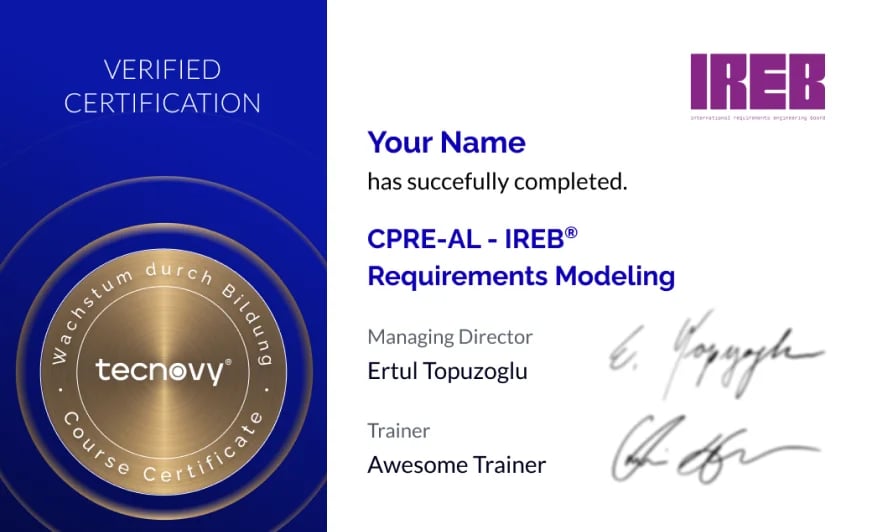 Open the Certificate Showroom tecnovy →
 Offer scope
Why tecnovy
01
Our pass rate is impressive. If you do not pass at the first attempt, we cover your second attempt (online exam), provided you sit it within 24 hours of the training.
02
Get your certificate of participation and, if you have one, add your exam certificate from E-Learning. Fully automated, beautifully designed. Just for you, only at tecnovy.
03
If you are not able to attend the course, you can rebook your training free of charge up to one week before the start of the training.
04
You are welcome to visit the training course online again within a year as a refresher or exam preparation.
05
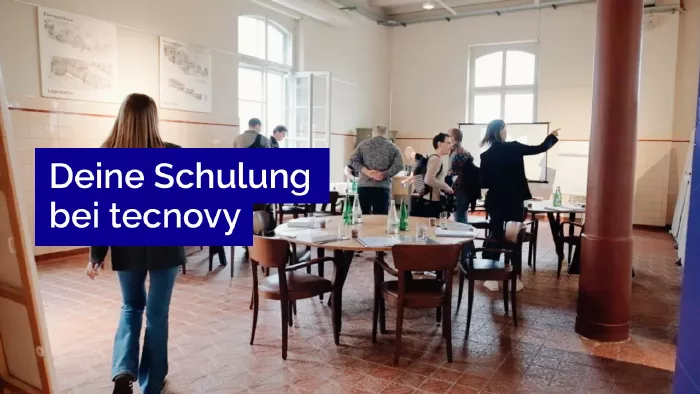
Promised: no PowerPoint marathon. We work in groups, tie theory to practice, and you get real project examples from our experienced trainers plus the exchange with like-minded people.
06
We always guarantee you the use of didactically and methodically first-class qualified trainers who draw their knowledge from training experience as well as professional practical and project experience.
FAQs
Tell us what we can do better next time.
© Copyright 2026, tecnovy GmbH, All Rights Reserved