
IT training across Europe - tecnovy makes you future-ready.

iSAQB® IMPROVE - Evolution and Improvement of Software Architectures

IMPROVE does not start on a greenfield, but on software that is already in production. You recognise technical debt and assess the current state with stakeholder interviews, ATAM and metrics for coupling, complexity and organisational structure. Every change is then weighed in OPEX, return on investment and break-even. You put refactoring, decoupling and application strangling into an order that holds across several releases.
iSAQB Accredited Training PartnerAttendance certificate4.8/5 on ProvenExpert

What this module delivers.

Analysing the current state takes 210 of IMPROVE's 1080 teaching minutes; assessment, planning and rebuilding take 570. The tecnovy training therefore turns your findings into a costed improvement plan rather than a list of defects.

How the training runs

Method
Current-state analysis, cost calculation and rebuild planning on a real example system
Basis
Official iSAQB curriculum 1.6.1, English only
Outcome
30 credit points: 20 methodical, 10 technical, no course exam

Dates & booking

Choose a date that fits

6 dates

  • EUREuro
  • USDUS Dollar
  • CHFSwiss Franc

Sessions with this symbol offer up to 25% group discount. Click “Details & Registration” to learn more.

30–02 Sep – Oct 2026CEST
Wed–Fri 09:00–17:00
Online training Group Discount Guaranteed
Time zone CEST
Language German
Trainer Dr. Gernot Starke
Seats Only 4 left

2,573 $

excl. VAT
04–06 Nov 2026CET
Wed–Fri 09:00–17:00
Germany Group Discount
City Frankfurt
Language German
Trainer Johannes Hochrainer
Seats 5+ seats
10% Earlybird Discount

2,866 $−287 $2,579 $

excl. VAT
24–26 Nov 2026CET
Tue–Thu 09:00–17:00
Germany Group Discount
City Hamburg
Language German
Seats Only 5 left
10% Earlybird Discount

2,866 $−287 $2,579 $

excl. VAT
22–24 Jun 2027CEST
Tue–Thu 09:00–17:00
Germany Group Discount
City Hamburg
Language German
Seats Only 5 left
10% Earlybird Discount

2,866 $−287 $2,579 $

excl. VAT
28–30 Sep 2027CEST
Tue–Thu 09:00–17:00
Online training Group Discount
Time zone CEST
Language German
Trainer Dr. Gernot Starke
Seats 5+ seats
10% Earlybird Discount

2,573 $−257 $2,316 $

excl. VAT
23–25 Nov 2027CET
Tue–Thu 09:00–17:00
Germany Group Discount
City Hamburg
Language German
Seats Only 5 left
10% Earlybird Discount

2,866 $−287 $2,579 $

excl. VAT

Fit

Who this module is designed for

Typical roles

  • You own a system that has been running for years and still has to grow.
  • You have to justify a rebuild to the people who hold the budget.
  • You decide between improving step by step and rebuilding from scratch.

Prerequisites

No prerequisites

You can start right away. Helpful: hands-on experience maintaining and evolving existing systems, working with the source code of medium to large systems, some experience with refactorings and code metrics.

Consider instead ARCEVAL Runs evaluation procedures such as ATAM, CBAM and DCAR across 570 minutes and stops at the findings, without planning what they cost or how they get implemented.

Curriculum

CPSA® IMPROVE Course in Detail

Curriculum 1.6.1 splits IMPROVE into six parts across 1080 teaching minutes. It starts at technical debt, runs through current-state analysis and economic assessment to long-term planning and the rebuild techniques themselves, and closes on a real example system. The official document is published in English only.

01Foundations of Improvement and Evolution

The first part settles what the rest of the training is talking about.

  • Change, evolution and maintenance as distinct jobs
  • Recognising technical debt and classifying it by cause
  • Reasons for change: features, quality requirements, context shifts, cost pressure
  • Ad-hoc change, refactoring, re-architecting and rewriting compared
02Analyse Current State

This part keeps finding problems strictly apart from solving them.

  • Stakeholder analysis and interviews as a source of weaknesses
  • Contextual analysis: system boundaries and external interfaces
  • Qualitative procedures including ATAM
  • Quantitative procedures: code, organisational and runtime metrics
03Estimate and Assess Problems and Solutions

Here every finding gets a price and every solution a counter-value.

  • Direct costs, capital expenditure (CAPEX) and operating expenditure (OPEX)
  • Run-the-company against develop-the-company
  • Return on investment, break-even and depreciation
  • Estimating as an interval rather than a single figure: best, average, worst case
04Long-Term Planning of Improvements

Individual measures become a strategy spanning several releases.

  • Documenting assessed problems and solutions explicitly
  • Clusters, dependencies and m:n relations between problems and approaches
  • Application strangling and encapsulating risk as a black box
  • Weighing a rewrite against continuous improvement
05Typical Approaches to Improvement

At 360 minutes this is the largest part of the curriculum: the work itself.

  • Semantics-preserving refactorings and how they relate to technical debt
  • Reducing coupling: modularisation, dependency injection, adapter, wrapper, gateway
  • Clean-code principles for comprehensible source code
  • Automated testing, continuous integration and continuous delivery
06Examples of Improvement

To close, one real system runs through the whole cycle once.

  • System scope, quality goals and usage scenarios of the example
  • The problems found in it and how they were assessed
  • Short, mid and long-term planning on the concrete case
  • Stated by the curriculum to be not examinable
Official syllabus(external link)

Outcome

What you will be able to do afterwards

  1. 01

    You classify technical debt and separate it from new functional requirements.

  2. 02

    You establish the current state from stakeholder interviews, documentation and runtime measurements.

  3. 03

    You read structural weaknesses out of metrics for coupling, complexity and cohesion.

  4. 04

    You put a figure on problems and solutions in CAPEX, OPEX and return on investment.

  5. 05

    You estimate effort as an interval with best, average and worst case instead of a single figure.

  6. 06

    You group individual findings into an improvement strategy spanning several releases.

  7. 07

    You retire legacy systems through application strangling and encapsulate risks as a black box.

  8. 08

    You reduce coupling through refactoring, dependency injection, adapters and gateways.

Credit points toward CPSA-A

Methodical competence
20
Technical competence
10
Communicative competence
0

30 of 70 points toward CPSA-A admission

Certificate of participation

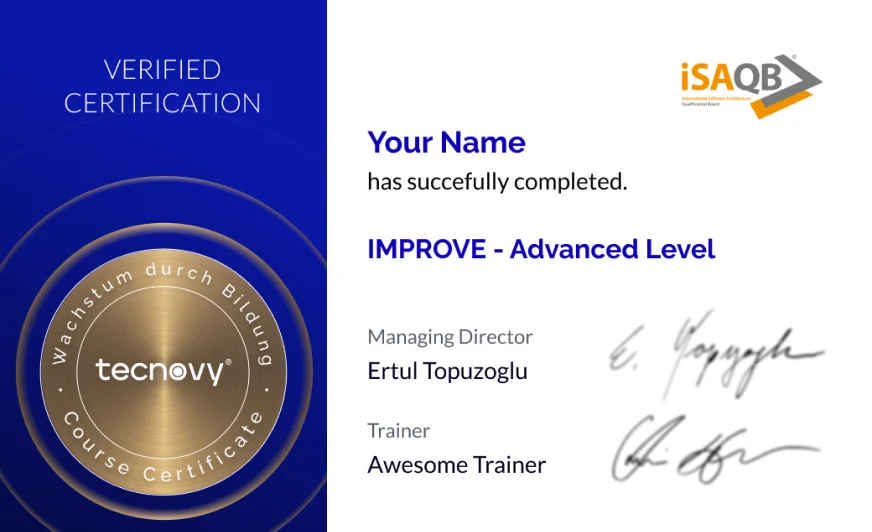
The tecnovy certificate of participation records your attendance of the IMPROVE training, not a passed examination.

Open the Certificate Showroom tecnovy →

≥80%attendance

Why tecnovy

What you get on top with us

02

Certificate Showroom

Get your certificate of participation and, if you have one, add your exam certificate from E-Learning. Fully automated, beautifully designed. Just for you, only at tecnovy.

03

No Slideshow, Hands-On!

Promised: no PowerPoint marathon. We work in groups, tie theory to practice, and you get real project examples from our experienced trainers plus the exchange with like-minded people.

04

Attend Twice, Pay Once

You are welcome to attend the training online again within a year as a refresher.

05

Learn from Authors

Your instructors are not just trainers, but the authors of the preparatory literature for the iSAQB CPSA-F certification exam and at the same time an active member of the iSAQB Foundation group.

06

Flexible Date Change

If you are not able to attend the course, you can rebook your training free of charge up to one week before the start of the training.

Experiences

What participants say

I took the iSAQB IMPROVE course because in most larger companies there is not only new development; the greater part of the software already exists. On top of that, the course was taught by Dr. Gernot Starke, a leading authority in the field. The course itself was very interesting, instructive and a long way from death by PowerPoint
Urs Blum TechLead | CSS Versicherungen

FAQs

Frequently asked questions

01Do I need CPSA-F to attend the tecnovy IMPROVE training?
No. The iSAQB curriculum for the IMPROVE module lists practical experience only as a prerequisite, not a certification. For the later CPSA-A certification, CPSA-F is mandatory.
02Is there an IMPROVE examination?
No. There is no examination for the IMPROVE module. The tecnovy IMPROVE training earns you 30 credit points and a certificate of participation; the assessment comes later on the path to CPSA-A certification, and it covers all modules together.
03How many credit points does IMPROVE carry?
The tecnovy IMPROVE training carries 30 credit points: 20 methodical and 10 technical. IMPROVE awards no communicative points, which matters for your planning: CPSA-A admission requires 70 points in total and at least 10 in each of the three areas of competence. The iSAQB may re-evaluate point allocations every 12 months; these figures are as of August 2026.
04How does the CPSA-A certification work?
CPSA-A certification consists of a written assignment. Two examiners recognised by the iSAQB assess it, and you then defend it in discussion with them. You can take it in German or English, and tecnovy is glad to help if you have questions about the process.
05How long is the IMPROVE training?
The tecnovy IMPROVE training runs for three days. The iSAQB curriculum sets the same minimum of three days and spreads 1080 teaching minutes, which is 18 hours, across six parts.
06What is the difference between IMPROVE and ARCEVAL?
ARCEVAL stops at the findings, IMPROVE starts there. Across two days and 570 teaching minutes, ARCEVAL runs evaluation procedures such as ATAM, CBAM, DCAR and ARID and delivers risks, sensitivity points and tradeoffs, for which it awards 20 methodical credit points. The tecnovy IMPROVE training takes three days and 1080 minutes, 570 of them on economic assessment, improvement planning and rebuild techniques, and it awards 20 methodical plus 10 technical points.
07Does IMPROVE cover the decision between rebuilding and rewriting?
Yes, it is a learning goal of its own in the curriculum's fourth part. In the tecnovy IMPROVE training you set a complete rewrite against continuous improvement and weigh both with the cost model from the third part. Application strangling and incremental replacement are the techniques for planning the route in between.
08Does the IMPROVE training work on a real system?
Yes. The curriculum requires at least one real example in every licensed IMPROVE training and reserves 180 of the 1080 teaching minutes for it. In the tecnovy training you follow that example the whole way, from system scope and quality goals through the problems found to the measures implemented; the curriculum states that this part is not examinable.
09Do I get the flipcharts from the IMPROVE training?
Yes. The analyses, cost calculations and refactoring plans produced on the flipcharts in the tecnovy IMPROVE training reach you afterwards as a photo protocol.
IMPROVEIMPROVE - Evolution and Improvement of Software Architectures

Ready for the next step?

Choose a public date or plan the course for your team.

Feedback Form
What should we improve?

Tell us what we can do better next time.

Success
Error

© Copyright 2026, tecnovy GmbH, All Rights Reserved