
IT training across Europe - tecnovy makes you future-ready.

iSAQB® FLEX - Flexible Architecture Models

Microservices, self-contained systems or a modulith: the tecnovy FLEX training gives you the criteria to justify that decision instead of inheriting it. You assess how tightly the parts couple in source code, in compiled artefacts and over the network. Where a module boundary runs is never a purely technical question. Conway's Law and Team Topologies explain why a system ends up mirroring the teams that build it.
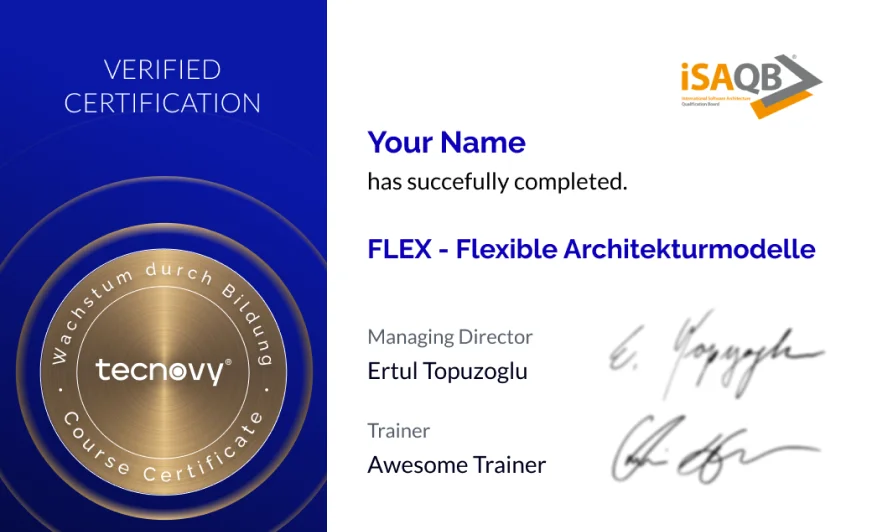
iSAQB Accredited Training PartnerAttendance certificate4.8/5 on ProvenExpert

What this module delivers.

The chain FLEX covers runs from the module cut through to live operation. The tecnovy training walks you through integration protocols, consistency models and resilience patterns, and it makes the cost of each of those decisions visible.

How the training runs

Method
Compare architecture options, work through operating models
Outcome
30 credit points: 10 methodical, 20 technical, no course exam

Dates & booking

Choose a date that fits

2 dates

  • EUREuro
  • USDUS Dollar
  • CHFSwiss Franc

Sessions with this symbol offer up to 25% group discount. Click “Details & Registration” to learn more.

02–04 Nov 2026CET
Mon–Wed 09:00–17:00
Online training Group Discount Guaranteed
Time zone CET
Language German
Seats Only 4 left
10% Earlybird Discount

2,569 $−257 $2,312 $

excl. VAT
01–03 Dec 2026CET
Tue–Thu 09:00–17:00
Online training Group Discount Guaranteed
Time zone CET
Language English
Trainer Marc-André Bumann
Seats 5+ seats
10% Earlybird Discount

2,569 $−257 $2,312 $

excl. VAT

Fit

Who this module is designed for

Typical roles

  • You cut a system into modules and own where the boundaries fall.
  • You decide whether services talk to each other synchronously or through events.
  • You operate distributed services and carry the consequences of your design decisions.

Prerequisites

No prerequisites

You can start right away. Helpful: hands-on experience with distributed systems and their protocols, experience with functional and technical modularisation, some exposure to deployment and operations processes.

Consider instead CLOUDINFRA Gives containers, infrastructure and telemetry the whole module, where FLEX covers runtime platforms in 90 of its 600 minutes.

Curriculum

CPSA® FLEX Course in Detail

Curriculum 2024.1 splits FLEX into six parts across 600 teaching minutes. It starts at the drivers behind flexible systems and runs through modularisation, organisational structure and integration to deployment and operation. Every part ends at a decision rather than at a technology.

01Why approach Flexible Systems

This part settles what the flexibility is actually being paid for.

  • Availability, reliability and time-to-market as the real drivers
  • Microservices, self-contained systems, moduliths and monoliths compared
  • Four kinds of isolation: devtime, runtime, deployment and team
  • What DevOps and continuous delivery change about the architecture
02Modularization of Systems of Systems

Here you decide where the boundaries between the parts actually run.

  • Strategic design and bounded contexts as the criterion for a cut
  • The Parnas criteria as a test for a cut, from the reading list of the curriculum
  • Coupling at the level of source code, build artefacts and network protocol
  • Cost and benefit of competing modularisation strategies
03Software Modules and the Organization

This part covers the half of the cut that is not written in the code.

  • Conway's law and what it means for the module boundary
  • Team topologies and context mapping between the teams
  • Socio-technical architecture: system and organisation as one design
  • Macro against micro architecture: which decision is taken where
04Integration Methods & Protocols

The longest part of the curriculum: how the pieces talk to each other.

  • Integration in the frontend, in the middle tier (REST, RPC, messaging) and through the database
  • Anti-corruption layer, shared kernel and customer/supplier as integration patterns
  • The CAP theorem, ACID against BASE and what it costs consistency
  • Circuit breakers, bulkheads and graceful degradation against cascading failure
05Deployment & Runtime/Platform Methods

This part is about getting a new version live without an outage.

  • Continuous deployment and what the CI/CD pipeline is for
  • IaaS, PaaS, CaaS and FaaS, and what each of them is actually good for
  • Blue-green, canary releases and rolling updates without downtime
  • Immutable infrastructure, infrastructure as code and containerisation
06Service Operation Models

To close, you plan operations before the first outage plans them for you. The curriculum makes observability binding here and lists the deeper topics below as optional.

  • Assembling observability from metrics, logs and traces
  • MTBF against MTTR, and what service level objectives make of them
  • Incident management and disaster recovery along RTO and RPO
  • Chaos engineering: triggering failures deliberately in order to understand them
Official syllabus(external link)

Outcome

What you will be able to do afterwards

  1. 01

    You justify the choice between microservices, self-contained systems and a modulith by the isolation actually needed.

  2. 02

    You cut systems along bounded contexts and test the cut against coupling, degree of isolation and deployment independence.

  3. 03

    You factor team and organisational structure into the module cut and argue it through Conway's law.

  4. 04

    You choose between REST, RPC and messaging, and decide between ACID and BASE.

  5. 05

    You guard system boundaries with circuit breakers, bulkheads and graceful degradation.

  6. 06

    You plan zero-downtime deployments using blue-green, canary releases or rolling updates.

  7. 07

    You assemble observability from metrics, logs and traces, and make failures traceable through it.

Credit points toward CPSA-A

Methodical competence
10
Technical competence
20
Communicative competence
0

30 of 70 points toward CPSA-A admission

Why tecnovy

What you get on top with us

02

Certificate Showroom

Get your certificate of participation and, if you have one, add your exam certificate from E-Learning. Fully automated, beautifully designed. Just for you, only at tecnovy.

03

No Slideshow, Hands-On!

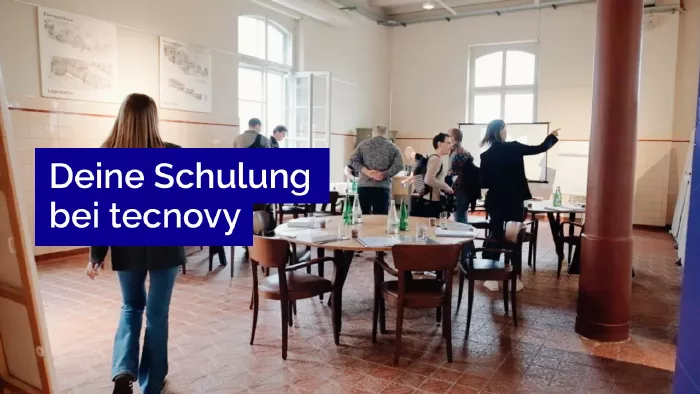
Promised: no PowerPoint marathon. We work in groups, tie theory to practice, and you get real project examples from our experienced trainers plus the exchange with like-minded people.

04

Attend Twice, Pay Once

You are welcome to attend the training online again within a year as a refresher.

05

Learn from Experts

We always guarantee you the use of didactically and methodically first-class qualified trainers who draw their knowledge from training experience as well as professional practical and project experience.

06

Flexible Date Change

If you are not able to attend the course, you can rebook your training free of charge up to one week before the start of the training.

Experiences

What participants say

tecnovy verfügt im deutschsprachigen Raum über sehr erfahrene Trainer. Das "Corona-bedingte Distanzlernen" wurde prima umgesetzt. Geeignete Collaborationsplattformen wie z.B. Mural kamen zum Einsatz und wurden in den Gruppenarbeiten sinnvoll eingesetzt. Die Zusammenarbeit mit tecnovy ist einwandfrei. Die besuchten ISAQB Kurse Soft Skills und Flex sind sehr zu empfehlen.
Z. Tretinjak Solution Architect | Helvetia Versicherungen

FAQs

Frequently asked questions

01Do I need CPSA-F to attend the tecnovy FLEX training?
No. The iSAQB curriculum for the FLEX module phrases its prerequisites as recommendations: fundamentals of describing architectures at CPSA-F level, and hands-on experience with distributed systems. No certification is required. For the later CPSA-A certification, CPSA-F is mandatory.
02Is there a FLEX examination?
No. There is no examination for the FLEX module. The tecnovy FLEX training earns you 30 credit points and a certificate of participation; the assessment comes later on the path to CPSA-A certification, and it covers all modules together.
03How many credit points does FLEX carry?
The tecnovy FLEX training carries 30 credit points: 20 technical and 10 methodical. FLEX awards no communicative points, which matters for your planning: CPSA-A admission requires 70 points in total and at least 10 in each of the three areas of competence. The iSAQB may re-evaluate point allocations every 12 months; these figures are as of August 2026.
04How does the CPSA-A certification work?
CPSA-A certification consists of a written assignment. Two examiners recognised by the iSAQB assess it, and you then defend it in discussion with them. You can take it in German or English, and tecnovy is glad to help if you have questions about the process.
05How long is the FLEX training?
The tecnovy FLEX training runs for three days. The iSAQB curriculum sets a minimum of three days and 600 teaching minutes, which is ten hours; tecnovy uses the three days in full and so goes well beyond that minimum.
06What is the difference between FLEX and CLOUDINFRA?
FLEX decides how a system is cut, integrated and operated, and spends 90 of its 600 teaching minutes on runtime platforms. CLOUDINFRA lives exactly there: containers, persistence, resilience, infrastructure automation and telemetry fill the whole module. If you build the platform itself, CLOUDINFRA is the right module; if you decide the cut and the integration, FLEX is.
07Why does an architecture module cover team structure?
Because the curriculum devotes a part to it. FLEX spends 90 minutes on Conway's law, team topologies and context mapping, because the way an architecture is cut and the way an organisation is cut force each other. A module boundary the team structure does not support will not survive contact with practice.
08Which book belongs to the FLEX seminar?
The tecnovy FLEX training works with "Softwarearchitekturen dokumentieren und kommunizieren" by Stefan Zörner, which every participant receives as an eBook within the seminar price. It covers how to record architecture decisions so that a team can still follow them later. The book is written in German only.
FLEXFLEX - Flexible Architecture Models

Ready for the next step?

Choose a public date or plan the course for your team.

Feedback Form
What should we improve?

Tell us what we can do better next time.

Success
Error

© Copyright 2026, tecnovy GmbH, All Rights Reserved