IT training across Europe - tecnovy makes you future-ready.

tecnovy AI Suite

LLMOps: operating generative AI

Your team's CI/CD pipeline already builds, tests and ships code automatically on every change. In the LLMOps training you send prompts, model versions and configuration through that same pipeline. Regression tests run on every change, and a quality threshold decides whether a release goes ahead. You then roll out new versions step by step, decide which measurements trigger an alert, and set budgets for usage.
Attendance certificate4.8/5 on ProvenExpert

What this module delivers.

Whether a changed prompt or a new model may go live is something you tie to tests against agreed quality thresholds in tecnovy's LLMOps training. Alerts, incident procedures and budgets follow, for ML, DevOps and platform engineers running LLM applications.

How the training runs

Method
Exercises on an example application with its CI/CD pipeline and monitoring
Basis
tecnovy curriculum for operating LLM applications
Outcome
tecnovy certificate of participation, no examination

Dates & booking

Choose a date that fits

No public dates are scheduled yet.

New dates are published regularly. Join the waitlist or plan an in-house course for your team.

Request in-house training

Fit

Who this module is designed for

Typical roles

  • You look after the CI/CD pipelines and platforms your applications go into production through.
  • You run an LLM application or are about to take over running one.
  • You are responsible for the quality and cost of AI services in your company.

Prerequisites

No prerequisites

You can start right away. What you need: experience with LLM applications, CI/CD basics, container basics.

Consider instead AI Evaluation If your team mainly needs to measure and monitor quality: you build evaluation datasets, combine automated and human assessment, and set up tracing and alerts.

Curriculum

LLMOps in Detail

Five parts on one example application with its own CI/CD pipeline: you place LLMOps, version and roll out, make evaluations a release step, define alerts and incident procedures, and control cost. Building evaluation datasets and using tracing in depth are covered in AI Evaluation & Observability.

01What makes LLMOps different

This part sets out what changes in operations once a language model is part of the application.

  • Differences from DevOps
  • Differences from classic MLOps
  • The lifecycle of an LLM application
02Versioning and releases

Here every change to a prompt, model or configuration gets a version and a route into production.

  • Versioning prompts, models and configuration
  • Planning model switches
  • Step-by-step rollouts: a new version first for a share of requests
03Evaluation in the pipeline

In this part evaluation becomes the pipeline step that decides on a release.

  • Regression tests: checking whether a change makes previously good results worse
  • Tests for prompt changes and for model switches
  • Quality thresholds as the release criterion
04Monitoring and observability

In production you decide which signals count and what happens when they turn.

  • Tracing (recording the steps of a request), metrics and user feedback as signals
  • Drift: inputs or answers that change gradually
  • Outages
  • Incident procedures: who responds and in which steps
05Cost and performance

Finally you control what a request costs and how long it takes.

  • Caching: not recomputing recurring requests or prompt parts
  • Routing between models, such as sending simple requests to a smaller model
  • Batch processing for requests that need no immediate answer
  • Budgets and limits

Outcome

What you will be able to do afterwards

  1. 01

    You map the stages in the lifecycle of an LLM application and distinguish LLMOps from DevOps and classic MLOps.

  2. 02

    You version prompts, models and configuration and manage releases through those versions.

  3. 03

    You plan model switches and roll out new versions step by step, first for a share of requests.

  4. 04

    You build regression tests for prompts and models into the CI/CD pipeline and make a quality threshold the release criterion.

  5. 05

    You decide at which values for quality, availability and usage an alert is triggered.

  6. 06

    You set up incident procedures for outages and for drift, meaning inputs or answers that change gradually.

  7. 07

    You apply caching, routing between models and batch processing and measure their effect on cost and latency.

  8. 08

    You set budgets and limits for the usage of an AI service.

Offer scope

What is included

Included

  • Example pipeline and monitoring setupYou receive the pipeline and the monitoring of the example application you work with in the course.

Why tecnovy

What you get on top with us

02

Certificate Showroom

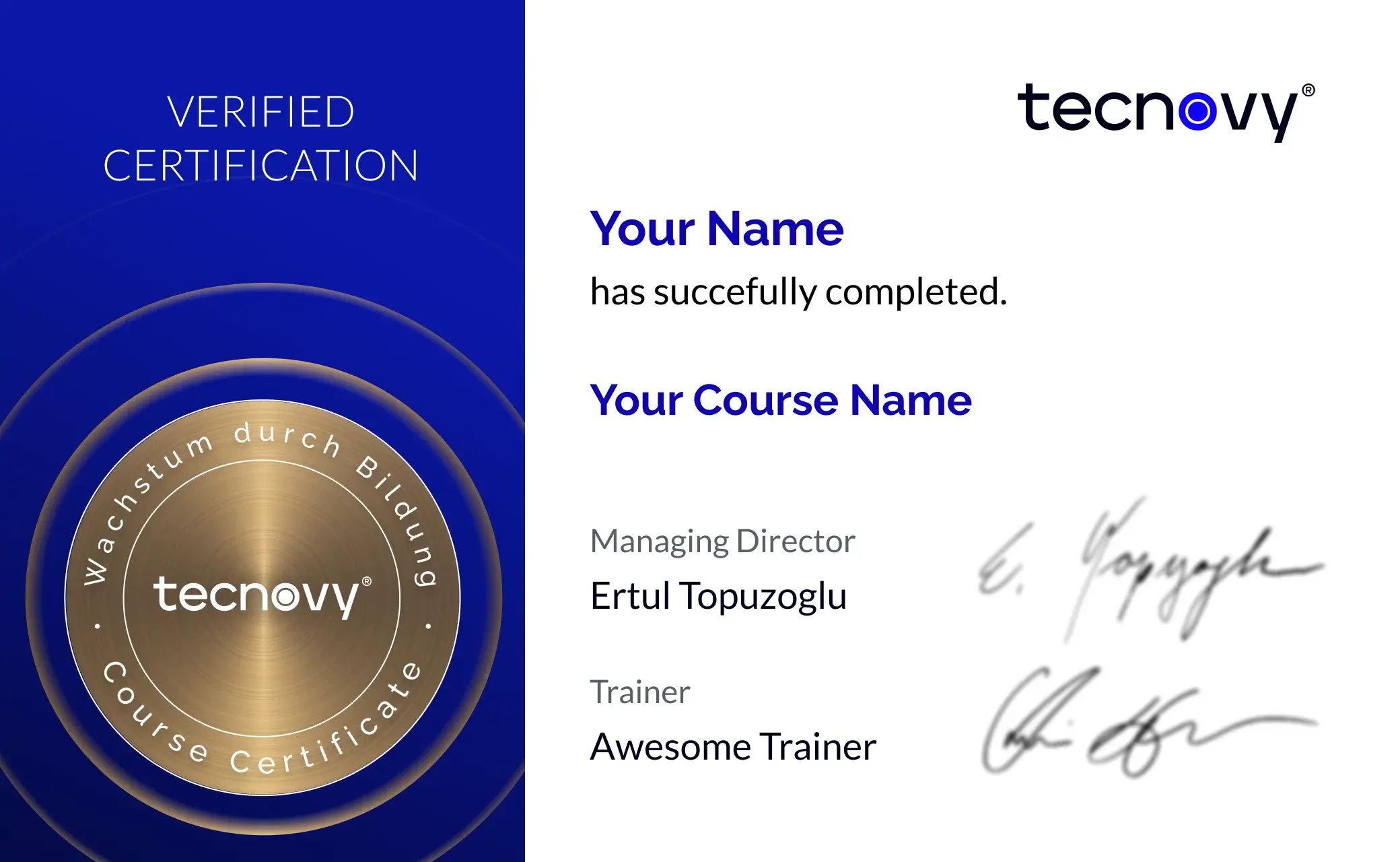
Get your certificate of participation and, if you have one, add your exam certificate from E-Learning. Fully automated, beautifully designed. Just for you, only at tecnovy.

03

Flexible Date Change

If you are not able to attend the course, you can rebook your training free of charge up to one week before the start of the training.

04

Attend Twice, Pay Once

You are welcome to attend the training online again within a year as a refresher.

05

Learn from Experts

We always guarantee you the use of didactically and methodically first-class qualified trainers who draw their knowledge from training experience as well as professional practical and project experience.

FAQs

Frequently asked questions

01What is the difference between LLMOps and MLOps?
MLOps runs models a team trains itself. LLMOps, as tecnovy's LLMOps training covers it, runs applications built on large language models, often from external providers, where prompts, model versions and evaluation are at the centre. For classic MLOps, tecnovy offers its MLOps training.
02Does LLMOps make an AI application reliable?
No. No process guarantees that a language model always answers correctly. In tecnovy's LLMOps training you set things up so that changes are tested before release, measured in production and handled by an agreed procedure when problems occur.
03How does the LLMOps training differ from AI Evaluation & Observability?
tecnovy's LLMOps training uses evaluations as a release step in the pipeline and also covers versioning, rollouts, incidents and cost. AI Evaluation & Observability goes deeper into building evaluation datasets, scoring answers automatically and by people, and using tracing in production. It fits as the next step if you want to measure quality more precisely.
04Does the LLMOps training teach me to build and deploy an AI application?
No, tecnovy's LLMOps training starts from an existing LLM application: how changes to it are tested, rolled out, monitored and kept within cost. You build a company application with sign-in, roles and deployment in the tecnovy course Building Enterprise AI Apps.
05Why does a team need to plan model switches?
Because a model does not have to stay available: Anthropic, for example, announces the retirement of publicly released models on its own platforms at least 60 days ahead, after which requests fail (as of November 2026). Amazon Bedrock and the Google-managed offering on Google Cloud set their own dates for this. In tecnovy's LLMOps training you therefore test a new model in the pipeline before rolling it out step by step.
06How do you control the cost of an LLM application in the LLMOps training?
With four levers: caching, routing between models, batch processing, and budgets and limits, whose effect you measure in tecnovy's LLMOps training. One example of batch processing: at Anthropic the Message Batches API is charged at 50 percent of standard API prices, and requests not processed within 24 hours expire (as of November 2026).
07Which tools does the LLMOps training use?
tecnovy's LLMOps training uses widely used open-source tools for tracing and evaluation and is tied to no particular vendor. The focus is on the procedures, from versioning to cost control, which you can carry over to other tools.
08What do the LLMOps training exercises need technically?
The exercises in tecnovy's LLMOps training run on an example application that calls a language model through an API, and on a pipeline that runs tests on every change. That requires API access to a model provider with a key, and every test run makes further model calls.
09Does the LLMOps training end with an examination?
No, the LLMOps training is a tecnovy course with no examination and no certification. With at least 80% attendance you receive the tecnovy certificate of participation.


What does your training at tecnovy look like?

LLMOpsLLMOps: operating generative AI

No dates yet

We will let you know as soon as the next date is scheduled.

Feedback Form
What should we improve?

Tell us what we can do better next time.

Success
Error

© Copyright 2026, tecnovy GmbH, All Rights Reserved