Retrieval Augmented Generation for Company Knowledge
Asked about the travel expense rule, the application answers in two sentences and points to "Travel policy, section 3.2". A language model on its own does not know your documents, so it knows no passage in them either. Retrieval augmented generation (RAG) first finds the matching passages and hands them to the model with the question. In this course such an application takes shape in Python, from the PDF to the answer with its reference.
Attendance certificate4.8/5 on ProvenExpert
What this module delivers.
You already write Python, and in the tecnovy course RAG Engineering you build an application that answers from documents and names the passage it used, with the separate search and answer checks your team needs before a knowledge assistant launches.
How the training runs
Method
Step-by-step build of a RAG application in Python with sample documents
Basis
tecnovy curriculum using a freely available vector database
Outcome
No examination, tecnovy certificate of participation
Dates & booking
Choose a date that fits
No public dates are scheduled yet.
New dates are published regularly. Join the waitlist or plan an in-house course for your team.
You build chatbots, assistants or search features for internal knowledge.
You work as a data scientist or ML engineer and need to connect language models to company documents.
You are responsible for knowledge management and want to see how a RAG system works technically.
Prerequisites
No prerequisites
You can start right away. What you need: working knowledge of Python. Helpful: experience with language model APIs from LLM Engineering or your own work.
Consider insteadLLM EngineeringWithout experience of language model APIs, that course lays the groundwork: model APIs, prompt design, structured outputs and tool calls in Python.
Curriculum
RAG Engineering in Detail
The path of a question through a RAG application sets the order: from the decision for RAG through preparation and search to an answer that cites its passage. The last part checks quality and plans operation. You build the application in Python with sample documents throughout.
01How RAG works
This part settles when RAG is worth it and how its three stages fit together.
When RAG fits, and when fine-tuning or a long context window fits better
The architecture in three stages: preparation, search, answer
The path of a question through the application you build in the following parts
02Preparing documents
Every answer depends on which text makes it into the search index at all.
Extracting text from PDFs, Office files and web pages
Chunking: splitting documents into passages that can be found one by one
Metadata such as document and section, which later becomes the cited passage
03Embeddings and vector search
This is where the search takes shape that finds the right passages for a question.
Embeddings: text as a number vector, with similar meanings close together
Choosing an embedding model
Vector databases: storing passages and querying them by similarity
Hybrid search: vector search combined with keyword search
04Generating answers
The model receives the passages found and is told to answer from them alone.
Prompts for source-grounded answers
Source references that point to document and section
A rule for questions the documents say nothing about
05Quality and operation
Finally you check what the application delivers and plan how it runs.
Rating search and answers separately
Checking whether the cited passage supports the answer
Access rights and keeping the document collection up to date
Data protection: which data goes to which model provider
Outcome
What you will be able to do afterwards
01
You decide whether RAG, fine-tuning (retraining a model) or a long context window (more text per request) fits a use case.
02
You extract text from PDFs, Office files and web pages and split it into passages (chunks) with metadata.
03
You choose an embedding model, which turns text into number vectors, and build vector search on top of it.
04
You combine vector search and keyword search into hybrid search.
05
You design prompts for answers that cite their passage, plus a rule for questions the documents do not answer.
06
You check whether the cited passage actually supports the answer.
07
You rate search hits and answers separately instead of looking only at the end result.
08
You plan access rights and how the document collection stays up to date in operation.
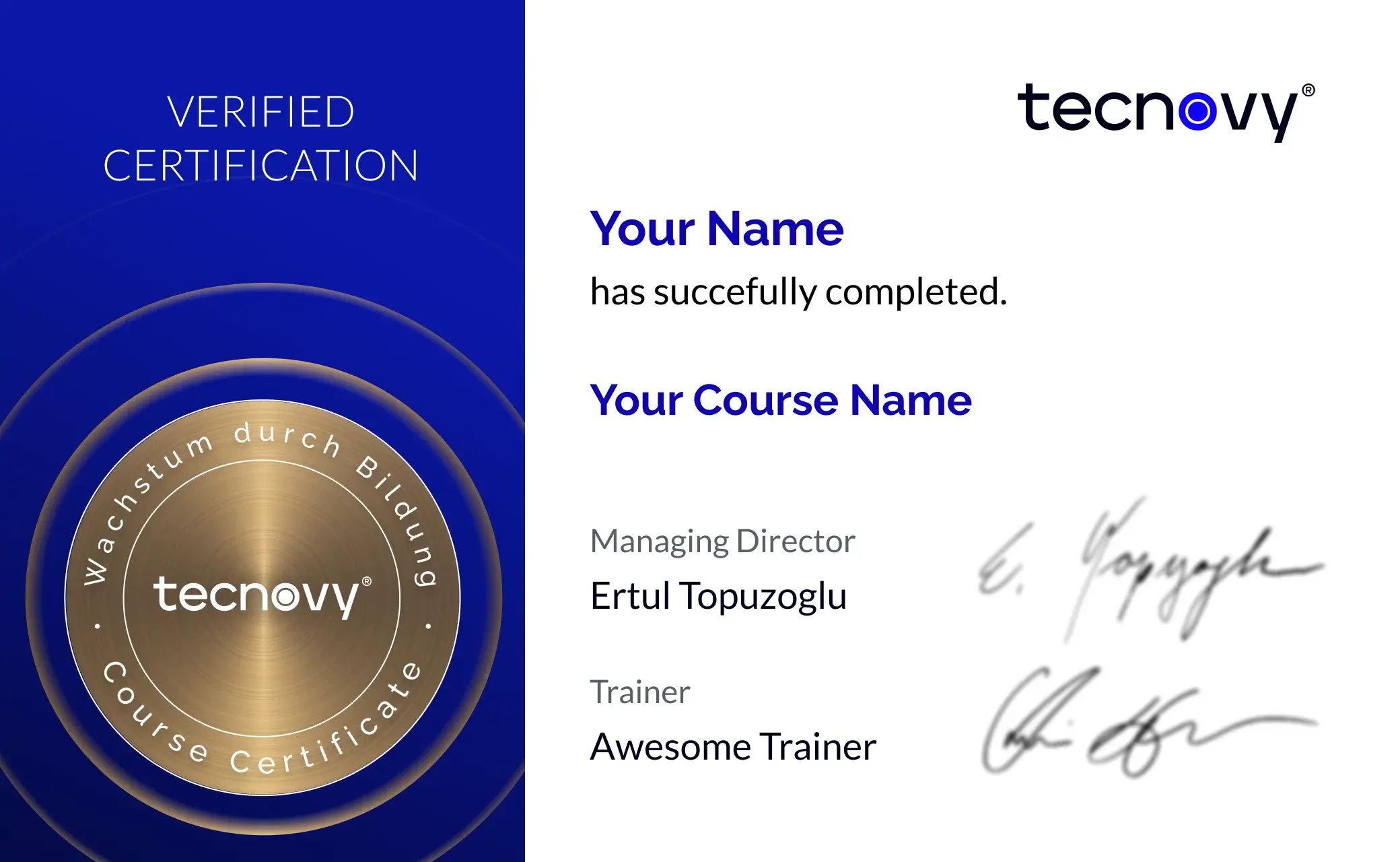
tecnovy Teilnahmezertifikat
Confirms your attendance and the curriculum covered in the training. Issued by tecnovy, shareable on LinkedIn.
Project repository with sample documentsIt is where you build the RAG application step by step during the course.
RAG Engineering
Why tecnovy
What you get on top with us
01
No Slideshow, Hands-On!
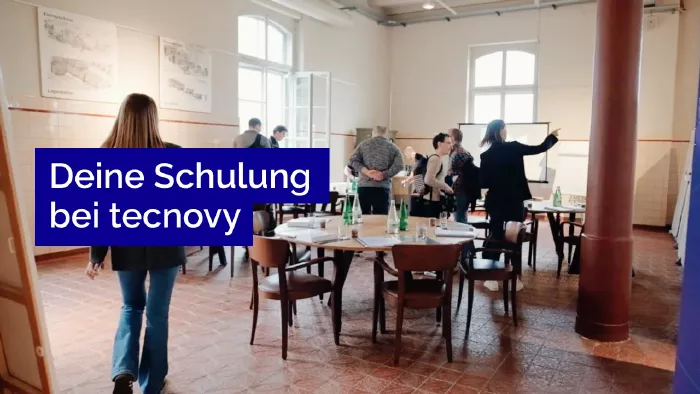
Promised: no PowerPoint marathon. We work in groups, tie theory to practice, and you get real project examples from our experienced trainers plus the exchange with like-minded people.
02
Certificate Showroom
Get your certificate of participation and, if you have one, add your exam certificate from E-Learning. Fully automated, beautifully designed. Just for you, only at tecnovy.
03
Flexible Date Change
If you are not able to attend the course, you can rebook your training free of charge up to one week before the start of the training.
04
Attend Twice, Pay Once
You are welcome to attend the training online again within a year as a refresher.
05
Learn from Experts
We always guarantee you the use of didactically and methodically first-class qualified trainers who draw their knowledge from training experience as well as professional practical and project experience.
FAQs
Frequently asked questions
01What is retrieval augmented generation?
Retrieval augmented generation (RAG) connects a search to a language model: for each question the system finds matching passages in your documents and passes them to the model as context. In the tecnovy course RAG Engineering you build this chain yourself in Python, from document preparation to an answer that cites its passage.
02When does RAG fit better than fine-tuning or a long context window?
RAG fits when documents change often, when every answer should name its source, or when a collection is too large for the context window, the amount of text a model processes per request. In the tecnovy course RAG Engineering you weigh RAG, fine-tuning and long context against each other in the first part.
03Which vector database does the course use?
The tecnovy course RAG Engineering works with a freely available vector database, a store that keeps text passages as embeddings and searches them by similarity. You compare common alternatives in the course, so you can justify the choice for your own project.
04What do the exercises need technically?
The exercises in the tecnovy course RAG Engineering run in Python and call language models through a model provider's API. They need a Python environment and access to such an API; the sample documents are in the project repository.
05Can a RAG system use confidential or personal data?
Whether a RAG system may use confidential or personal data is decided by your company's policy, not by the technology. In the tecnovy course RAG Engineering you learn to check which passages go to which model provider, who may see which documents, and how changes and deletions reach the search index.
06Does a RAG system always answer correctly?
No. Even with RAG a model can miss a relevant passage, cite the wrong one or add something the source does not say. That is why in the tecnovy course RAG Engineering you rate search and answer separately and check whether the cited passage supports the answer.
07Do I need to take LLM Engineering first?
No, the tecnovy course RAG Engineering needs working Python, and experience with language model APIs is recommended. If you lack it, the LLM Engineering course lays the groundwork: model APIs, prompt design, structured outputs and tool calls.
08Is there an examination at the end?
No. The tecnovy course RAG Engineering ends without an examination and leads to no certification. With at least 80% attendance you receive the tecnovy certificate of participation.
09What comes after this course?
The next step at tecnovy is Advanced RAG, where you measure an existing RAG system before and after each change and improve it with techniques such as reranking (re-sorting the hits), knowledge graphs and agentic search, where an agent decides for itself which searches to run.
What does your training at tecnovy look like?
RAG EngineeringRetrieval Augmented Generation for Company Knowledge
No dates yet
We will let you know as soon as the next date is scheduled.