An AI agent reads a document with instructions hidden inside it, and follows them. Because its tool permissions reach the customer database, data ends up where it should never have gone. A filter added later lowers that risk but leaves the design unchanged. In this training you model such threats before anything is built, then set trust boundaries, least privilege and isolation so that a successful prompt injection has little to reach.
Attendance certificate4.8/5 on ProvenExpert
What this module delivers.
The tecnovy Secure AI Architecture training moves AI security decisions ahead of the build. You settle what agents may do, which data models see and which controls apply in operation, so architecture, security and platform teams share one plan.
How the training runs
Method
Architecture workshops and threat modeling exercises
Basis
tecnovy curriculum for the secure design of AI systems
Outcome
tecnovy certificate of participation, no examination
Dates & booking
Choose a date that fits
No public dates are scheduled yet.
New dates are published regularly. Join the waitlist or plan an in-house course for your team.
You design or review the architecture of AI applications and agents.
You are responsible for the security of an AI project and decide which controls it needs.
You run the platform or cloud environment where models, tools and agents operate.
Prerequisites
No prerequisites
You can start right away. What you need: experience in software architecture or IT security. Helpful: basic knowledge of LLM applications or AI agents.
Consider insteadAI Security & LLM SecurityFor those who want to attack and test AI systems in a lab rather than design them.
Curriculum
Secure AI Architecture Course in Detail
Four parts in the order of a design: the threat model first, then identities, rights and isolation, then data and models, and finally the controls in operation. Every decision builds on the threat model from the first part.
01Threat modeling for AI
This part shows where an AI system is exposed before you choose any controls.
Trust boundaries between users, application, model and tools
Attack surfaces, including prompts, retrieved documents and tool responses
Deriving threats and ranking them by risk
02Identities, rights and isolation
Here you decide who may act in the system and how far that reach extends.
Identities for models, tools and agents
Least privilege instead of blanket access
Sandboxing for agent execution
Network segmentation between AI components and other systems
03Securing data and models
This part follows data and models from their origin into use.
Data flows through application, model and tools
Encryption along those data flows
The model supply chain: where models come from and what you check before use
04Controls in operation
Finally you plan what limits a running system and keeps it visible.
Guardrails for AI applications and agents
Logging and monitoring
Incident response for security incidents in AI systems
Checking against requirements of the AI Regulation
Outcome
What you will be able to do afterwards
01
You create a threat model for an AI system covering trust boundaries, attack surfaces and threats.
02
You define identities and least-privilege rights for models, tools and agents.
03
You design agent isolation with sandboxing and network segmentation.
04
You analyse the data flows of an AI system and decide where encryption is needed.
05
You assess the supply chain of a model before it runs in your system.
06
You plan guardrails, logging and monitoring for operation.
07
You define how your team responds to a security incident in an AI system.
08
You check your controls against requirements of the AI Regulation.
tecnovy Teilnahmezertifikat
Confirms your attendance and the curriculum covered in the training. Issued by tecnovy, shareable on LinkedIn.
Template for AI threat modelsIt lets you apply the method from the training to further AI systems.
Secure AI Architecture
Why tecnovy
What you get on top with us
01
No Slideshow, Hands-On!
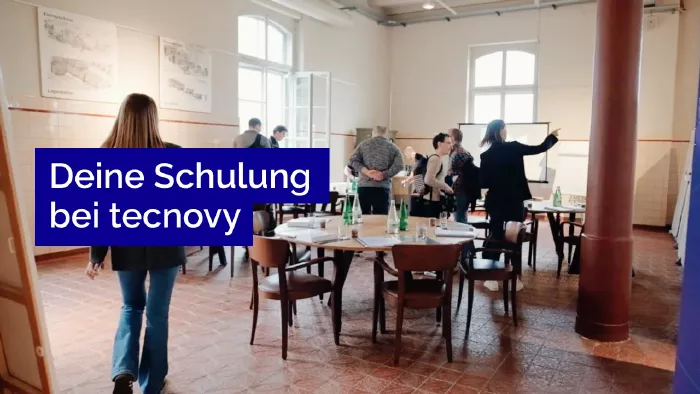
Promised: no PowerPoint marathon. We work in groups, tie theory to practice, and you get real project examples from our experienced trainers plus the exchange with like-minded people.
02
Certificate Showroom
Get your certificate of participation and, if you have one, add your exam certificate from E-Learning. Fully automated, beautifully designed. Just for you, only at tecnovy.
03
Flexible Date Change
If you are not able to attend the course, you can rebook your training free of charge up to one week before the start of the training.
04
Attend Twice, Pay Once
You are welcome to attend the training online again within a year as a refresher.
05
Learn from Experts
We always guarantee you the use of didactically and methodically first-class qualified trainers who draw their knowledge from training experience as well as professional practical and project experience.
FAQs
Frequently asked questions
01How does Secure AI Architecture differ from AI Security & LLM Security?
The tecnovy Secure AI Architecture training starts at the design, AI Security & LLM Security at attacks and testing. Here you set trust boundaries, rights and isolation before a system is built. There you attack AI systems in a lab environment and document their weaknesses.
02Why is security hard to retrofit in AI systems?
Because the decisive questions are design questions: which data a model sees, which tools an agent may call and where trust boundaries run. In its 2025 Top 10, the OWASP GenAI Security Project leaves open whether any complete protection against prompt injection exists. The tecnovy Secure AI Architecture training therefore plans for a successful attack to reach as little as possible.
03What is a threat model for an AI system?
A threat model describes where trust boundaries run in an AI system, which attack surfaces arise and which threats are realistic there. In AI systems, prompts, retrieved documents and tool responses count as attack surface too. In the tecnovy Secure AI Architecture training it is the starting point for every later decision.
04What do I have at the end of the training?
The tecnovy Secure AI Architecture training ends with a threat model for an AI application and the security architecture developed from it. That architecture sets controls for data, models, tools and agents and extends into operation.
05Do I need to be a security specialist?
No. For the tecnovy Secure AI Architecture training you bring experience in software architecture or in IT security, and you do not need both. There is no formal admission requirement.
06Does the training make my AI system compliant with the AI Regulation?
No, attending does not make a system compliant, but in the tecnovy Secure AI Architecture training you check your controls against requirements of the AI Regulation. Article 15 requires high-risk AI systems to reach an appropriate level of cybersecurity and names data and model poisoning among the attacks. As of October 2026 this applies from 2 December 2027 to Annex III systems and from 2 August 2028 to Annex I systems.
07Is there an examination or a certification?
No, the tecnovy Secure AI Architecture training ends without an examination and leads to no certification. You receive the tecnovy certificate of participation, which confirms your attendance and the topics covered.
08Which tecnovy trainings complement Secure AI Architecture?
Two tecnovy trainings complement Secure AI Architecture directly. OWASP Top 10 for LLM and GenAI Applications works through the individual risks with examples and shows countermeasures. Agentic AI Architecture designs agentic systems as a whole, from orchestration to governance, and treats security as one part of that.
What does your training at tecnovy look like?
Secure AI Architecture
No dates yet
We will let you know as soon as the next date is scheduled.