IT training across Europe - tecnovy makes you future-ready.

IREB® CPRE Requirements Management Practitioner

A change request is quickly raised. The answer to what else it touches sits in attributes, versions and links that somebody had to set up beforehand. That preparatory work is the subject of IREB CPRE Requirements Management, and tecnovy has you design the attribute schemas, traceability models and prioritisations yourself during the course. What you end up with is a body of requirements you can report on rather than search through.
Attendance certificate4.8/5 on ProvenExpert

What this module delivers.

A few dozen requirements you can manage in your head; a few thousand you cannot. Past that scale the structure decides. In the tecnovy CPRE Requirements Management training you design the information model, the attribute schema and traceability yourself.

How the training runs

Method
Design attribute schemas and traceability models yourself
Outcome
Official IREB examination, CPRE Foundation Level required

Dates & booking

Choose a date that fits

No public dates are scheduled yet.

New dates are published regularly. Join the waitlist or plan an in-house course for your team.

Request in-house training

Fit

Who this module is designed for

Typical roles

  • You are responsible for a body of requirements that has grown too large to keep in view.
  • You have to be able to say, for every change, what else it affects.
  • You report the state and progress of requirements to project management or to an audit.

Prerequisites

Formal prerequisites

  • IREB CPRE Foundation Level certificate, required by IREB for admission to the Practitioner examination
  • IREB alternatively accepts the BCS Practitioner Certificate in Requirements Engineering

Consider instead CPRE-FL Without the CPRE Foundation Level certificate IREB will not admit you to the Requirements Management examination, and the Foundation Level itself has no admission rule.

Curriculum

CPRE® Requirements Management Course in Detail

IREB syllabus 2.1.0 is the largest of the four Practitioner modules and holds eleven educational units. They are grouped here into five parts, running from the information model through prioritisation, change and traceability to reporting, process and tools.

01Foundations and setup in requirements management

This unit settles what requirements management covers as a task and what it returns.

  • Definition, tasks, goals and benefits of requirements management
  • The requirements management plan as the steering document
  • Where requirements management starts in a project and who owns it
  • Relevant standards and what they actually demand
02Information model, attributes and views

This is where the structure everything else rests on gets built.

  • Designing and representing a requirements information model
  • Designing attribute schemas rather than accumulating attributes
  • Changing an attribute schema without devaluing the existing set
  • Defining views, knowing their risks and optimising their upkeep
03Evaluation, prioritisation and variants

This unit answers what gets built first, and why.

  • Principles for evaluating requirements
  • Ad-hoc techniques such as two-criteria classification and the 100-dollar method
  • Analytical methods and combining several techniques
  • Documenting variants explicitly and controlling them through feature models
04Versions, changes and traceability

The core of the module: staying in control of change without losing the overview.

  • Versioning, configurations, baselines and branching
  • Causes and types of change, and the stability of requirements
  • Setting up a change process that keeps decisions traceable
  • Modelling traceability to fit the project and assessing what it returns
05Reporting, process, agile work and tools

The closing unit turns to steering the requirements process itself.

  • Building a reporting system and deriving metrics via Goal-Question-Metric
  • Running requirements engineering as a measurable, improvable process
  • Requirements management in agile projects and alongside Scrum
  • Selecting tools and exchanging data between them
Official syllabus(external link)

Outcome

What you will be able to do afterwards

  1. 01

    You design a requirements information model that fits the size and approach of the project.

  2. 02

    You assign attributes against a schema of your own and derive views from it for different stakeholders.

  3. 03

    You prioritise requirements with ad-hoc and analytical techniques and justify the resulting order.

  4. 04

    You introduce versioning, baselines and a change process that makes changes assessable.

  5. 05

    You model traceability to fit the project and judge how much of it is worth the effort.

  6. 06

    You derive metrics using Goal-Question-Metric and build reporting that holds up from them.

  7. 07

    You document variants explicitly and treat the requirements engineering process itself as something you steer.

CPRE Requirements Management Practitioner certificate (Level 2)

Once you pass, the certification body issues you the official certificate. IREB states that it does not expire and never needs renewing. It covers this one module: the four Practitioner modules are certified individually and there is no aggregate status.

Certification terms cpre.ireb.org ↗

Examination

IREB CPRE Requirements Management Practitioner examination

70%Pass mark

Questions
~45
Working time
75 min
Format
Multiple Choice

You book the examination together with your registration; the exam fee is not part of the seminar price. It takes place after the training at a certification body recognised by IREB, online or on site. If the exam language is not your native language, you can request a 15-minute extension.

Official examination rules cpre.ireb.org ↗

Proof of attendance

Certificate of participation

≥80%attendance

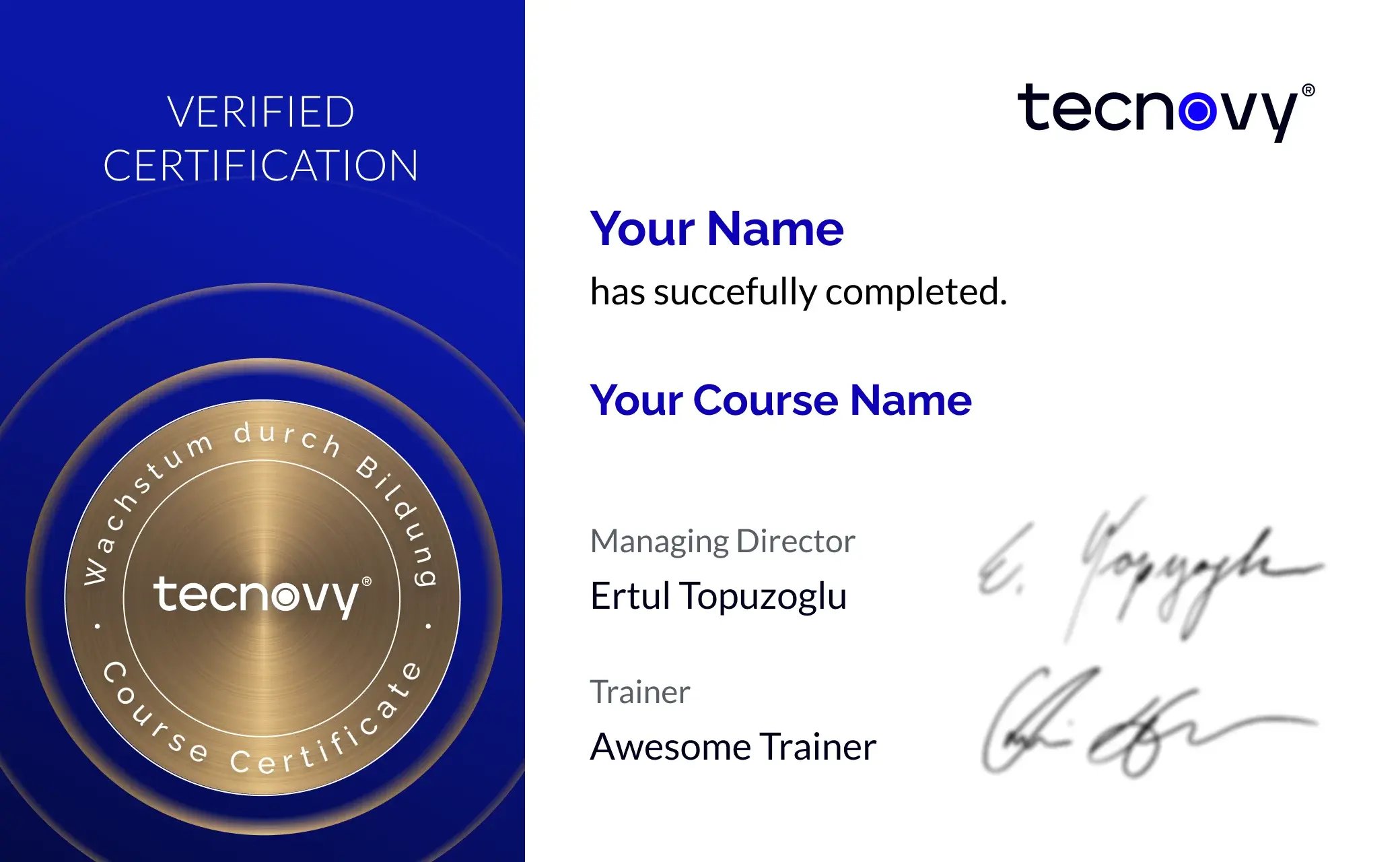
The tecnovy certificate of participation records your attendance of the CPRE Requirements Management training, not a passed examination.

Sample of the tecnovy certificate of participation Open the Certificate Showroom tecnovy →

Offer scope

What the course price does not cover

Not included

  • Fee for the CPRE Requirements Management Practitioner examinationNot part of the seminar price; you add it as a separate item during registration, where the amount is shown.

Why tecnovy

What you get on top with us

02

Certificate Showroom

Get your certificate of participation and, if you have one, add your exam certificate from E-Learning. Fully automated, beautifully designed. Just for you, only at tecnovy.

03

Flexible Date Change

If you are not able to attend the course, you can rebook your training free of charge up to one week before the start of the training.

04

Attend Twice, Pay Once

You are welcome to visit the training course online again within a year as a refresher or exam preparation.

05

No Slideshow, Hands-On!

Promised: no PowerPoint marathon. We work in groups, tie theory to practice, and you get real project examples from our experienced trainers plus the exchange with like-minded people.

06

Learn from Experts

We always guarantee you the use of didactically and methodically first-class qualified trainers who draw their knowledge from training experience as well as professional practical and project experience.

FAQs

Frequently asked questions

01Do I need the CPRE Foundation Level for the tecnovy Requirements Management training?
Not for the tecnovy training, but yes for the examination. IREB requires a valid CPRE Foundation Level certificate or the BCS Practitioner Certificate in Requirements Engineering for admission to the CPRE Requirements Management Practitioner examination. You can attend the training without one.
02How does requirements management differ from requirements engineering?
Requirements engineering produces requirements; requirements management keeps them under control over time. The CPRE Requirements Management module therefore starts where elicitation and documentation stop: at attributes, views, versions, changes, traceability, variants and the reporting on all of it.
03What does the CPRE Requirements Management examination look like?
The examination is about 45 multiple-choice questions in 75 minutes, and you pass from 70.00 percent of the available points. Questions carry different weights, so the threshold is about points rather than the number of correct answers. If the exam language is not your native language, you can request a 15-minute extension.
04When and where do I sit the examination after the tecnovy training?
The examination takes place after the tecnovy training at a certification body recognised by IREB, online or on site. IREB does not run examinations itself; it licenses certification bodies working to ISO/IEC 17024 to do that. You add the fee to your tecnovy registration when you book.
05What happens if I do not pass the examination?
You can retake the CPRE Requirements Management examination twice with no waiting period; only after a third failed attempt does IREB require a year's pause. tecnovy gives you the second attempt as an online examination if your first sitting is within 24 hours of the training.
06Does the CPRE Requirements Management certificate expire?
No. IREB states that the certificate is valid indefinitely and never needs renewing, and charges no recurring fees for it. It attests to this one Practitioner module, not to the CPRE scheme as a whole.
07Is this the former IREB Advanced Level?
Yes. IREB split the former Advanced Level into the two levels Practitioner and Specialist with syllabus version 3.0. Requirements Management has been a Practitioner module since then, and older labels such as "CPRE AL" refer to the same stage. The Specialist builds on it and is assessed through a written assignment.
08What materials do I get in the tecnovy Requirements Management training?
You get the seminar script and a photo record of every flipchart produced during the training, including the prioritisation exercises from the working phases. The official IREB syllabus 2.1.0 is freely available and is used in the training as the shared basis.
09Why book the Requirements Management training with tecnovy?
With eleven educational units, Requirements Management is the largest of the four Practitioner syllabi, and tecnovy teaches all of it in three days. tecnovy is a Swiss training provider based in Lenzburg in the canton of Aargau, and runs its IREB trainings online and on site, in German and English. Group discounts of up to 25 percent apply from three participants from one company.
10What comes after the Requirements Management Practitioner?
The CPRE Specialist in the same module is the next step, and the Practitioner certificate is what admits you to it. The Specialist examination is not multiple choice but a written assignment set in your own project context, assessed by examiners recognised by IREB.


What does your training at tecnovy look like?

CPRE-ManagementCPRE Requirements Management Practitioner

No dates yet

We will let you know as soon as the next date is scheduled.

Feedback Form
What should we improve?

Tell us what we can do better next time.

Success
Error

© Copyright 2026, tecnovy GmbH, All Rights Reserved