
2,669 $−267 $2,402 $
What this module delivers.
How the training runs
- Method
- Running proofs on the tools, working one example end to end
- Basis
- Official iSAQB curriculum FM 2024.1-rev2, English only
- Outcome
- 30 credit points: 10 methodical, 20 technical, no course exam
Dates & booking
Choose a date that fits
2 dates
Sessions with this symbol offer up to 25% group discount. Click “Details & Registration” to learn more.
2,311 $−232 $2,079 $
No dates match this selection.
Dates are still available. Reset the filters to see them.
Fit
Who this module is designed for
Typical roles
- You own parts of a system whose misbehaviour endangers people, money or data.
- You have to evidence correctness where test coverage does not carry the proof.
- You decide which verification techniques enter a project toolchain.
Prerequisites
No prerequisites
You can start right away. What you need: basic knowledge of algebra and logic. Helpful: experience with functional programming, familiarity with programming-language semantics.
Consider instead FUNAR Puts 600 of its 1080 minutes into functional modelling and macro architecture, and gets there without proof assistants or model checkers.
Curriculum
CPSA® FM Course in Detail
Curriculum 2024.1-rev2 splits FM into five parts across 1080 teaching minutes, 415 of them practice. It starts at logic, runs through specification languages and the place of formal methods in the development process to the tools, and closes on a fully worked example. The iSAQB publishes this curriculum in English only.
01Logic
This part fixes the language every later guarantee is written in.
- Propositional logic: syntax, semantics, normal forms, decidability
- First-order predicate logic with quantifiers, skolemization and substitution
- Temporal operators and the difference between LTL and CTL
- Calculi: natural deduction, sequent calculus, resolution
02Specification and Implementation
This is where the specification everything is later proved against gets written.
- Examples, properties, formal and mechanized specification set apart
- Specifications for functions, data types, algorithms and whole systems
- Specifying qualities such as functionality, performance efficiency, security and safety
- Isabelle/HOL, ACL2, TLA+ and Alloy, plus the notion of refinement
03Formal Methods and the Development Process
The shortest part answers the most expensive question: where the effort pays off.
- The SPE model as a grid for how precisely software is specified
- Weighing expressiveness against effort and the qualification a method demands
- Entering gradually through static typing and property-based testing
- Architecture evaluation with SMT/SAT solving and abstract interpretation
04Tools
Half of it is practice: 150 of the 300 minutes are hands-on tool work.
- Property-based testing, and what type systems up to dependent types guarantee
- Model checking over finite automata, BDDs, CTL and PLTL
- Proof assistants and SMT solvers for arbitrary software systems
- Abstract interpretation as a static prediction of dynamic behaviour
05Examples
To close, one complete example is worked through instead of more talk about techniques.
- At least one worked example is mandatory in every licensed course
- 180 minutes, 60 of them practice time
- The iSAQB deliberately does not prescribe the type or structure of the examples
- They may follow the systems and interests of the participants
Outcome
What you will be able to do afterwards
- 01
You state critical system properties in propositional and predicate logic instead of prose.
- 02
You compare Isabelle/HOL, ACL2, TLA+ and Alloy by expressiveness and effort.
- 03
You use the SPE model to determine which parts of a system are open to formal methods.
- 04
You partition a system so that component properties compose into system properties.
- 05
You introduce formal methods gradually through static typing and property-based testing.
- 06
You verify properties of finite automata through model checking.
- 07
You translate project requirements into proof obligations for a proof assistant.
- 08
You check constraints of a software system with SMT solvers.
Credit points toward CPSA-A
- Methodical competence
- 10
- Technical competence
- 20
- Communicative competence
- 0
30 of 70 points toward CPSA-A admission
Certificate of participation
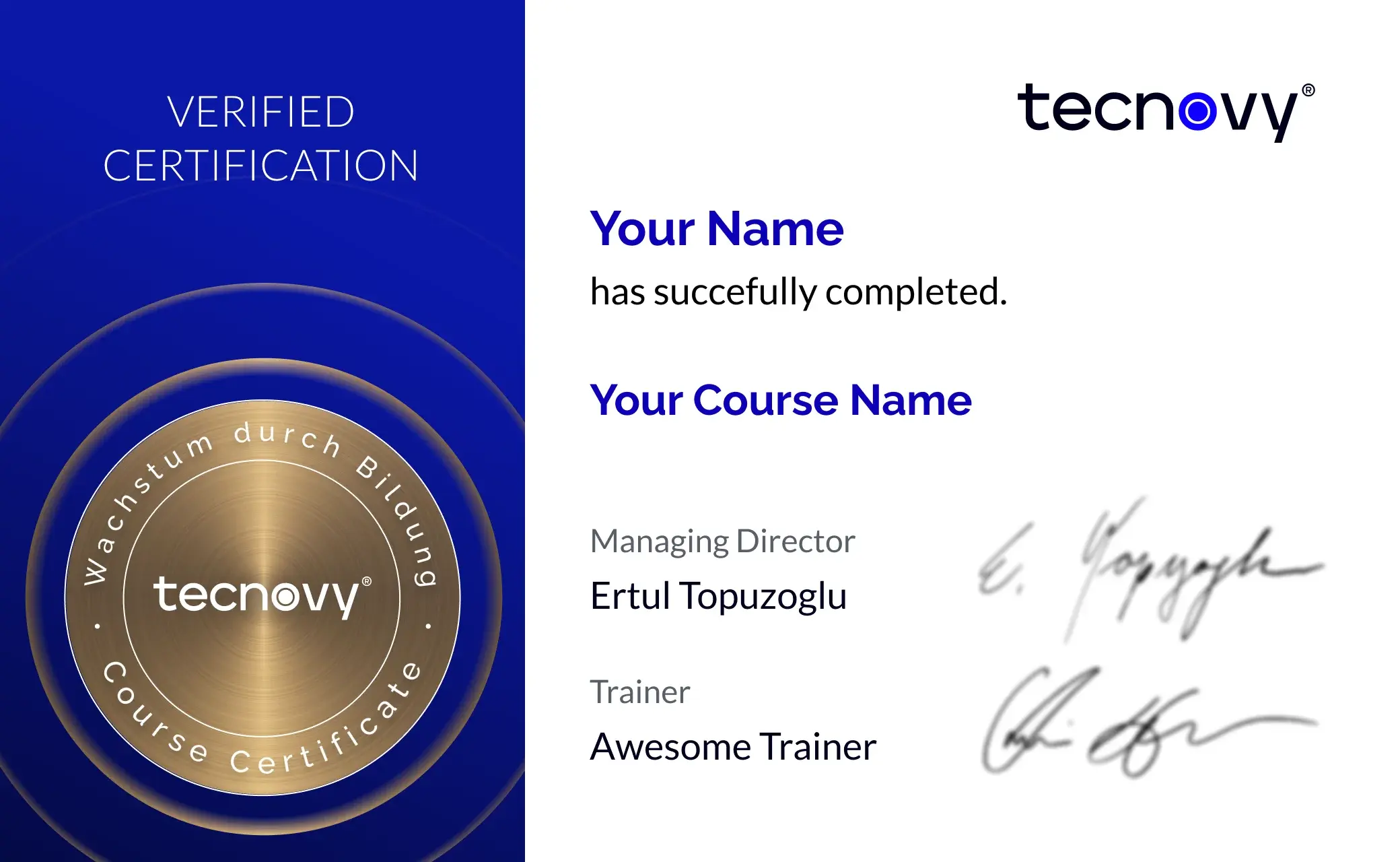
The tecnovy certificate of participation records your attendance of the FM training, not a passed examination.
Open the Certificate Showroom tecnovy →≥80%attendance
Trainers
Why tecnovy
What you get on top with us
01
iSAQB® Accredited Provider
We are an officially accredited Training Provider of the International Software Architecture Qualification Board.
02
Certificate Showroom
Get your certificate of participation and, if you have one, add your exam certificate from E-Learning. Fully automated, beautifully designed. Just for you, only at tecnovy.
03
No Slideshow, Hands-On!
Promised: no PowerPoint marathon. We work in groups, tie theory to practice, and you get real project examples from our experienced trainers plus the exchange with like-minded people.
04
Attend Twice, Pay Once
You are welcome to attend the training online again within a year as a refresher.
05
Learn from Experts
We always guarantee you the use of didactically and methodically first-class qualified trainers who draw their knowledge from training experience as well as professional practical and project experience.
06
Flexible Date Change
If you are not able to attend the course, you can rebook your training free of charge up to one week before the start of the training.
FAQs
Frequently asked questions
01Do I need CPSA-F to attend the tecnovy FM training?
02Is there an FM examination?
03How many credit points does FM carry?
04How does the CPSA-A certification work?
05How long is the FM training?
06What is the difference between FM and FUNAR?
07How much mathematics does FM require?
08Is FM a purely theoretical module?
09Do I get the flipcharts from the FM training?
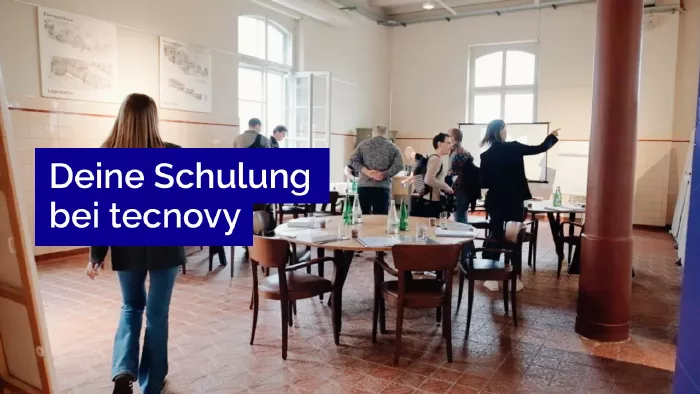
What does your training at tecnovy look like?