
IT training across Europe - tecnovy makes you future-ready.

tecnovy AI Suite

AI Agents Deep Dive

A planner agent passes a task to a reviewer agent, which sends it back with objections, and the two keep passing it back and forth until the API budget is used up. No agent reports an error. In the AI Agents Deep Dive you develop a multi-agent system for a complex process and make failures like this visible: with evaluation datasets, failure analysis across agent boundaries, attack tests, monitoring and cost control.
Attendance certificate4.8/5 on ProvenExpert

What this module delivers.

Whether a multi-agent system can go live should be settled by measured results, not a good demo. In the tecnovy AI Agents Deep Dive you set up evaluation, attack tests, monitoring and cost control on a system you develop yourself.

How the training runs

Method
Project work across all days, architecture reviews and a final presentation
Basis
tecnovy curriculum built on framework-independent architecture patterns
Outcome
tecnovy certificate of participation, no examination

Dates & booking

Choose a date that fits

No public dates are scheduled yet.

New dates are published regularly. Join the waitlist or plan an in-house course for your team.

Request in-house training

Fit

Who this module is designed for

Typical roles

  • You are responsible for moving agent prototypes into operation.
  • As an AI engineer, senior developer or architect, you design systems in which several agents work together.
  • You are building an agent platform for your company.

Prerequisites

No prerequisites

You can start right away. What you need: experience developing agents, solid Python skills, basic knowledge of cloud and containers.

Consider instead Claude Code Expert For developers whose agents work on codebases and migrations: multi-agent workflows in Claude Code and your own agents built with the Claude Agent SDK.

Curriculum

AI Agents Deep Dive in Detail

Six parts lead from the architecture of a multi-agent system, through quality and security, to operation and governance. One project connects them: you extend it across every day, put it up for discussion in architecture reviews and present it at the end.

01Multi-agent architectures

You decide whether and how several agents solve a task better than one.

  • Orchestration: who distributes and who executes
  • Hierarchies and collaboration between agents
  • When several agents make sense and when they do not
02Communication and state

This part settles how agents share work and bring it back together.

  • Distributing tasks and merging results
  • Shared state and memory
  • Resuming after failures
03Quality and evaluation

You make it measurable whether the system as a whole does its job.

  • Building evaluation datasets
  • Automated grading of results
  • Failure analysis in multi-step runs
04Security

You test where the system is exposed and set the controls.

  • Prompt injection and data leakage
  • Excessive permissions of agents
  • Sandboxing and approvals
  • Logging
05Production operation

You plan how the system runs, scales and is monitored.

  • Deployment and scaling
  • Monitoring in operation
  • Cost control and model choice
06Governance

Finally you settle who is responsible for the system and how that is evidenced.

  • Responsibilities and documentation
  • Traceability of agent decisions
  • Requirements from the AI Regulation and internal policies

Outcome

What you will be able to do afterwards

  1. 01

    You design a multi-agent architecture for a complex process and justify where a single agent is enough.

  2. 02

    You distribute tasks between agents, merge their results and keep a shared state.

  3. 03

    You make sure an interrupted run resumes at the right point after a failure.

  4. 04

    You build evaluation datasets and automated grading for the system as a whole.

  5. 05

    You trace back in multi-step runs which agent and which step a failure comes from.

  6. 06

    You test the system for prompt injection, data leakage and excessive permissions, and set sandboxing, approvals and logging.

  7. 07

    You plan deployment, scaling and monitoring, and control costs through the choice of models.

  8. 08

    You define responsibilities and documentation and check them against the AI Regulation and internal policies.

Offer scope

What is included

Included

  • Project repository with a reference architecture for a multi-agent systemThe project across all days builds on it, and you keep it as a starting point for your own systems.
  • Checklists for security and production operationThey sum up what you check before an agent system goes live.

Why tecnovy

What you get on top with us

02

Certificate Showroom

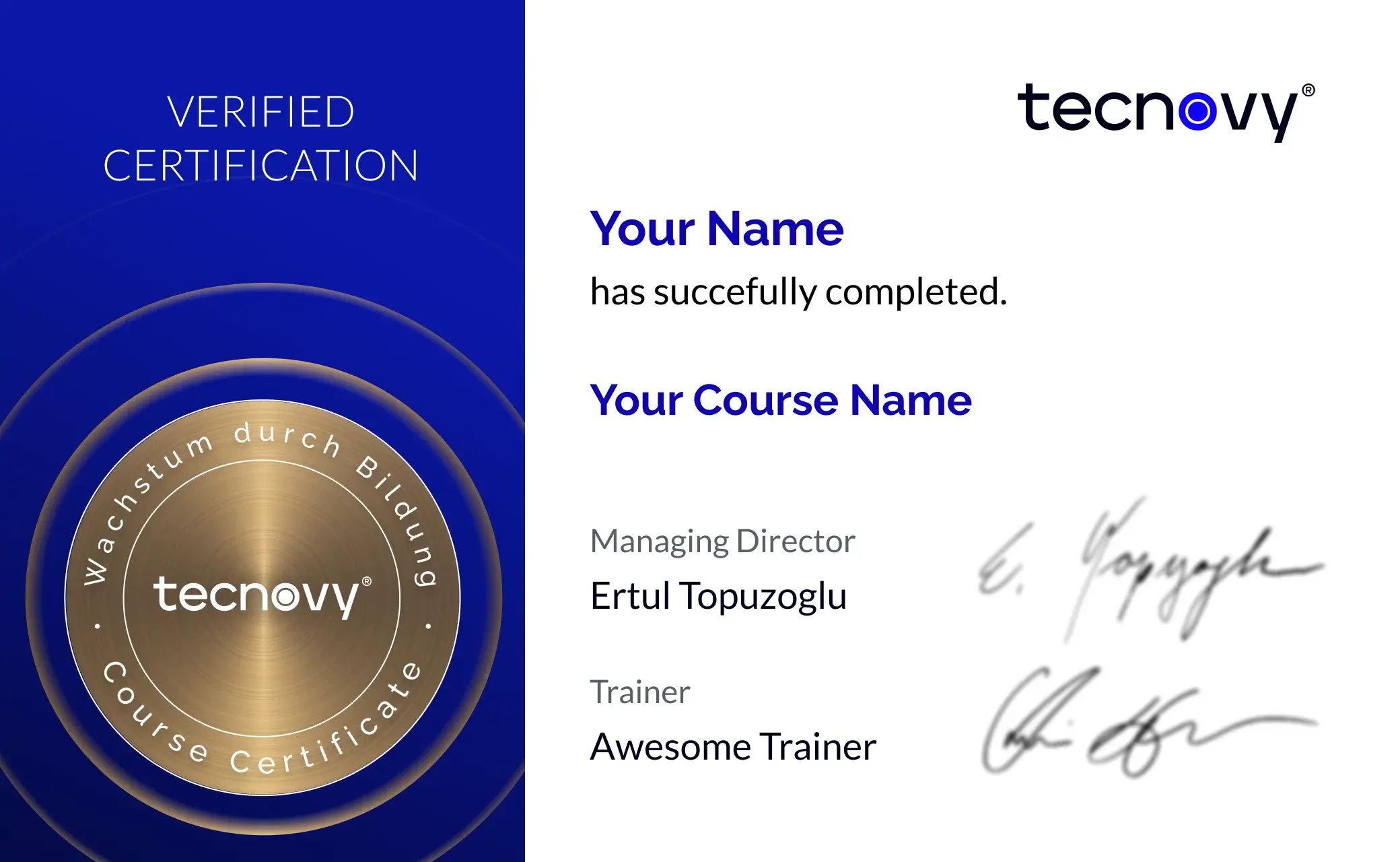
Get your certificate of participation and, if you have one, add your exam certificate from E-Learning. Fully automated, beautifully designed. Just for you, only at tecnovy.

03

Flexible Date Change

If you are not able to attend the course, you can rebook your training free of charge up to one week before the start of the training.

04

Attend Twice, Pay Once

You are welcome to attend the training online again within a year as a refresher.

05

Learn from Experts

We always guarantee you the use of didactically and methodically first-class qualified trainers who draw their knowledge from training experience as well as professional practical and project experience.

FAQs

Frequently asked questions

01When are several agents worth it instead of one?
Not always: every additional agent adds a hand-off, its own model calls and another source of failure. In the tecnovy AI Agents Deep Dive you therefore check first whether a single agent can do the job before you design orchestration and hierarchies.
02Will our multi-agent system be production-ready after the Deep Dive?
No training can promise that. In the tecnovy AI Agents Deep Dive you learn what to base that decision on: evaluation results, attack tests, logs and cost figures. In its 2026 Top 10 for LLM applications, the OWASP GenAI Security Project lists Excessive Agency and Unbounded Consumption as risks of their own.
03Do I need to take Developing AI Agents first?
No, experience building Python agents with your own tools replaces Developing AI Agents as the preceding course. For the tecnovy AI Agents Deep Dive you also need basic knowledge of cloud and containers, because the system in the course goes as far as deployment.
04Can I work on my own project?
Yes, above all in the in-house format of the tecnovy AI Agents Deep Dive. In the open training everyone works on a realistic sample project that tecnovy provides.
05Which framework and which access do the exercises use?
tecnovy sets the framework for each date of the AI Agents Deep Dive; the architecture patterns themselves are framework-independent. The exercises call language models through an API.
06Does the Deep Dive make our agent system compliant with the AI Regulation?
Compliance does not come from a training; in the tecnovy AI Agents Deep Dive you set responsibilities, documentation and traceability and check them against the AI Regulation. For high-risk AI systems it requires, among other things, automatic logging (Article 12) and effective human oversight (Article 14). As of November 2026 this applies from 2 December 2027 to Annex III systems and from 2 August 2028 to Annex I systems.
07How does the Deep Dive differ from Claude Code Expert?
The tecnovy AI Agents Deep Dive builds agents for business processes, independent of any one tool or framework. If you want agents for your own software development, such as large refactorings and framework migrations, Claude Code Expert teaches that with Claude Code and the Claude Agent SDK.
08Does the Deep Dive end with an examination or a certification?
Neither: the tecnovy AI Agents Deep Dive ends with a final presentation of your project, not with an examination. If you attend at least 80% of the training time, you receive the tecnovy certificate of participation.
09Which courses follow on from the Deep Dive?
Agentic AI Architecture and AI Security & LLM Security fit after the tecnovy AI Agents Deep Dive. The first designs agentic systems at enterprise level, up to the platform strategy; in the second you attack AI systems in a lab environment and derive protective measures.

What does your training at tecnovy look like?

AI Agents Deep Dive

No dates yet

We will let you know as soon as the next date is scheduled.

Feedback Form
What should we improve?

Tell us what we can do better next time.

Success
Error

© Copyright 2026, tecnovy GmbH, All Rights Reserved