
IT training across Europe - tecnovy makes you future-ready.

tecnovy AI Suite

AI Literacy: AI skills for all employees

You give an AI assistant a goal, context and an output format instead of a vague question. You check its answer for invented facts and bias before you pass it on. And you work out which data the GDPR and your company's policy allow into which tool. AI Literacy trains these three working methods on tasks from your own job. Along the way you see how generative AI produces text and what the EU AI Act means for your work.
Attendance certificate4.8/5 on ProvenExpert

What this module delivers.

AI Literacy gives your team a shared way of working with AI assistants, from administration to customer service. In the tecnovy training you write structured prompts, check results for errors and clarify which data company policy allows in which tool.

How the training runs

Method
Short inputs, then exercises on tasks from your own job
Basis
Vendor-neutral tecnovy curriculum for AI literacy
Outcome
No examination, tecnovy certificate of participation at 80% attendance

Dates & booking

Choose a date that fits

No public dates are scheduled yet.

New dates are published regularly. Join the waitlist or plan an in-house course for your team.

Request in-house training

Fit

Who this module is designed for

Typical roles

  • You already use ChatGPT, Microsoft Copilot, Claude or Gemini at work, so far mostly by feel.
  • You are expected to use AI in administration, sales, marketing, HR, purchasing or customer service.
  • You are building AI literacy in your organisation and need a format for many employees.
Prerequisites

No prerequisites

You can start right away. Helpful: access to an AI assistant your company has approved.

Consider instead AIF-C01 For anyone who wants a vendor certification with an exam and to place AI services on AWS without writing code.

Curriculum

AI Literacy Course in Detail

Six parts lead from how generative AI works, through practical use, to data protection and the EU AI Act. About half of the time is hands-on work, using tasks from your own job.

01How generative AI works

This part builds a shared basic understanding, with no maths involved.

  • AI, machine learning and generative AI: what sets them apart
  • How a language model produces text: tokens (word fragments) and probabilities
  • The context window: how much text the model takes into account at once
  • Why a language model can sound convincing and still be wrong
02AI assistants in everyday work

Here you see where an AI assistant pays off at work and where it does not.

  • Typical uses: writing, summaries, research, translation, ideas, simple data analysis
  • Common tools at a glance: ChatGPT, Microsoft Copilot, Claude, Gemini
  • When AI is not the right choice
03Prompting basics

The practical core: a prompt is your instruction to the AI, and here a vague request becomes a usable result.

  • How a good prompt is built: goal, context, role, format, examples
  • Improving results step by step in dialogue
  • Reusable prompt templates for your own tasks
04Checking results critically

This part shows you how not to trust AI results blindly.

  • Spotting hallucinations: convincingly phrased but invented statements
  • Verifying facts against sources
  • Recognising bias: one-sided or skewed results
  • When a person must have the final say
05Data protection, confidentiality and copyright

This part protects you and your company when you handle data.

  • Which data you may enter into which tool, and which you may not
  • GDPR basics for using AI
  • Copyright questions around AI-generated content
  • The role of an internal AI policy
06The EU AI Act at a glance

Finally, you work out what Regulation (EU) 2024/1689 means for your job.

  • The risk-based approach: prohibited practices, high-risk AI systems, transparency obligations
  • Article 4 on AI literacy as amended in July 2026
  • What this means in practice for people using AI tools

Outcome

What you will be able to do afterwards

  1. 01

    You explain in your own words how a language model produces text and why it can sound convincing and still be wrong.

  2. 02

    You identify tasks in your job that suit an AI assistant, and those where it is the wrong choice.

  3. 03

    You write prompts with a goal, context, role, format and examples, and improve the result step by step in dialogue.

  4. 04

    You build reusable prompt templates for recurring tasks from your own work.

  5. 05

    You check AI results for accuracy, completeness and bias, and verify facts against sources.

  6. 06

    You decide at which point a person must keep the final say over an AI result.

  7. 07

    Before every input, you check whether the GDPR and your company's policy allow that data in that tool.

  8. 08

    You work out what the EU AI Act means for your own work with AI tools.

Why tecnovy

What you get on top with us

02

Certificate Showroom

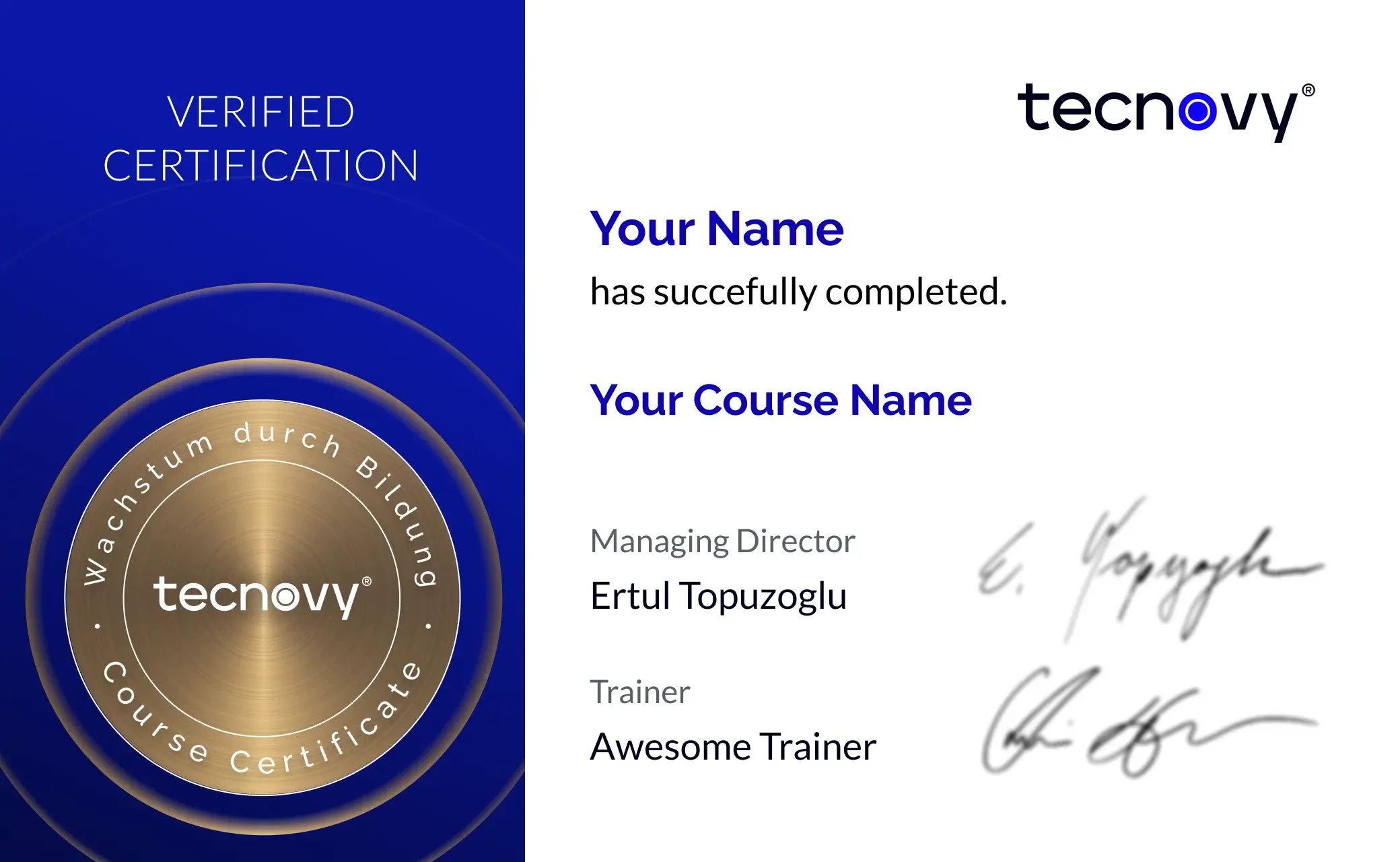
Get your certificate of participation and, if you have one, add your exam certificate from E-Learning. Fully automated, beautifully designed. Just for you, only at tecnovy.

03

Flexible Date Change

If you are not able to attend the course, you can rebook your training free of charge up to one week before the start of the training.

04

Attend Twice, Pay Once

You are welcome to attend the training online again within a year as a refresher.

05

Learn from Experts

We always guarantee you the use of didactically and methodically first-class qualified trainers who draw their knowledge from training experience as well as professional practical and project experience.

FAQs

Frequently asked questions

01Is attending AI Literacy required by law?
No, Article 4 of the EU AI Act does not prescribe this or any other specific training. As of November 2026 it requires providers and deployers of AI systems to take measures that support the development of AI literacy among their staff and other people operating or using AI systems on their behalf; a deployer is any organisation using an AI system under its own authority. The organisation decides which measures to take; the tecnovy AI Literacy training can be one of them. It is no substitute for legal advice.
02Did the 2026 amendment to the EU AI Act abolish the AI literacy obligation?
No, it rewrote Article 4. Since 27 July 2026, in the version set by Regulation (EU) 2026/1744, it requires measures that support AI literacy and explicitly does not oblige anyone to guarantee a specific level for any individual. The tecnovy AI Literacy training covers this current version.
03What proof do I get after AI Literacy?
You receive the tecnovy certificate of participation if you attend at least 80 percent of the AI Literacy training; there is no examination, and the certificate is not a certification. As of November 2026, Article 4 of the EU AI Act prescribes no particular evidence, so your organisation decides whether to add the certificate to its records.
04Do I need technical knowledge for AI Literacy?
No, the tecnovy AI Literacy training is built for people without a technical background and has no admission requirements. Even the part on how language models produce text works without any maths.
05Which AI tools does AI Literacy use?
The tecnovy AI Literacy training is vendor-neutral and introduces common AI assistants such as ChatGPT, Microsoft Copilot, Claude and Gemini. In the exercises you work with an AI assistant on tasks from your own job, ideally one your company has approved.
06May I enter confidential company data into an AI assistant?
Only if your company's policy allows it for that specific tool; whether a tool is approved for confidential data is your company's decision. In the tecnovy AI Literacy training you practise checking what the GDPR and internal policy allow before every input.
07What is a hallucination, and how do I spot one?
A hallucination is a statement a language model phrases convincingly but which is false or made up, such as a source that does not exist. In the tecnovy AI Literacy training you check AI answers against sources and decide when a person must have the final say.
08Can I book AI Literacy for many employees at once?
Yes, tecnovy also offers AI Literacy as an inhouse training for one team or organisation. The exercises then use the AI tools your organisation has approved.
09How does AI Literacy differ from AWS Certified AI Practitioner?
AI Literacy teaches vendor-neutral, safe use of AI assistants in everyday work and ends without an exam. The tecnovy AWS Certified AI Practitioner training goes deeper into machine learning, works with AWS services and prepares you for the AWS exam AIF-C01.

What does your training at tecnovy look like?

AI LiteracyAI Literacy: AI skills for all employees

No dates yet

We will let you know as soon as the next date is scheduled.

Feedback Form
What should we improve?

Tell us what we can do better next time.

Success
Error

© Copyright 2026, tecnovy GmbH, All Rights Reserved