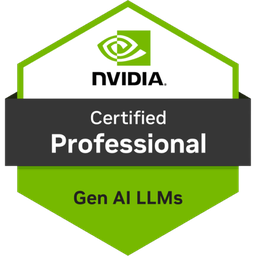
NVIDIACertified Professional: Generative AI LLMs (NCP-GENL)
Quantisation, pruning and knowledge distillation, parameter-efficient fine-tuning with LoRA, data, tensor and pipeline parallelism: these are the techniques NVIDIA's study guide names for the NCP-GENL exam. It asks when you would use which one to train, adapt and run LLMs efficiently on GPUs. In the tecnovy training you work through the ten exam domains, watch the techniques in demos and practise with exam-format questions.
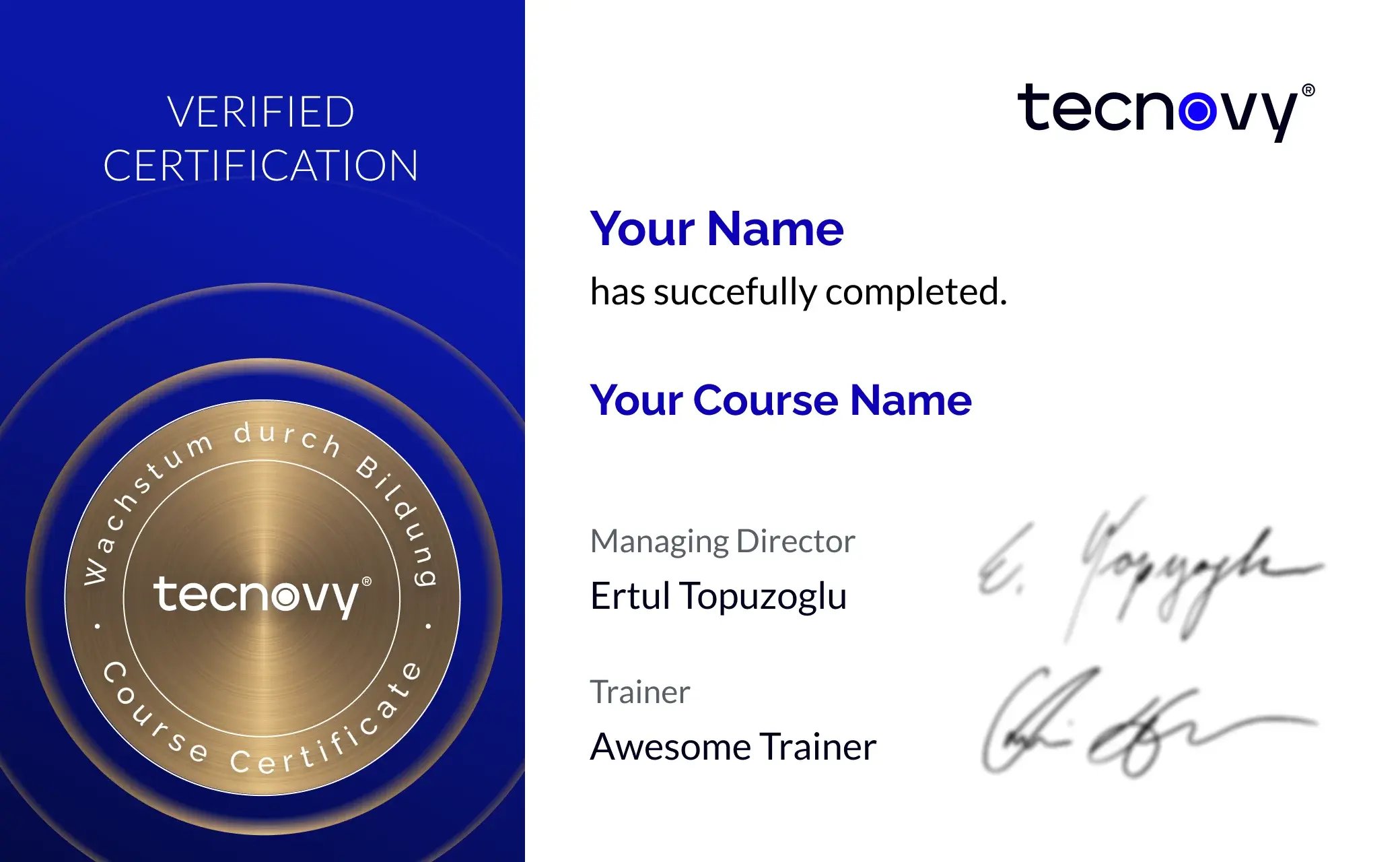
Attendance certificate4.8/5 on ProvenExpert
What this module delivers.
For ML engineers with two to three years of LLM practice: the tecnovy training for NVIDIA NCP-GENL has you weigh fine-tuning, quantisation and parallelism against each other and prepares you for the NVIDIA Professional exam.
How the training runs
Method
Concept blocks, demos on GPU environments and exam-format practice questions
Basis
NVIDIA study guide for NCP-GENL, as of September 2025
Outcome
Exam run by NVIDIA, fee separate, plus tecnovy certificate of participation
Dates & booking
Choose a date that fits
No public dates are scheduled yet.
New dates are published regularly. Join the waitlist or plan an in-house course for your team.
You train or fine-tune LLMs and need to scale training and inference across several GPUs.
You take LLMs into production as an ML engineer, data scientist or solutions architect.
You want to back several years of LLM work with a certification from NVIDIA.
Prerequisites
No prerequisites
You can start right away. Helpful: two to three years of hands-on work with LLMs in AI or ML roles, experience with transformer architectures and distributed training, solid Python skills.
Consider insteadNCA-GENLFor starting out without years of LLM practice: NVIDIA expects a basic understanding of generative AI and LLMs there.
Curriculum
NCP-GENL Course in Detail
The tecnovy training follows the ten domains of the NVIDIA study guide for NCP-GENL (as of September 2025), grouped into the five topics NVIDIA itself lists for preparation. The brackets give NVIDIA's weighting of the two domains in each part: optimisation and GPU acceleration together make up almost a third of the exam.
01LLM architecture and prompt engineering (6 % and 13 %)
This part covers how an LLM is built and how you adapt it to new tasks through prompts.
Encoders, decoders and self-attention in transformer models
Embeddings and sampling in text generation
Chain-of-thought, zero-, one- and few-shot prompts
Output control
02Data preparation and fine-tuning (9 % and 13 %)
Here you prepare data and adapt a pretrained model to a domain.
Cleaning, curating and formatting datasets
Tokenisation and vocabulary
Fine-tuning and domain adaptation
Parameter-efficient methods such as LoRA
03Model optimisation and GPU acceleration (17 % and 14 %)
The largest block of the exam: models get smaller and faster, and training and inference scale across several GPUs.
Pruning, quantisation and knowledge distillation
Multi-GPU and distributed training with data, tensor and pipeline parallelism
Memory and batch optimisation
Finding bottlenecks through profiling
04Deployment and operation (9 % and 7 %)
This part takes an LLM into production and keeps it reliable there.
Containerised inference pipelines with NVIDIA Dynamo-Triton, formerly Triton Inference Server
Model serving and orchestration with Kubernetes
Monitoring dashboards, reliability metrics and root-cause analysis
Versioning and retraining in operation
05Evaluation and responsible AI (7 % and 5 %)
Finally you measure the quality of a model and limit its risks.
You adapt an LLM to a new task with chain-of-thought, zero-, one- and few-shot prompts and control its output.
02
You plan the data preparation for a fine-tuning run and choose a fitting tokenisation.
03
You decide when prompting is enough and when fine-tuning with parameter-efficient methods such as LoRA is needed.
04
You choose between pruning, quantisation and knowledge distillation and estimate what each one costs in accuracy.
05
You justify which form of parallelism a multi-GPU training run needs, and read profiling results for bottlenecks.
06
You outline a containerised inference pipeline with NVIDIA Dynamo-Triton and Kubernetes.
07
You define reliability metrics, monitoring and versioning for an LLM in production.
08
You assess a model with benchmarks and error analysis and check it for bias and fitting guardrails.
NVIDIA-Certified Professional: Generative AI LLMs
NVIDIA awards the certification only for a passed exam, as a digital badge with an optional certificate. It is valid for two years from issue; to recertify, you take the exam again.
NVIDIA runs the exam online and remotely proctored, in English and separately from the tecnovy training. It is graded pass or fail only, and you do not receive a score.
German/English glossaryIt sets the terms of the NVIDIA study guide side by side in German and English.
Not included
NVIDIA exam feeNVIDIA charges USD 200 for each exam attempt (as of November 2026).
NCP-GENL
Why tecnovy
What you get on top with us
01
No Slideshow, Hands-On!
Promised: no PowerPoint marathon. We work in groups, tie theory to practice, and you get real project examples from our experienced trainers plus the exchange with like-minded people.
02
Certificate Showroom
Get your certificate of participation and, if you have one, add your exam certificate from E-Learning. Fully automated, beautifully designed. Just for you, only at tecnovy.
03
Flexible Date Change
If you are not able to attend the course, you can rebook your training free of charge up to one week before the start of the training.
04
Attend Twice, Pay Once
You are welcome to visit the training course online again within a year as a refresher or exam preparation.
05
Learn from Experts
We always guarantee you the use of didactically and methodically first-class qualified trainers who draw their knowledge from training experience as well as professional practical and project experience.
FAQs
Frequently asked questions
01How does the NVIDIA NCP-GENL exam work?
NVIDIA runs NCP-GENL online and remotely proctored, separately from the tecnovy training: 60 to 70 questions in 120 minutes. To access the exam you need a Certiverse account, which is also where you register. NVIDIA marks registration "Coming soon" on 2 November 2026.
02What score do I need to pass the NVIDIA NCP-GENL exam?
NVIDIA publishes no passing score: its certification exams are graded pass or fail only, and you do not receive a score (as of November 2026). That is why the tecnovy training practises with exam-format questions across all ten domains.
03Can I take the NVIDIA NCP-GENL exam in German?
No, NVIDIA offers NCP-GENL in English (as of November 2026). If an exam is not offered in your native language, you can request extra time through an NVIDIA support case before the exam; NVIDIA decides case by case and states no fixed amount.
04What happens if I do not pass the NVIDIA NCP-GENL exam?
You purchase the exam again and can retake it after a 14-day waiting period. NVIDIA allows at most five attempts per exam within 12 months, counted from your first purchase (as of November 2026).
05Do I need to pass the NVIDIA NCA-GENL exam before NCP-GENL?
No, NVIDIA requires no other certification for NCP-GENL, but recommends two to three years of hands-on work with LLMs in AI or ML roles. If you are just starting with generative AI, the tecnovy training for NVIDIA NCA-GENL, the Associate-level exam, is the better fit.
06When do I get the result and badge for the NVIDIA NCP-GENL exam?
For most NVIDIA exams you see the result on screen at the end, and the email can take up to 24 hours. After a passed NCP-GENL, NVIDIA sends the credential notice within 24 hours, and you accept the digital badge in the Credly portal (as of November 2026).
07What do I need technically to practise for NVIDIA NCP-GENL on my own?
In the tecnovy training for NVIDIA NCP-GENL, the demos run on GPU environments. For your own experiments with fine-tuning, quantisation or distributed training, you need access to an NVIDIA GPU environment, local or in the cloud.
What does your training at tecnovy look like?
NCP-GENLCertified Professional: Generative AI LLMs
No dates yet
We will let you know as soon as the next date is scheduled.