Before anyone can check whether an AI system is fair, someone has to decide which groups are compared, which kind of error counts for more, and what the gap is read from. Common fairness measures generally cannot all hold at once, so that decision needs someone who owns it. In Responsible AI you make it on case studies, test data and models for bias, document systems with model cards, and settle who signs off and when to escalate.
Attendance certificate4.8/5 on ProvenExpert
What this module delivers.
tecnovy's Responsible AI turns fairness, transparency and human oversight into requirements you can check. Product, data and governance leads set fairness measures, document systems and settle sign-offs. Your team then knows who answers for which AI decision.
How the training runs
Method
Case studies, discussion and assessment exercises
Basis
tecnovy curriculum drawing on OECD principles, NIST AI RMF, EU AI Act
Outcome
tecnovy certificate of participation, no examination
Dates & booking
Choose a date that fits
No public dates are scheduled yet.
New dates are published regularly. Join the waitlist or plan an in-house course for your team.
You own an AI product, a model or the data behind it, and have to justify its fairness.
You assess AI initiatives in compliance, ethics or governance before they go into use.
You sign off AI initiatives as a manager and want it settled who answers for what afterwards.
Prerequisites
No prerequisites
You can start right away. What you need: basic knowledge of AI.
Consider insteadAI Risk ManagementFor anyone who has to assess every risk of an AI system, not only fairness and transparency: with the NIST AI RMF and ISO/IEC 23894, built into existing risk management.
Curriculum
Responsible AI in Detail
Four parts: you sort out the principles and frameworks, test data and models for bias, make systems traceable with documentation and explanations, and finally settle who decides about an AI system and who answers for it.
01Principles and frameworks
This part sets out what responsible AI actually demands.
Checklist for impact assessmentsYou receive the checklist and can use it for your own AI systems after the training.
Responsible AI
Why tecnovy
What you get on top with us
01
No Slideshow, Hands-On!
Promised: no PowerPoint marathon. We work in groups, tie theory to practice, and you get real project examples from our experienced trainers plus the exchange with like-minded people.
02
Certificate Showroom
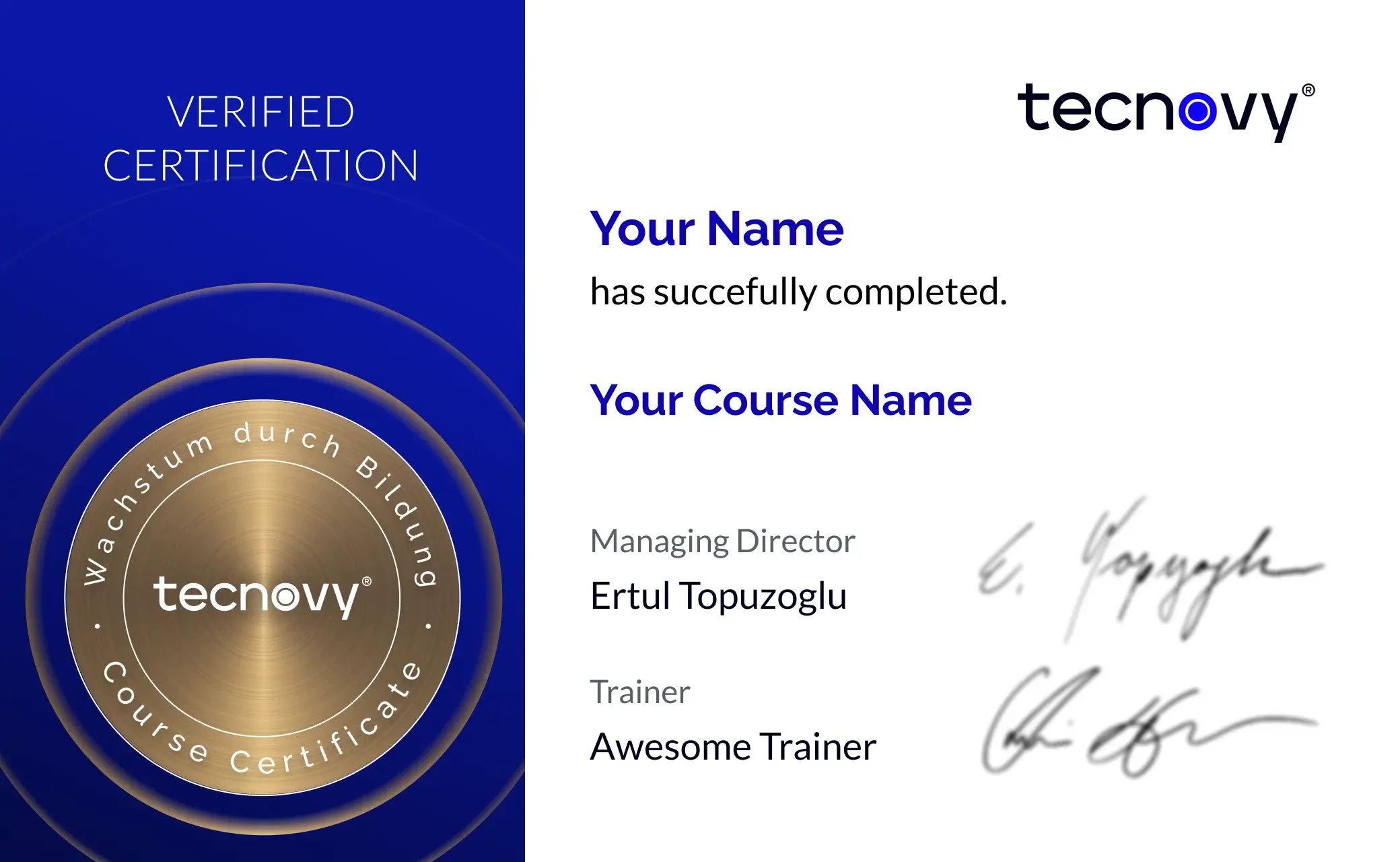
Get your certificate of participation and, if you have one, add your exam certificate from E-Learning. Fully automated, beautifully designed. Just for you, only at tecnovy.
03
Flexible Date Change
If you are not able to attend the course, you can rebook your training free of charge up to one week before the start of the training.
04
Attend Twice, Pay Once
You are welcome to attend the training online again within a year as a refresher.
05
Learn from Experts
We always guarantee you the use of didactically and methodically first-class qualified trainers who draw their knowledge from training experience as well as professional practical and project experience.
FAQs
Frequently asked questions
01Is an AI system fair after Responsible AI?
No, tecnovy's Responsible AI training does not make any system fair or free of bias. Kleinberg, Mullainathan and Raghavan showed in 2016 that three common fairness conditions cannot all be met at once outside special cases, and the NIST AI RMF 1.0 notes that less bias does not automatically mean fairness. You learn to make a choice, justify it and document it openly.
02Is Responsible AI a technical course?
No, tecnovy's Responsible AI training is meant for technical and non-technical roles alike. You should bring basic knowledge of AI, for example from tecnovy's AI Literacy course.
03Which frameworks does Responsible AI draw on?
tecnovy's Responsible AI training draws on the OECD AI Principles (adopted 2019, updated in May 2024), the NIST AI Risk Management Framework 1.0 of January 2023, and the EU AI Act. NIST is currently revising its framework (as of November 2026).
04What part does the EU AI Act play in Responsible AI?
For high-risk AI systems it requires, among other things, that data sets are examined for possible biases (Article 10), that deployers can interpret the output (Article 13), and that effective human oversight is possible (Article 14). As of November 2026 these obligations apply from 2 December 2027 for Annex III systems and from 2 August 2028 for Annex I systems. tecnovy's Responsible AI training practises the methods behind them but does not replace a legal review of your system.
05What is a model card?
A model card is a short document accompanying a trained model that sets out its intended use, evaluation procedure and performance, including per group of people; the format goes back to Mitchell et al. (2019). Datasets have the counterpart, datasheets for datasets by Gebru et al., and tecnovy's Responsible AI training has you practise both formats.
06How does transparency differ from explainability?
Transparency is about what information people can get about an AI system and its results at all; explainability is about how the system arrives at a result. That is how the NIST AI RMF 1.0 separates them. In tecnovy's Responsible AI training you write explanations separately for the people affected and for specialist users, because they ask different questions.
07How does Responsible AI differ from AI Risk Management?
tecnovy's Responsible AI focuses on fairness, transparency and human oversight. AI Risk Management covers every risk of an AI system, from technical and legal to supplier risks, using the NIST AI RMF and ISO/IEC 23894, and builds them into existing risk management.
08Is there an examination or a certification at the end of Responsible AI?
No, Responsible AI is a tecnovy training with no examination and no certification. If you attend at least 80% of it, you receive the tecnovy certificate of participation.
What does your training at tecnovy look like?
Responsible AI
No dates yet
We will let you know as soon as the next date is scheduled.