
1,650 €−248 €1,402 €
What this module delivers.
How the training runs
- Method
- Apply test design techniques to worked examples
- Basis
- Official ISTQB syllabus 4.0.1
- Outcome
- 40 questions, 26 to pass, exam booked separately
Dates & booking
Choose a date that fits
4 dates
Sessions with this symbol offer up to 25% group discount. Click “Details & Registration” to learn more.
1,650 €−165 €1,485 €
1,650 €−165 €1,485 €
1,650 €−165 €1,485 €
No dates match this selection.
Dates are still available. Reset the filters to see them.
Fit
Who this module is designed for
Typical roles
- You design test cases for software other people built.
- You report defects and have to describe them so that somebody else can reproduce them.
- You help decide what still gets tested before a release and what does not.
Prerequisites
No prerequisites
There are no formal admission requirements. You can start right away.
Consider instead CTAL-TM Goes deeper into test strategy, risk management and team leadership, and requires the CTFL certificate.
Curriculum
ISTQB CTFL Course in Detail
Syllabus 4.0 splits CTFL into six chapters across at least 1135 minutes of instruction. It starts at the fundamental terms and runs through static techniques and test design to managing the test activities. The weight sits clearly on design: a third of the time goes to chapter 4.
01Fundamentals of Testing
This chapter builds the vocabulary the rest of the course runs on.
- Test objectives, and what separates testing from debugging
- Error, defect and failure, and their root causes
- The testing principles
- The whole team approach and the independence of testing
02Testing Throughout the Software Development Lifecycle
Here you place tests in the phases where they actually happen.
- DevOps and testing, and what shift-left means in practice
- Test levels from component testing to acceptance testing
- Functional, non-functional, black-box and white-box test types
- Confirmation testing, regression testing and maintenance testing
03Static Testing
The part that finds defects before any code exists for them.
- Which work products can be examined statically
- Where static testing and dynamic testing part ways
- The activities of the review process, its roles and responsibilities
- Review types and the success factors behind them
04Test Analysis and Design
The longest chapter in the syllabus: this is where the test cases come from.
- Equivalence partitioning, boundary value analysis, decision tables and state transition testing
- Statement and branch coverage as the measure of structural testing
- Experience-based techniques: error guessing, exploratory testing, checklist-based testing
- Collaboration-based approaches such as acceptance test-driven development
05Managing the Test Activities
This part answers what gets tested first and when you stop.
- The purpose and content of a test plan, entry and exit criteria
- Estimation techniques, test case prioritisation, the test pyramid and testing quadrants
- Product risk analysis and product risk control
- Defect management, test reports and configuration management
06Test Tools
The shortest chapter, and deliberately not tool training.
- Tool support for testing
- The benefits and the risks of test automation
Outcome
What you will be able to do afterwards
- 01
You distinguish error, defect and failure, and name them consistently across your team.
- 02
You map test levels and test types onto the phases of a development approach.
- 03
You run reviews and find defects in requirements before any code exists for them.
- 04
You derive test cases using equivalence partitioning, boundary value analysis and decision tables.
- 05
You measure coverage through statement and branch coverage, and argue when it is enough.
- 06
You prioritise tests by risk and justify the resulting order to your team.
- 07
You write defect reports that can be reproduced without a follow-up question.
- 08
You assess which test activities are worth automating in your own context.
Certified Tester Foundation Level
Once you pass, you receive the official ISTQB Certified Tester Foundation Level certificate. It is valid for life and never needs renewing.
Certification terms istqb.org ↗Examination
ISTQB CTFL examination
40Questions
- Working time
- 60 min
- Pass mark
- 26 / 40
- Format
- Multiple Choice
- Conditions
- Closed Book
The examination is administered by our exam partners iSQI and Brightest, not by tecnovy. Every question is worth one point. If you do not sit the exam in your native language you can apply for 25 percent more time; the application has to be in at least one week before the exam date.
Official examination rules istqb.org ↗Proof of attendance
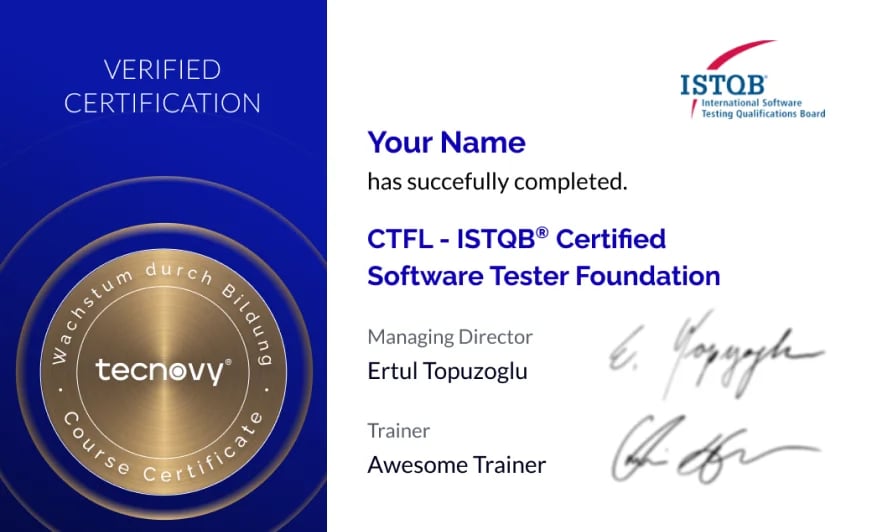
Certificate of participation
≥80%attendance
The tecnovy certificate of participation records your attendance of the CTFL training, not a passed ISTQB examination.
Open the Certificate Showroom tecnovy → Offer scope
What is included – and what is not
Included
- eBook "Basiswissen Softwaretest" by Andreas Spillner and Tilo LinzPublished by dpunkt.verlag and included in the seminar price for every participant. The book is written in German.
Not included
- Fee for the ISTQB certification examinationThe exam fee is charged by the exam partner, not by tecnovy: CHF 250 excl. VAT, around EUR 270. The euro amount is converted at the daily rate and shown in the booking step.
Why tecnovy
What you get on top with us
01
Certification Guarantee
We have an impressive pass rate on the certification exam, so we're pretty confident you'll pass the exam on the first try. However, we're giving you the 2nd try for free. Promised!
02
Certificate Showroom
Get your certificate of participation and, if you have one, add your exam certificate from E-Learning. Fully automated, beautifully designed. Just for you, only at tecnovy.
03
Flexible Date Change
If you are not able to attend the course, you can rebook your training free of charge up to one week before the start of the training.
04
Attend Twice, Pay Once
You are welcome to visit the training course online again within a year as a refresher or exam preparation.
05
No Slideshow, Hands-On!
Promised: no PowerPoint marathon. We work in groups, tie theory to practice, and you get real project examples from our experienced trainers plus the exchange with like-minded people.
06
Learn from Experts
We always guarantee you the use of didactically and methodically first-class qualified trainers who draw their knowledge from training experience as well as professional practical and project experience.
FAQs
Frequently asked questions
01Do I need any prior knowledge for the CTFL training?
02How is the CTFL examination structured?
03Is the examination part of the tecnovy CTFL training?
04Can I take the CTFL exam in German?
05Why does the CTFL training run for three days?
06Does CTFL teach me test automation?
07What can I take after CTFL at tecnovy?
What does your training at tecnovy look like?