Not every task needs an AI agent. If a single request to an AI assistant delivers the result, that request is all you need. If a process follows fixed rules, classic automation handles it predictably. An agent earns its place where it has to plan its own steps, use tools and react to interim results. Here you draw that line on examples and your own processes, then build your first agents without writing code.
Attendance certificate4.8/5 on ProvenExpert
What this module delivers.
Before your team builds its first AI agent, tecnovy's AI Agents Foundations settles which processes suit one. You assess use cases by benefit, effort and risk, build an agent without code and plan where people sign off.
How the training runs
Method
Concepts through examples, then building agents in small teams
Basis
tecnovy curriculum on planning and building AI agents, November 2026
Outcome
tecnovy certificate of participation, no examination
Dates & booking
Choose a date that fits
No public dates are scheduled yet.
New dates are published regularly. Join the waitlist or plan an in-house course for your team.
You own business processes and want to decide where an AI agent helps and where it does not.
You work in IT or a business unit and are expected to start a first agent project.
You use AI assistants day to day and want to know what sets an agent apart before you build one.
Prerequisites
No prerequisites
You can start right away. What you need: experience with an AI assistant such as Claude or ChatGPT. Helpful: a process from your own work as a possible use case.
Five parts take you from the question of whether an agent fits at all to the rules for using one. In between you assess use cases with a scoring grid and build a first agent in small teams, without program code.
01What AI agents are
An AI agent pursues a goal over several steps instead of only answering a request.
From chatbot to agent: goal, planning, tools, memory
Levels of autonomy: from assistance to a process that runs on its own
How agents differ from single requests and classic automation
02Assessing use cases
You decide which processes justify an agent and which do not.
What makes a process suitable for an agent, and what rules it out
Weighing benefit, effort and risk with the scoring grid
Placing use cases from your own organisation
03The first agent
In small teams you build an agent for a specific task, using a no-code or low-code tool.
Setting instructions, tools and knowledge sources
Building the agent for a specific task
Testing whether it does the task, then refining it
04Tools and connections
An agent becomes useful only with access to systems, and that is exactly where it needs limits.
How agents reach systems, for example through the Model Context Protocol (MCP)
Planning human sign-offs at critical points
05Risks and rules
You estimate what can go wrong when an agent is in use, and what it costs.
Sources of error, running costs and security risks
Keeping an agent's permissions narrow
The role of the EU AI Act and internal policies
Outcome
What you will be able to do afterwards
01
You tell apart tasks for a single request, for classic automation and for an AI agent.
02
You explain the building blocks of an agent: goal, planning, tools and memory.
03
You assess processes with a scoring grid for benefit, effort and risk.
04
You decide for a use case how independently an agent may work.
05
You build and test a first agent with instructions, tools and knowledge sources, without programming.
06
You plan human sign-offs at the points where a mistake is costly or hard to undo.
07
You estimate an agent's sources of error, costs and security risks and limit its permissions to match.
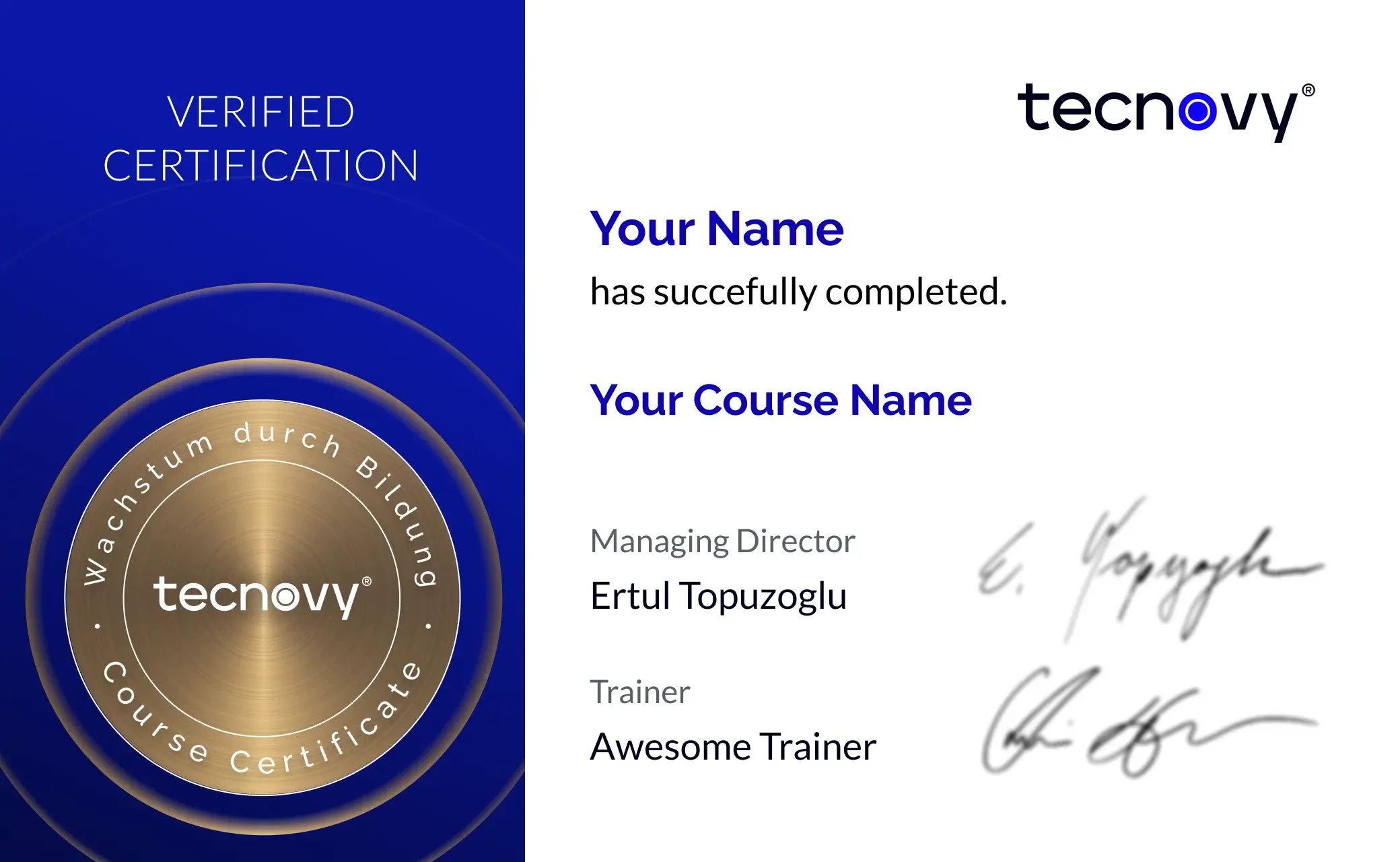
tecnovy Teilnahmezertifikat
Confirms your attendance and the curriculum covered in the training. Issued by tecnovy, shareable on LinkedIn.
Scoring grid for agent use casesIt lets you rank processes by benefit, effort and risk, in the course and afterwards in your own team.
AI Agents Foundations
Why tecnovy
What you get on top with us
01
No Slideshow, Hands-On!
Promised: no PowerPoint marathon. We work in groups, tie theory to practice, and you get real project examples from our experienced trainers plus the exchange with like-minded people.
02
Certificate Showroom
Get your certificate of participation and, if you have one, add your exam certificate from E-Learning. Fully automated, beautifully designed. Just for you, only at tecnovy.
03
Flexible Date Change
If you are not able to attend the course, you can rebook your training free of charge up to one week before the start of the training.
04
Attend Twice, Pay Once
You are welcome to attend the training online again within a year as a refresher.
05
Learn from Experts
We always guarantee you the use of didactically and methodically first-class qualified trainers who draw their knowledge from training experience as well as professional practical and project experience.
FAQs
Frequently asked questions
01How does an AI agent differ from classic automation?
Classic automation follows rules someone set in advance; an AI agent decides for itself, within a set frame, which step to take next. In the tecnovy AI Agents Foundations training you sort processes by exactly that difference.
02What does an agent do that a basic chatbot without tools does not?
A basic chatbot without tools answers a request; an agent pursues a goal over several steps, uses tools along the way and reacts to what it finds. The tecnovy AI Agents Foundations training shows this through examples before you build an agent yourself.
03Do I need to know how to code?
No, in the tecnovy AI Agents Foundations training you build your first agents with no-code or low-code tools. In them you set instructions, tools and knowledge sources through an interface rather than in program code.
04What part does the Model Context Protocol (MCP) play in the course?
In the tecnovy AI Agents Foundations training, MCP serves as an example of how an agent reaches other systems. MCP is an open standard through which AI applications connect to data sources and tools; in the course you decide which access an agent actually needs.
05How safe are AI agents?
It depends on what an agent is allowed to do: which systems it reaches, which data it sees and which steps it takes without sign-off. In the tecnovy AI Agents Foundations training you check exactly those three points and keep permissions narrow. Defending against targeted attacks is a topic of the tecnovy AI Agents Deep Dive.
06What do I receive at the end?
The tecnovy AI Agents Foundations training ends with the tecnovy certificate of participation, which you receive from 80% attendance. It includes no examination.
07What comes after this training?
AI Agents Foundations is the first of three steps in the tecnovy agent series. In Developing AI Agents you build multi-step agents in Python, with your own tools, connected company knowledge and systematic tests; the AI Agents Deep Dive moves on to multi-agent systems.
What does your training at tecnovy look like?
AI Agents Foundations
No dates yet
We will let you know as soon as the next date is scheduled.