IT training across Europe - tecnovy makes you future-ready.

iSAQB® SWARC4AI - Software Architecture for AI Systems

A model that convinces in a notebook is not yet a system that holds up in production. SWARC4AI takes on exactly that stretch, for classic machine learning as much as for generative AI with RAG and agentic workflows. You choose hardware and model sizes, work out running cost, and judge attacks such as jailbreak or data poisoning. Architecture experience and basic Python plus common ML libraries are recommended.
iSAQB Accredited Training PartnerAttendance certificate4.8/5 on ProvenExpert

What this module delivers.

The AI component moves into a system that already exists. SWARC4AI at tecnovy works on that seam, from the data flow through the serving pattern to drift monitoring, and you classify every project under the EU AI Act.

How the training runs

Method
Case studies and practical projects on real AI scenarios
Outcome
30 credit points: 10 methodical, 20 technical, no course exam

Dates & booking

Choose a date that fits

2 dates

  • EUREuro
  • USDUS Dollar
  • CHFSwiss Franc

Sessions with this symbol offer up to 25% group discount. Click “Details & Registration” to learn more.

10–12 Nov 2026CET
Tue–Thu 09:00–17:00
Online training Guaranteed
Time zone CET
Language German
Trainer Matthias Bohlen
Seats Only 1 left

2,674 $

excl. VAT
01–03 Dec 2026CET
Tue–Thu 09:00–17:00
Switzerland Group Discount
City Zürich
Language German
Trainer To be announced
Seats 5+ seats
10% Earlybird Discount

3,567 $−357 $3,210 $

excl. VAT

Fit

Who this module is designed for

Typical roles

  • You take a trained model into a production system and own the interface.
  • You decide whether a model ships as a service, as a dependency or precomputed.
  • You have to show which EU AI Act risk class your AI system falls into.

Prerequisites

No prerequisites

You can start right away. Helpful: a basic understanding of artificial intelligence, machine learning and data science, basic Python plus an overview of scikit-learn, TensorFlow and PyTorch, experience with software architecture, DevOps and the design of APIs.

Consider instead FLEX Gives 150 of its 600 teaching minutes to the integration protocols and resilience patterns of distributed systems, which SWARC4AI touches only as serving patterns.

Curriculum

CPSA® SWARC4AI Course in Detail

Curriculum 2024.1 splits SWARC4AI into seven parts across 1080 teaching minutes. It starts at classifying AI and the rules of the EU AI Act, runs through design, data and operation to generative AI, and closes in case studies. Every part ends at a decision rather than at a tool.

01Introduction to software architecture-relevant concepts for artificial intelligence

This part settles when a problem actually calls for AI and when conventional software is the better answer.

  • Telling AI, machine learning, deep learning and generative AI apart
  • Typical use cases and the limits of today's models
  • Risks in use: hallucination, bias and societal consequences
  • Roles in an AI team: data scientist, ML engineer, AI architect, MLOps engineer
02Compliance, security, alignment

This part gives your AI system a legal position and an attack surface.

  • The EU AI Act risk classes and what follows from each of them
  • Data protection, copyright and the licensing of open ML models
  • Attack types: jailbreak, adversarial attack, data poisoning, model inversion
  • Documenting models and datasets for the transparency obligation
  • AI safety, AI alignment, ethics guidelines and AI governance for companies
03Design and development of AI systems

The longest part of the curriculum: how an AI system is designed and joined to an architecture that already exists.

  • Process models from CRISP-ML(Q) to the generative AI life cycle
  • Input data as tensors, one-hot encodings and embeddings
  • Serving patterns: model-as-service, model-as-dependency, precompute, hybrid serving
  • Quality attributes from latency and robustness to explainability and bias
04Data management and data processing for AI systems

Without a data flow that holds, every model stays a prototype.

  • Data acquisition and labelling, including with external tooling
  • ETL pipelines plus cleansing, transformation and augmentation
  • Data warehouse, data lake and data mesh compared
  • Data contracts and data products as a boundary of responsibility
05Important quality features for the operation of AI systems

This part is about the day after deployment, when the model quietly gets worse.

  • Hardware for training and inference, its cost and its power draw
  • Quantization, pruning, distillation and LoRA as trade-offs
  • Detecting drift, separating its causes and triggering retraining
  • MLOps: CI/CD, model management, deployment strategies and monitoring
06System architectures and platforms for generative AI systems

This part carries everything before it over to large language models.

  • Integration levels from the application down to the ML infrastructure
  • RAG use cases and techniques, embeddings and vector databases
  • Types of prompt engineering and agentic workflows
  • Cost management and selection criteria for LLMs
07Case studies and practical projects

The closing part is exercise only: the curriculum allots it as many exercise minutes as teaching minutes.

  • Applying the concepts of the six preceding parts to real scenarios
  • The curriculum deliberately leaves the type of examples and exercises open
  • The case studies follow the systems the group in the room actually runs
Official syllabus(external link)

Outcome

What you will be able to do afterwards

  1. 01

    You decide with reasons whether a problem is solved with AI or with conventional software development.

  2. 02

    You place an AI system in the EU AI Act risk classes and derive the resulting obligations.

  3. 03

    You defend models against jailbreaks, adversarial attacks and data poisoning.

  4. 04

    You choose between model-as-service, model-as-dependency, precompute and hybrid serving.

  5. 05

    You design data pipelines and justify the choice between data warehouse, data lake and data mesh.

  6. 06

    You detect drift in production, separate its causes and plan the monitoring and retraining for it.

  7. 07

    You build LLM applications on RAG, prompt engineering and agentic workflows.

Credit points toward CPSA-A

Methodical competence
10
Technical competence
20
Communicative competence
0

30 of 70 points toward CPSA-A admission

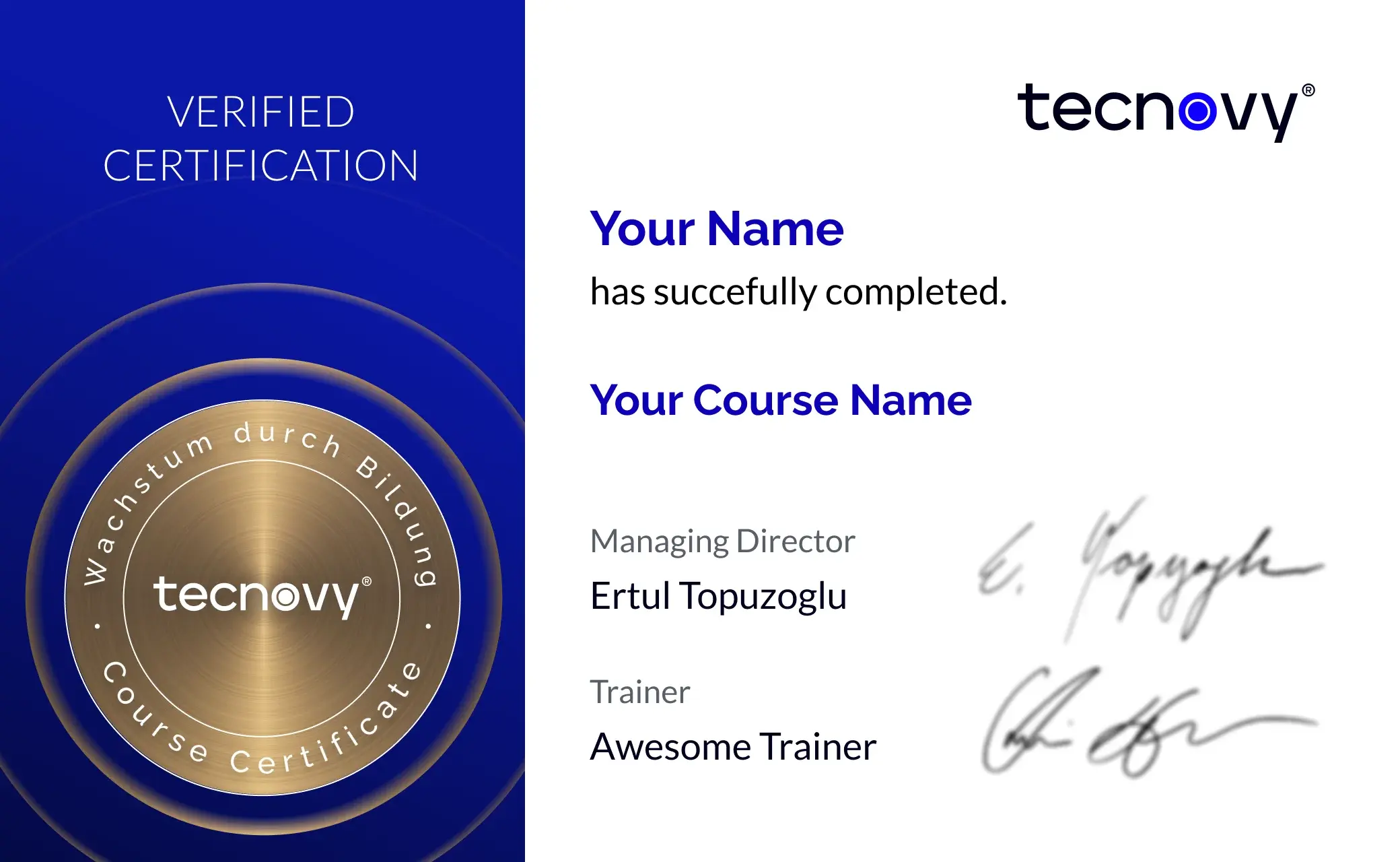
Certificate of participation

The tecnovy certificate of participation records your attendance of the SWARC4AI training, not a passed examination.

Open the Certificate Showroom tecnovy →

≥80%attendance

Trainers

Matthias Bohlen

Matthias Bohlen

iSAQB®

Why tecnovy

What you get on top with us

02

Certificate Showroom

Get your certificate of participation and, if you have one, add your exam certificate from E-Learning. Fully automated, beautifully designed. Just for you, only at tecnovy.

03

No Slideshow, Hands-On!

Promised: no PowerPoint marathon. We work in groups, tie theory to practice, and you get real project examples from our experienced trainers plus the exchange with like-minded people.

04

Attend Twice, Pay Once

You are welcome to attend the training online again within a year as a refresher.

05

Learn from Experts

We always guarantee you the use of didactically and methodically first-class qualified trainers who draw their knowledge from training experience as well as professional practical and project experience.

06

Flexible Date Change

If you are not able to attend the course, you can rebook your training free of charge up to one week before the start of the training.

FAQs

Frequently asked questions

01Do I need CPSA-F to attend the tecnovy SWARC4AI training?
No. The iSAQB curriculum for the SWARC4AI module lists CPSA-F as helpful background, not as a prerequisite. For the later CPSA-A certification, CPSA-F is mandatory.
02Is there a SWARC4AI examination?
No. There is no examination for the SWARC4AI module. The tecnovy SWARC4AI training earns you 30 credit points and a certificate of participation; the assessment comes later on the path to CPSA-A certification, and it covers all modules together.
03How many credit points does SWARC4AI carry?
The tecnovy SWARC4AI training carries 30 credit points, 20 of them technical and 10 methodical. This module awards no communicative points, so you will need another module for those: CPSA-A admission requires 70 points in total and at least 10 in each of the three areas of competence. The iSAQB may re-evaluate point allocations every 12 months; these figures are as of August 2026.
04How does the CPSA-A certification work?
CPSA-A certification consists of a written assignment. Two examiners recognised by the iSAQB assess it, and you then defend it in discussion with them. You can take it in German or English, and tecnovy is glad to help if you have questions about the process.
05How long is the SWARC4AI training?
The tecnovy SWARC4AI training runs for three days. The iSAQB curriculum also sets three days as its minimum, with 1080 teaching minutes, which is 18 hours spread across seven parts. The longest of them, design and development of AI systems, takes 320 minutes on its own.
06What is the difference between SWARC4AI and FLEX?
SWARC4AI deals with the AI component itself, FLEX with the distributed system around it. The FLEX curriculum gives 150 of its 600 teaching minutes to integration protocols, consistency models and resilience patterns, where SWARC4AI treats integration as serving patterns, data pipelines and drift monitoring. Both carry 30 credit points on the same split, so the choice comes down to the subject alone.
07What Python knowledge does SWARC4AI expect?
The iSAQB curriculum recommends basic Python and an overview of scikit-learn, TensorFlow and PyTorch, but makes none of them a condition of attendance. SWARC4AI is an architecture module: in the tecnovy training you design and assess AI systems rather than program models. Without that background the parts on design and operation are harder work, but they are not closed to you.
08Does SWARC4AI cover generative AI and LLMs?
Yes, a curriculum part of its own with 160 teaching minutes belongs to generative AI. The tecnovy SWARC4AI training covers RAG, embeddings and vector databases, types of prompt engineering, agentic workflows and the cost management of LLM applications there. Classic machine learning loses nothing to it: data, training and operation fill the other six parts.
09Do I get the flipcharts from the SWARC4AI training?
Yes. You receive the flipcharts from all three days of the tecnovy SWARC4AI training afterwards as a photo protocol.


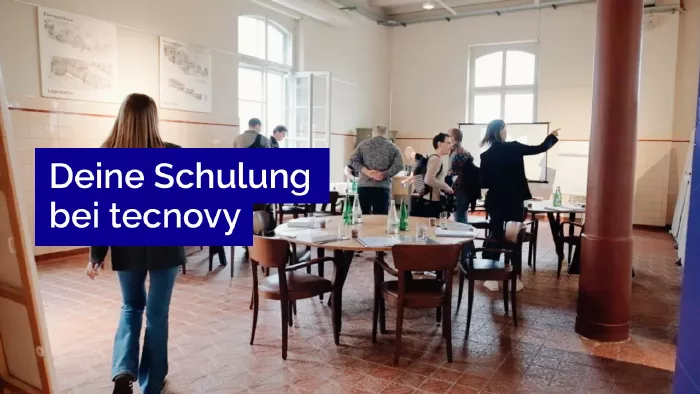
What does your training at tecnovy look like?

SWARC4AISWARC4AI - Software Architecture for AI Systems

Ready for the next step?

Choose a public date or plan the course for your team.

Feedback Form
What should we improve?

Tell us what we can do better next time.

Success
Error

© Copyright 2026, tecnovy GmbH, All Rights Reserved