Insights · IT EducationiSAQB® CPSA Course and Certifications
IT Education and AI in 2026: What Happened, What Will Come Next?
Artificial intelligence is already used in daily operations. It started being implemented before any training program, policy or scheduled time for education existed in many firms.
Such chronology is important as anyone can download artificial intelligence software and get started working with it almost immediately. To learn to evaluate its results, to keep the information secure and to integrate it into workflow requires much more time.
There were four studies released in 2026 which described the same situation through different perspectives. There is no doubt that the development of artificial intelligence is increasing, but the structured learning is lagging behind. They all show one definite thing – the IT education should be based on linking tools with practical tasks and human experience.
AI use moved faster than company training
The clearest example comes from the TÜV Continuing Education Study 2026. In its survey of 500 German companies with at least 20 employees, 56% said they used generative AI at work. Only 27% had trained employees to use it.
The gap was larger in smaller companies. While 49% of companies with at least 250 employees had offered AI training, the share fell to 21% among companies with 20 to 49 employees.
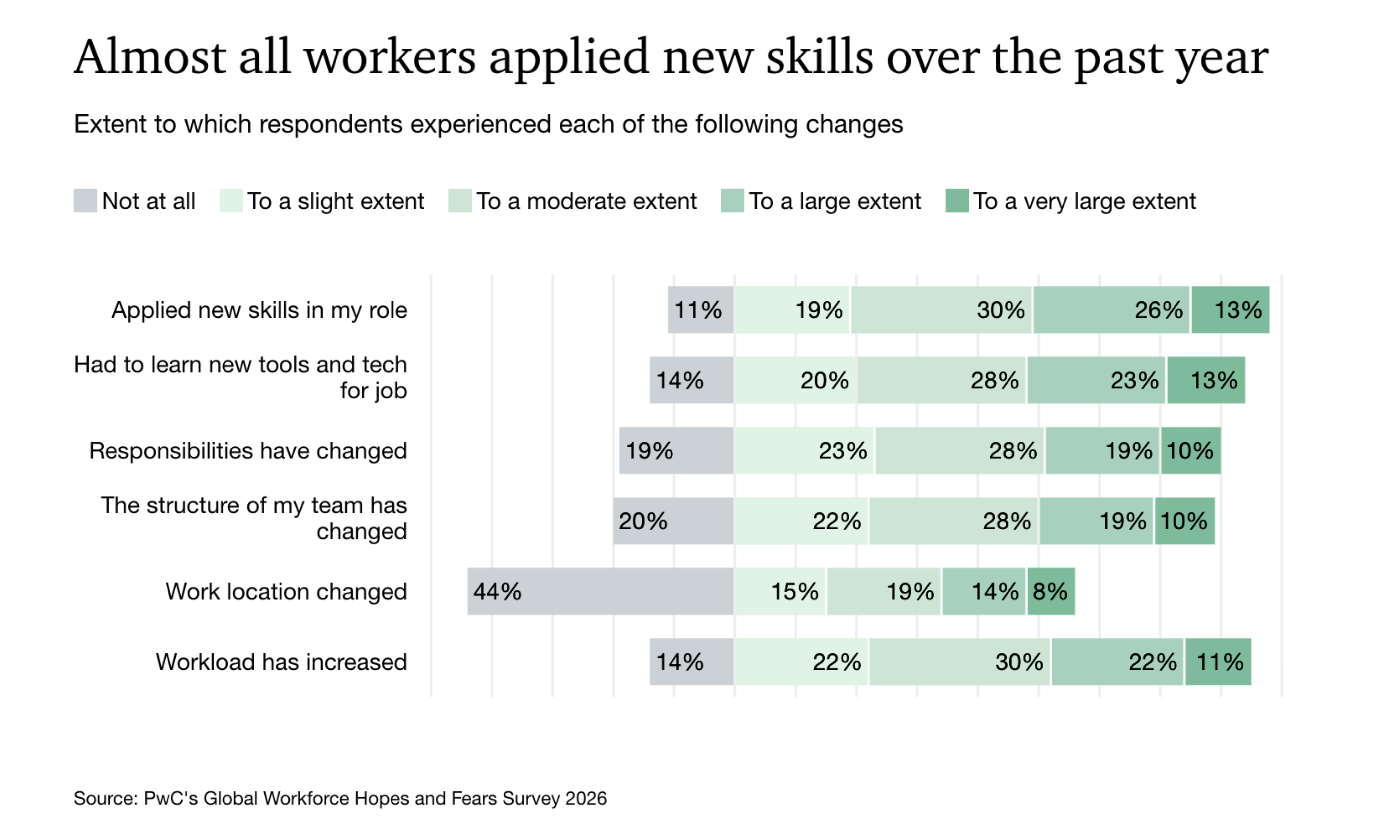
A global study shows a similar pattern from the worker's point of view. The PwC Global Workforce Hopes and Fears Survey 2026 gathered answers from 49,364 workers across 48 countries and regions. It found that 64% had used AI at work during the past year. Daily use of generative AI rose from 14% to 22%.
At the same time, only 51% said they had access to learning and development resources. That was down from 59% one year earlier.
The figures come from different groups, so they should not be treated as one combined dataset. Yet they show the same problem. Access to AI can grow much faster than the support needed to use it well.
Knowing an AI tool is not the same as using it well
It is very easy to confuse usage with competency. One might know how to phrase the prompt, but not be aware of getting wrong results, leaking sensitive information, or making a bad technical decision.
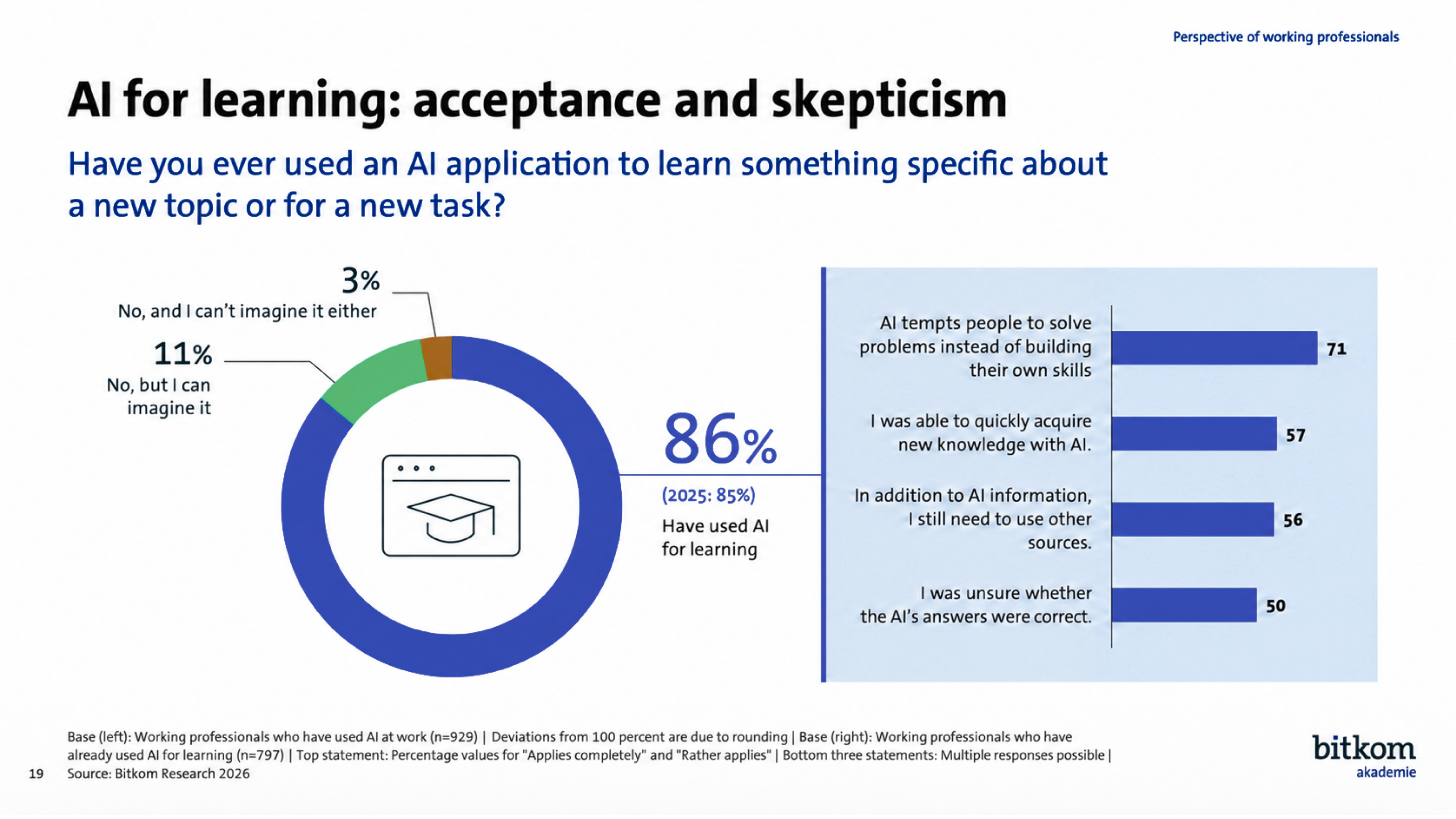
Bitkom Akademie Continuing Education Study 2026 provides us with two different feelings about the subject matter. 73% out of 1,275 employees in Germany stated they have used AI on the job. On top of that, 79% want to acquire more AI competence.
The study also asked the employees that used AI during learning to assess their experience. 50% were unsure of the correctness of the answers. 56% said that they had to look up in additional sources. In total, 71% admitted that the temptation of solving the problem with AI prevents people from developing the skills needed to solve it independently.
It does not suggest that AI is not a good learning aid. It suggests that speed can mask inadequate comprehension. While a fast answer can assist in accomplishing tasks, it does not necessarily help a person in explaining the answer or testing it or applying the same logic to a new situation.
According to PwC, there is a similar issue with regular users. For 31% of regular users, accuracy was the biggest obstacle to using AI. The individuals using these technologies may become more conscious of their limitations, not less.
Good AI education must therefore ask more than, "Can you use the tool?" It must also ask:
Can you check the result?
Can you explain why it is suitable?
Do you know which data should not enter the tool?
Can you spot risk, bias, or missing context?
Do you know when a person must make the final decision?
Technical skill and human judgment now belong in the same lesson
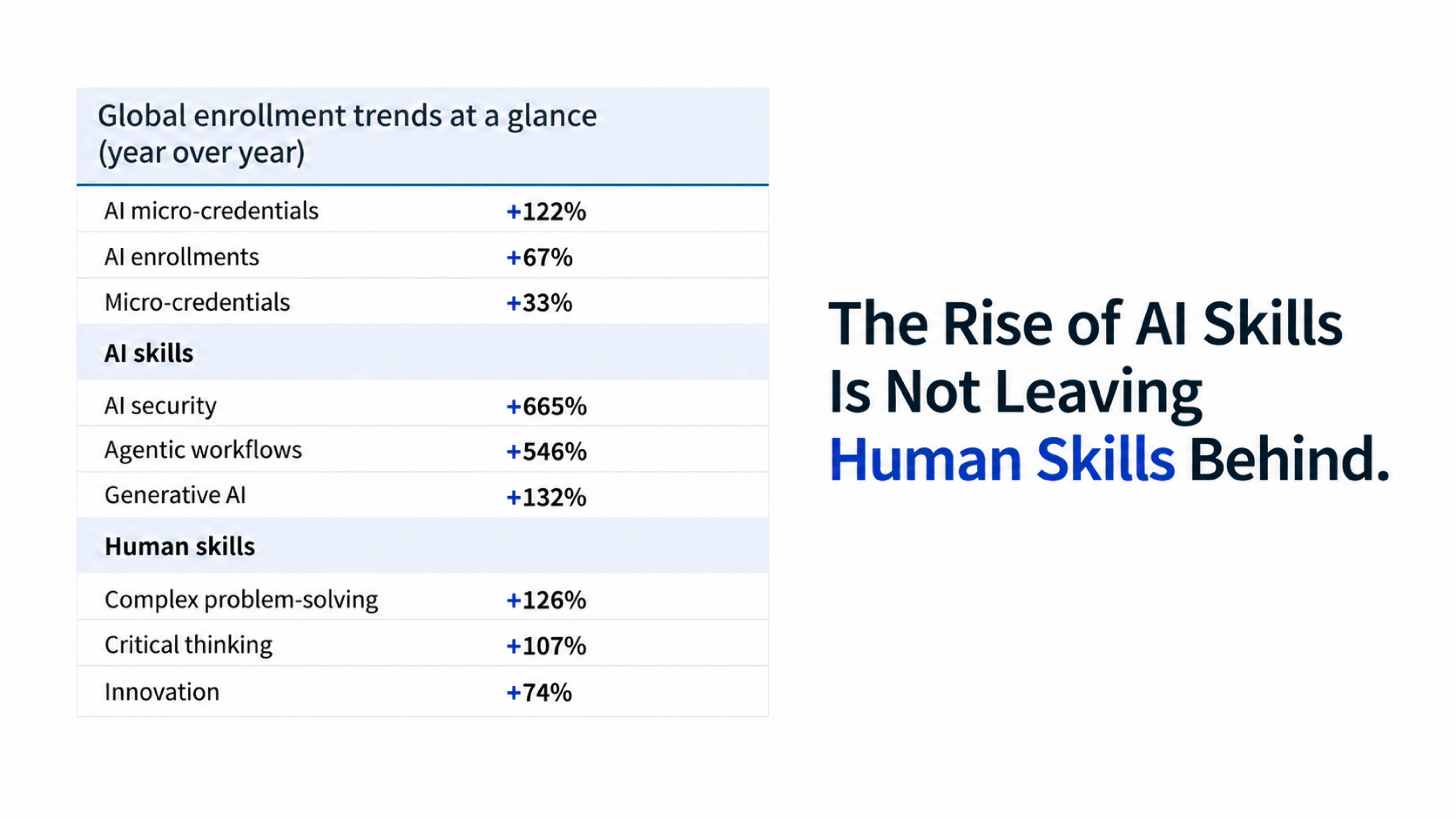
The Coursera and Udemy Global Skills Report 2026 draws on a subset of learning data from more than 300 million learners. AI course enrolments rose by 67% over the prior year. Generative AI enrolments rose by 132%.
However, the growth was not only in technical subjects. There was an increase in critical thinking of 107% and a rise in complex problem solving of 126%. Learners were learning AI-related subjects along with judgment, idea testing, and communicating with people.
This is relevant to IT since AI-based jobs take place within teams and systems. For example, a developer can make code using AI technology, but somebody needs to review its security, performance, maintainability, and integration into the existing system. Similarly, an architect can compare the available alternatives with AI, but a team should agree on standards and responsibilities.
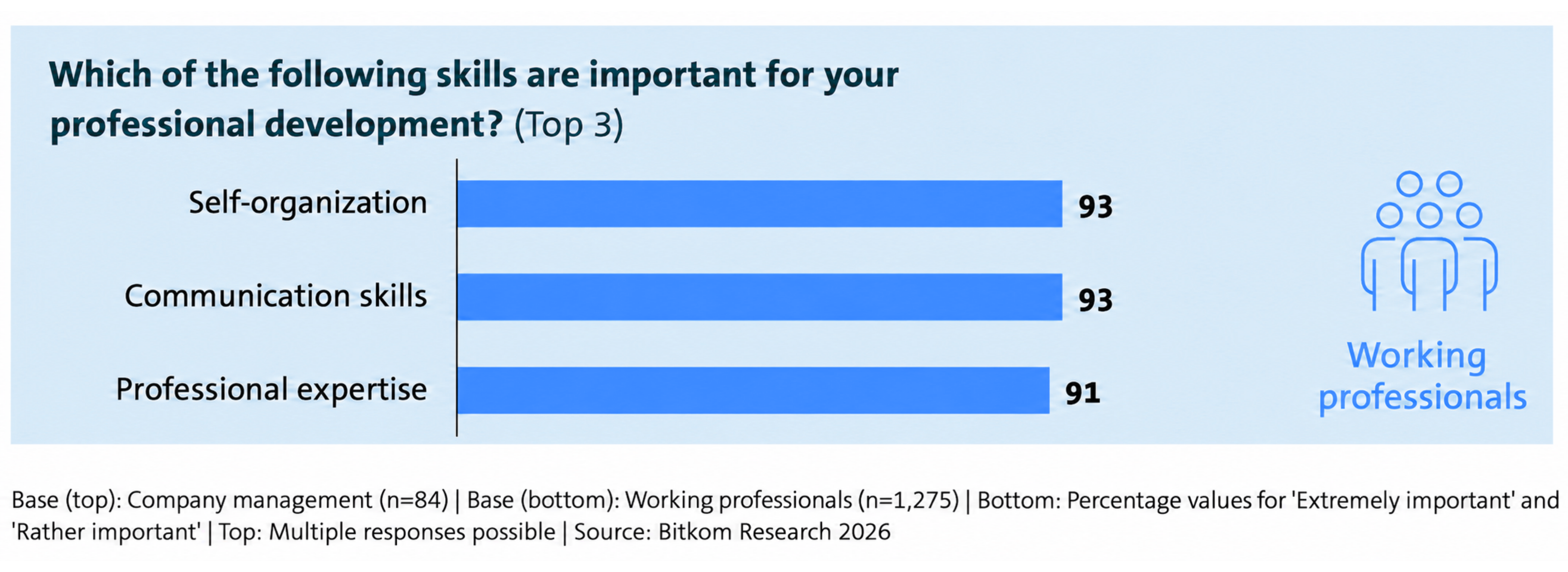
One more interesting result of the Bitkom research is that workers value communication and self-organization skills highly for their careers as they were chosen by 93% of respondents. Special knowledge follows at 91%.
It is not either-or choice between technical and human skills. IT specialists need both skills for the same job.
People still want to learn from people
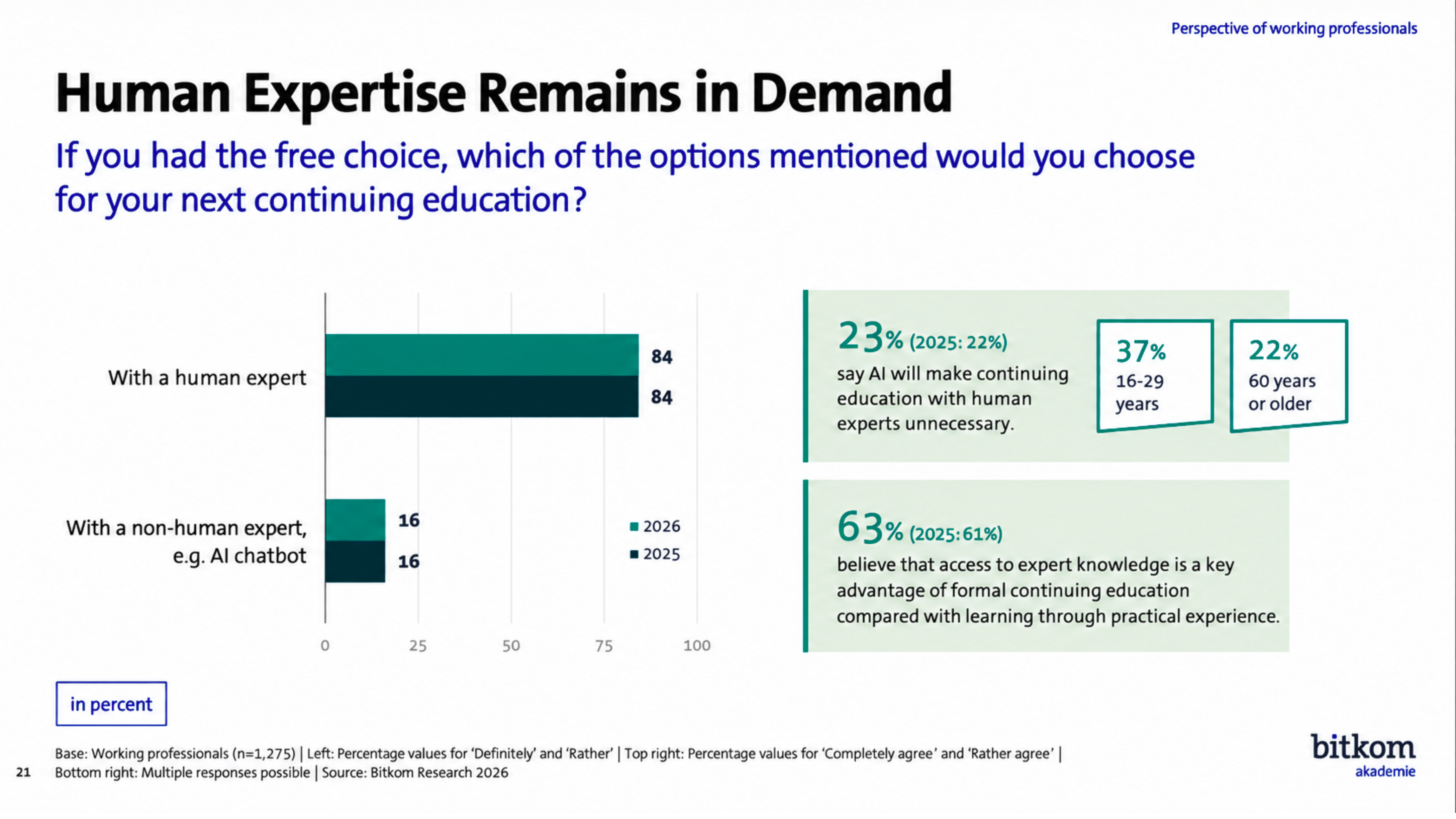
AI is able to provide an explanation, give an example, or give an initial response at any moment. It thus acts as a valuable learning resource. Nevertheless, the Bitkom survey revealed that 84% of employees would prefer a human trainer in their next learning session if they had a choice.
It is obvious why. The trainer could ask a question on why a certain decision was made. The trainer could identify when the class understands the term but is unable to apply it. The trainer could also add the context of the project, raise a more difficult question, and show why a seemingly correct answer is not feasible in practice.
The role of the trainer could evolve in the future along with the evolution of AI technology. Less time will be spent on repeating the basics. More time will be spent on practice, revision, feedback, and discussion.
This is not a fight between a person and a tool. The right question is what each of them should do to help the learner.
The problem is often the system around learning
Employees do not need just access to courses; they need time, assistance, and a reason to apply knowledge they gained.
According to the Bitkom survey, 82% of business leaders identified further training as one of the key drivers of company change; at the same time, only 51% considered it an element of corporate or HR strategy. As for the employee perspective, only 24% mentioned the existence of worktime regulations that facilitate training at their workplace; only 21% mentioned that their supervisor approached them concerning this matter.
In the TÜV survey, there was also the indication of a similar problem. While 87% of companies considered further education to be important, only 29% had any written training strategy. The majority of companies provided employees with one to five days of training per year.
According to PwC, employees assessed their own ability to learn more positively than their opportunities to use training resources. Therefore, motivation cannot be the only problem. Employees can be motivated enough but they lack time or guidance.
Companies cannot treat AI learning as extra work that happens after normal duties. If the skill matters to the job, learning must have a place inside the job.
A five-question check for AI training
The four reports help us form a simple check for companies planning AI education.
This check also helps companies avoid a common mistake: buying one general AI course for every role. A basic course can give people shared terms and rules. It cannot cover every task that follows.
What IT education may look like in 2027
These researches do not provide any single prediction about the future. However, they confirm at least five reasonable predictions.
1. Basic knowledge about AI will be needed by all IT professionals
Understanding the capabilities and limitations of AI becomes important even for those who are not going to develop any AI tools. This also means knowing basic principles related to data, precision, security, and responsibility.
2. Training will be personalized for each position
Software testing engineer, developer, architect, and IT manager may apply the same AI tool but in completely different ways. Thus, training program must take into account duties and responsibilities of each person.
3. Practical experience will become an integral part of evaluation
The fact that a person completed certain learning path is proved by the certificate. However, practical application of the skill is confirmed by any project, decision made, test performed or architecture created.
4. Human judgment will go hand-in-hand with learning technical skills for AI
Assessment of evidence, asking the right questions, recognizing tradeoffs, and when to stop are not something separate from AI. They are key to excelling at it.
5. AI will leave the trainers more time to do coaching
AI will assist the learner in drilling content and asking questions. The human trainer will concentrate on context, faulty assumptions, tough problems, and the rationale of the decision-making process.
What this means for software architects
Software architects face two different AI learning needs.
The first one is the broader requirement for architecture design knowledge, quality objectives, documentation, assessment, and communication. The tecnovy iSAQB training and CPSA certification page lists the foundation and advanced programs related to these topics.
Second, architects may need a focused path based on how AI appears in their work.
In the case when the AI model is integrated into the software design, the questions concern data flow, model serving, monitoring, security, cost, RAG, and legal risks. The iSAQB SWARC4AI training in software architecture of AI systems is aimed at addressing this issue.
When the coding agents are used to transform software, the questions become different. There is a need to define what kind of architecture knowledge will be given to the agents, decision-making process, guardrails, and human responsibility for actions. The iSAQB AGENTA training in agentic software engineering addresses this problem.
The difference is simple:
SWARC4AI: How do we design and operate a system that contains AI?
Both needs sit inside a wider software architecture practice. Neither can be reduced to learning a single tool.
The questions we will take into our webinar
The reports give us facts, but they also leave important questions open:
Has AI changed what IT professionals need to learn, or mainly how they learn it?
Where must human review remain part of the work?
Who should make time for learning inside a busy company?
How can training move from general AI lessons to real role-based work?
What should count as proof of AI skill in 2027?
We used these questions in our live conversation about "IT education and AI".
AI is not removing the need for IT education. It is raising the standard. Knowing how to open a tool and write a prompt is only the starting point. People must also test the result, understand the risk, explain their choices, and know when a human decision is still required.
That is the task now for training teams, managers, and IT professionals.
Bitkom Akademie, Continuing Education Study 2026, published 17 September 2026. Online surveys of 1,275 workers and 84 company leaders in Germany. The report states that these surveys are not representative.
Coursera and Udemy, Global Skills Report 2026, published 28 September 2026. The report draws on a subset of learning data from more than 300 million learners. It notes that learning activity does not prove skill use or results at work.
In my role as a business developer and passionate research enthusiast, I deal with both the development of current trends and their comprehensive capture. I am always open to new challenges and enjoy ensuring that all processes run smoothly and that Tecnovy continues to develop.
With an unwavering commitment to continuous learning and staying up-to-date with industry trends, I am always seeking new ways to push boundaries and make a difference. Passionate about social media management, I recognize the power of digital platforms in shaping brand perception and driving engagement.
You have a whole team that you want to be trained, but none of our trainings meet your requirements? Don't worry. We will create a special Inhouse Training Course that is especially tailored to the needs of your company. Let's have a chat!



 Insights · IT Education
iSAQB® CPSA Course and Certifications
Insights · IT Education
iSAQB® CPSA Course and Certifications